Last week, on May 5, 2026, President Trump told a group of young children in the Oval Office that “we have to make a journey down to Iran to take the nuclear weapon. They would have had a nuclear weapon within two weeks.”
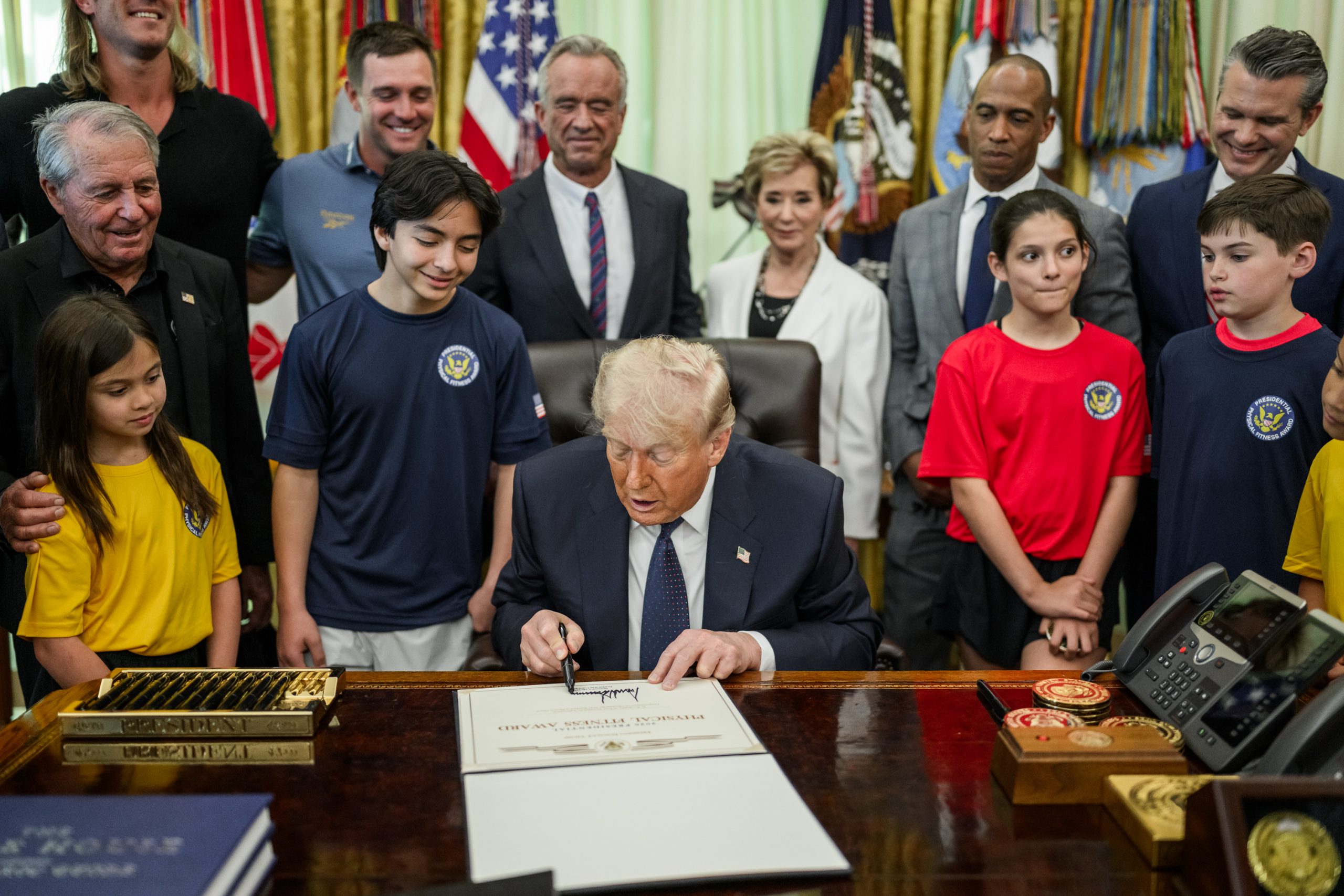
Trump also told the children, “Iran with a nuclear weapon…maybe we wouldn’t all be here right now… I can tell you, the Middle East would have been gone. Israel would have been gone. And they would have trained their sights on Europe, first, and then us.”
According to the White House website, Trump warned Iran against having nuclear weapons on 74 occasions prior to the war. Since the war began on February 28, 2026, Trump has discussed Iranian nuclear issues in at least 20 documented public appearances, based on the Senate Democrats’ Trump transcript archive and Roll Call’s Factbase transcript database.
Some of Trump’s more pointed claims:
About six weeks into the current war, on April 16, 2026, Trump said Iran “would have had a nuclear weapon within one month” if the U.S. had not used B-2 bombers to strike Iranian civilian nuclear energy facilities during the June 2025 war on Iran.
About one month after the war began, Trump said on March 27, 2026, “the Iranian lunatics refused to cease their pursuit of nuclear weapons” after the June 2025 war.
And on February 24, 2026, just four days before starting the current war in Iran, Trump said that Iran was “warned to make no future attempts to rebuild their weapons program, and in particular nuclear weapons, yet they continue. They’re starting it all over…”.
Trump’s statements go beyond saying ‘Iran cannot have a nuclear weapon.’ He has repeatedly claimed that Iran was weeks away from having one, that U.S. strikes stopped Iran from obtaining one, and that Iran was trying to rebuild or continue a nuclear weapons program.
But Trump’s claims are not supported by the record. In fact, official statements from U.S. intelligence, the State Department, the IAEA, and others state that Iran does not have a nuclear weapon, is not currently building one, and does not seek to build one.
US Intelligence, Government Agencies & Figures
The CIA claimed that Iran had a nuclear weapons program before 2003, but for more than two decades, they have assessed that Iran halted that program in 2003 and is not seeking a nuclear weapon.
The broader U.S. Intelligence Community has reached the same conclusions in official assessments:
- Joe Kent, who resigned as Trump’s Director of the National Counterterrorism Center citing his opposition to the war in Iran, wrote on May 8, 2026: “One of the many tragedies of this war is that before the war began, the U.S. Intel Community, including CIA, was in agreement that Iran wasn’t developing a nuclear weapon & that Iran would target U.S. bases in the region & shut down the Strait of Hormuz if they were attacked by Israel & the U.S.”
- About three weeks after the war started, on March 18, 2026, U.S. Director of National Intelligence (DNI), Tulsi Gabbard stated, “As a result of Operation Midnight Hammer [in June 2025], Iran’s nuclear enrichment program was obliterated. There [have] been no efforts since then to try to rebuild their enrichment capability.”
- On the same day, the 2026 Annual Threat Assessment of the U.S. Intelligence Community was released. The report, reflecting the conclusions of the 18 U.S. intelligence agencies, did not state that Iran has a nuclear weapon or an active nuclear weapons program. Instead, it said Iran was seeking to recover damaged nuclear infrastructure, had denied inspectors access to key facilities, and remained under U.S. Intelligence Community monitoring for WMD-related capabilities and actions.
- Also on March 18, 2026, one day after Joe Kent resigned as Director of the National Counterterrorism Center, he was asked whether Iran was on the verge of creating a nuclear bomb. Kent replied: “No. They weren’t three weeks ago when this started, and they weren’t in June either.” Kent also said Iran had a fatwa, or legal decree, barring nuclear weapons and that “we had no intelligence to indicate that fatwa was being disobeyed.”
- About five weeks before the war started, the Department of Defense released the 2026 National Defense Strategy on January 23, 2026, stating that “Operation MIDNIGHT HAMMER [in June 2025] … obliterated Iran’s nuclear program.”
- Four days after the 2025 war on Iran began, Sen. Mark Warner of Virginia, the top Democrat on the Senate Intelligence Committee, said on June 17, 2025: “Director Gabbard stated publicly in March [2025] that the Iranians were not actively pursuing a bomb… I’ve seen nothing in recent intelligence that contradicts what Director Gabbard said.”
- Two months before the 2025 war on Iran began, the U.S. State Department released its Arms Control Compliance Report in April 2025. The report said, “The United States continues to assess that Iran is not currently manufacturing a nuclear weapon, although it has undertaken activities that better position it to produce one, if it so chooses.”
- More than two months before the 2025 war began, Gabbard testified on March 26, 2025: “The [Intelligence Community] continues to assess that Iran is not building a nuclear weapon and Supreme Leader Khomeini [Khamenei] has not authorized the nuclear weapons program that he suspended in 2003.”
- Also in March 2025, the Director of National Intelligence’s Annual Threat Assessment of the U.S. Intelligence Community stated that “Iran is not building a nuclear weapon and that [Ayatollah Ali Khamenei] has not reauthorized the nuclear weapons program he suspended in 2003, though pressure has probably built on him to do so.”
- On January 10, 2025, CIA director William Burns said, “We do not see any sign today that any such decision has been made,” to weaponize their nuclear program.
- On October 7, 2024, Burns said there was “no evidence that Iran has decided to build a nuclear weapon,” and if it did, the U.S. and its allies would most likely be able to detect such a step soon after it was taken.
- The April 2024 U.S. State Department Arms Control Compliance Report said, “The United States continues to assess that Iran is not currently undertaking the key nuclear weapons development activities that we assess would be necessary to produce a testable nuclear device.”
- The 2013 CIA Center for the Study of Intelligence review repeats the National Intelligence Estimate’s (NIE) core judgment: “We judge with high confidence that in fall 2003, Tehran halted its nuclear weapons program.”
- On September 27, 2013, President Obama said, “Iran’s Supreme Leader has issued a fatwa against the development of nuclear weapons. President Rouhani has indicated that Iran will never develop nuclear weapons. I have made clear that we respect the right of the Iranian people to access peaceful nuclear energy in the context of Iran meeting its obligations.”
The United Nations’ Nuclear Watchdog
- About six weeks after the current war began, Rafael Grossi, head of the IAEA, the UN’s nuclear watchdog, said on April 6, 2026, “While there has been no evidence of Iran building a nuclear bomb, its large stockpile of near–weapons grade enriched uranium and refusal to grant my inspectors full access are cause for serious concern,” adding that “unless and until Iran assists the [IAEA] in resolving the outstanding safeguards issues, the Agency will not be in a position to provide assurance that Iran’s nuclear program is exclusively peaceful.”
- Roughly a week after the war started, Grossi said on March 4, 2026, that there was no evidence that Iran was currently building a nuclear bomb and that the IAEA had not found proof Iran was developing a nuclear weapon.
- On Oct. 29, 2025, when asked whether Iran was developing nuclear weapons, Grossi said: “No, they are not, and they were not. I want to be very clear on this.” He also said the IAEA’s June 2025 report, “said clearly that Iran did not have such a programme” and that “we do not see anything that would give rise to the hypothesis of any substantive work going on there.”
- On June 20, 2025, one week after the 2025 war on Iran began, Grossi said, “The IAEA can guarantee, through a watertight inspections system, that nuclear weapons will not be developed in Iran.”
Iran
- On February 11, 2026, seventeen days before the current war began, Iranian President Pezeshkian said Iran “does not seek nuclear weapons” and is “ready for any verification of that.”
- On February 16, 2013, Iranian Supreme Leader Ayatollah Ali Khamenei said: “We believe that nuclear weapons must be eliminated. We don’t want to build atomic weapons.”
- On February 22, 2012, Khamenei said, “Nuclear technology is different than producing nuclear bomb. Nuclear technology is considered to be a scientific progress in a field that has lots of benefits. Those who want nuclear bomb can pursue that field and get the bomb. We do not want bomb. We are even against chemical weapons. Even when Iraq attacked us by chemical weapons, we did not produce chemical weapons.”
- Iran’s August 9, 2005 statement to the IAEA Board of Governors said, “The Leader of the Islamic Republic of Iran, Ayatollah Ali Khamenei has issued the Fatwa that the production, stockpiling and use of nuclear weapons are forbidden under Islam and that the Islamic Republic of Iran shall never acquire these weapons.”
Nuclear Double Standards & American Superiority Complex
According to the IAEA’s PRIS database, 31 countries currently generate electricity from civilian nuclear power reactors. The World Nuclear Association reports the same figure, and also notes that there are about 220 research reactors operating in more than 50 countries, which is a broader category than civilian nuclear power generation.
Given that civilian nuclear energy is widely accepted around the world, why is Iran being singled out for pursuing the same right?
Today, nine countries have nuclear weapons: the United States, Russia, the United Kingdom, France, China, India, Pakistan, North Korea, and Israel.
Since the U.S. and other countries already possess nuclear weapons, what gives the U.S. the authority to wage war against Iran, even if Iran were pursuing nuclear weapons?
For those who think it’s justified to bomb Iran based on accusations that it is pursuing nuclear weapons, what is the penalty for the U.S. and Israel for actually possessing them?
What gives Americans the right to tell another country it cannot have what the U.S. already has?
Is it because many Americans have a superiority complex and they dehumanize Iranians and see them as lesser?
Is it because a nuclear-armed Iran would limit the ability of the U.S. and Israel to pressure, threaten, or control it?
Iran isn’t being punished for possessing a nuclear weapon. It is being punished because it refuses to accept that nuclear-armed powers are entitled to decide who has rights and who gets bombed.
And even if Iran were to obtain nuclear weapons, it would almost certainly be for defensive deterrence. The idea that Iran would acquire them to strike Israel, for example, ignores the obvious consequence: devastating nuclear retaliation from Israel and the U.S.
Why do people talk about Iran as if it were a country of 93 million suicide bombers, eager to acquire nuclear weapons only to bring destruction on itself?