As we indicated in Part 1, even by the end of the 18th century, the nation of “Ukraine” was nowhere to be seen on the maps of the era. And shortly thereafter the greatest map-making assemblage of nations that the world had ever seen only confirmed its non-existence within the maws of an expanding Russian Empire.
We are referring to the Congress of Vienna in 1814-1815, which was the diplomatic mechanism by which the victors over Napoleon – Russia, Austria, Prussia, and Great Britain – reordered the political geography of Europe. Their purpose was to restore monarchical legitimacy after a quarter-century of revolution and war, to prevent the re-emergence of French hegemony, and to compensate themselves for the costs of the struggle.
Under the guiding influence of Austria’s Prince Metternich, Russia’s Tsar Alexander I, Britain’s Viscount Castlereagh, and Prussia’s Prince Hardenberg, the powers rejected both the popular sovereignty associated with the French Revolution and also any simple reversion to the pre-revolution map of 1789.
Instead they fashioned a conservative settlement grounded in dynastic right, a workable balance among the great powers, and mutual territorial swaps and boundary adjustments. These rearrangements extended across the continent and into the adjacent Eurasian borderlands.
Thus, France was confined to its frontiers of 1792 and surrounded by reinforced buffer states. The German lands were consolidated into a confederation dominated by Austria, while Italy was left divided among restored or compensated rulers. In northern Europe, territorial exchanges strengthened Sweden and created a united Kingdom of the Netherlands.
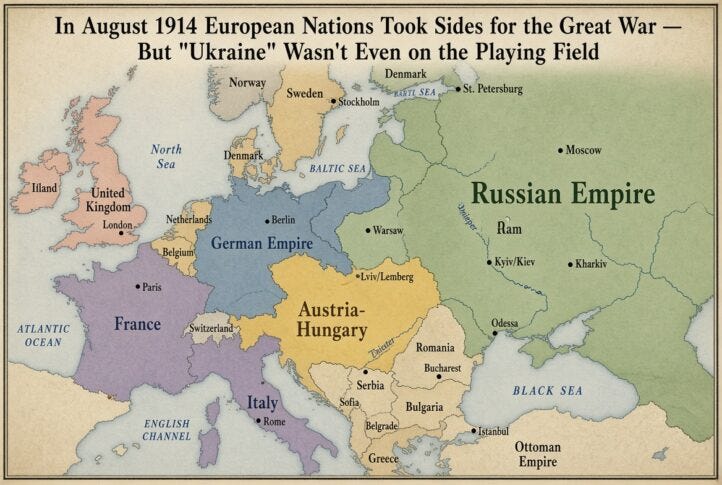
But it was the settlement in the east that is material to what was the still missing map of Ukraine at the end of the Congress. In fact, its handiwork went in the opposite direction by confirming and enlarging the late 18th century gains and colonization projects of the Russian Empire.
Alexander I of Russia received most of the former Duchy of Warsaw, reconstituted as the Kingdom of Poland under the Russian crown, and obtained formal recognition of the extensive territories Russia had already acquired through the eighteenth-century partitions of Poland and through earlier wars. Those acquisitions encompassed the greater part of the territories that constitute modern Ukraine: the Right Bank and the Left Bank of the Dnieper River, as well as the region then known as Novorossiya, and the Crimean Peninsula.
At that point in time, Galicia, including the city of Lviv, remained under Habsburg rule, a secondary consequence of the partitions that the Vienna powers left undisturbed. Prussia obtained more limited Polish districts to the west.
In none of these allocations did an independent Ukrainian state appear. The peacemakers regarded the region as imperial territory to be distributed among the victorious monarchies, not as the patrimony of a distinct nation entitled to sovereignty. British and Prussian acquiescence in Russia’s share formed part of the larger bargain that contained France and preserved the conservative equilibrium; neither power had an interest in promoting a Ukrainian polity that would have unsettled the eastern settlement they had helped to construct.
The Concert of Europe that issued from Vienna therefore placed the Czarist empire’s control over the Ukrainian lands under the collective sanction of the anti-Napoleonic coalition. Territories that had been absorbed through Russian conquest, partition, and colonization in the preceding century were now underwritten by the authority of the principal European powers.
For the remainder of the nineteenth century and into the early twentieth, therefore, the territories of today’s Ukraine continued to be governed as provinces of the Russian and Austrian empires. Their inhabitants remained subjects of those states rather than citizens of a Ukraine that the statesmen of 1814 had not had reason to reject because as of yet it had not even been envisioned.
Needless to say, the 1814 map below speaks for itself. The current line of contact in the Ukraine War, which is just east of the Dnieper River has seen the slaughter of upwards of 400,000 soldiers on both sides of the trenches. Yet when the modern map of Europe was fixed at the Congress of Vienna their forebears had all been subjects of the same Russian Empire; most were adherents of the Russian Orthodox confession; and the mother tongue of many was Russian, as well.
As even casual students of European history are aware, the writ of the Congress of Vienna imposed by the great powers from above was thereafter periodically challenged by liberal and nationalist uprisings from below. In particular, the year 1848 is remembered across Europe as the “Spring of Nations,” a wave of liberal and nationalist revolutions that briefly shook the conservative order established by the Congress of Vienna.
In Italy, the German states, the Austrian Empire, and parts of France and Central Europe, popular demands arose for constitutional government, an end to absolute monarchy, and, above all, national unification or independence. In the Italian peninsula, for instance, uprisings in Milan, Venice, and elsewhere challenged Austrian rule and local princely authority. Likewise, the short-lived Roman Republic and the wars of the Risorgimento signaled a growing drive toward Italian unity.
In the German Confederation, the Frankfurt Parliament attempted to create a unified German state under a constitutional monarch, while revolutions in Berlin, Vienna, and Prague forced temporary concessions from the Prussian and Austrian crowns.
During this time Hungary rose in a full-scale war of independence against Habsburg rule, and similar unrest touched Bohemia, Galicia, and other provinces of the Austrian Empire. Further north, liberal agitation in the Low Countries and Scandinavia added to the sense that the old order was under siege.
Yet the outcomes of 1848–1849 proved highly uneven as between Europe proper and the interior lands of Czarist Russia. Thus, in Italy and the German lands the revolutions were largely suppressed in the short term, but they accelerated the long-term processes of national consolidation.
By the 1860s and 1870s both Italy and Germany would emerge as unified nation-states, their fragmented patchwork of kingdoms, duchies, and free cities replaced by centralized nation-states. The map of Central Europe was thereby simplified and nationalized.
Similarly, the Austrian Empire survived, but only after crushing the Hungarian revolt with Russian assistance and later compromising with Hungary in the 1867 Ausgleich (settlement) that created the Dual Monarchy. The revolutionary year therefore left a lasting imprint: it demonstrated the power of nationalist sentiment and set in motion the political rearrangements that would produce modern Italy and Germany.
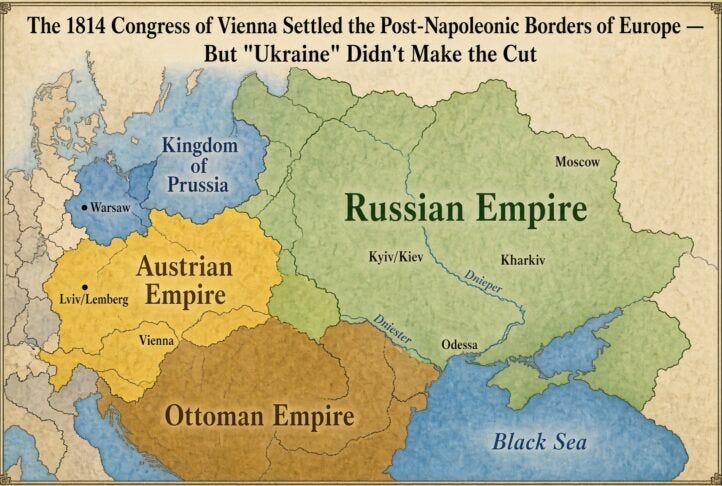
But this era also produced no incipient Ukraine.The territories that today lie within the borders latter drawn by Soviet rulers experienced no comparable transformation.
Instead, on the political map of 1848 those lands remained divided between two multi-ethnic empires. The great majority – Right-Bank and Left-Bank Ukraine, Novorossiya, and Crimea – belonged to the Russian Empire. Western Galicia, including Lviv (Lemberg), formed part of the Austrian Empire. Neither empire recognized a Ukrainian nation-state, nor did the upheavals of 1848 produce any widespread attempt from below to realize one.
In Austrian Galicia a modest Ukrainian (Ruthenian) national movement did arise, centered on cultural and linguistic demands. As it happened, much of the impetus came from the Greek Catholic clergy which was dominant in the region, as opposed to the Russian Orthodoxy that prevailed in the old Kievan Rus’ to the east.
While some activists might have sought release from their respective imperial overlords, these hopes were disappointed.The Hapsburg authorities restored order, and Galicia remained an Austrian province.
Within the Russian Empire the situation was even more restrictive. The Czarist government viewed the Ruthenian (Ukrainian) agitation, which was rooted in Galicia with suspicion, especially after the Polish uprising of 1830–31. Accordingly, the use of the Ukrainian language in print and education was tightly controlled, and political organization was impossible. The 1848 revolutions elsewhere in Europe thus elicited no parallel uprising capable of altering the status of the Ukrainian lands under the Tsar.
Consequently, while the revolutions of 1848 helped clear the path toward the nation-states of Italy and Germany, they left the map of Eastern Europe essentially unchanged with respect to Ukraine. The Russian and Austrian empires continued to administer the territories that the Soviet commissars would later force into the de novo polity of Ukraine, treating them as integral provinces rather than as the homeland of a separate people entitled to sovereignty.
The contrast is instructive: The same historical moment that loosened the bonds of dynastic empire in Central Europe and allowed national consolidation in those regions left the Ukrainian lands firmly embedded within the imperial structures of St. Petersburg and Vienna. Not until the collapse of those empires in the First World War would the question of Ukrainian statehood re-emerge on the European agenda.
Indeed, by the eve of the Great War (WWI) in 1914 the political map of Europe was dominated by a handful of consolidated nation-states and multi-ethnic empires. Italy had completed its unification in the 1860s and 1870s. France and the United Kingdom stood as established great powers.
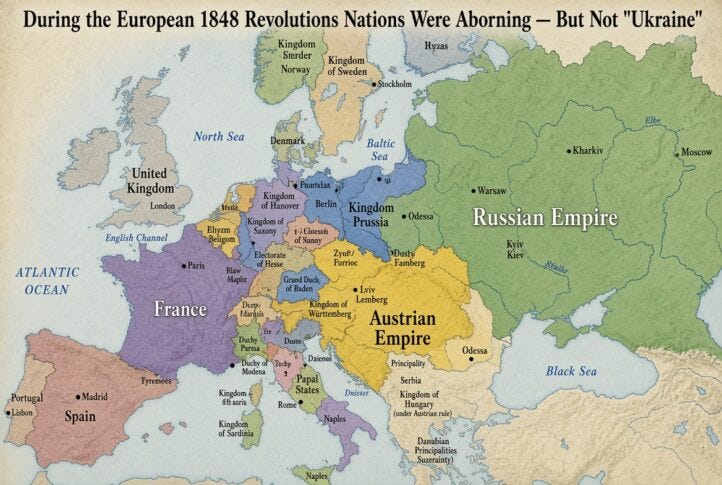
And across Central and Eastern Europe the three remaining imperial giants—the German Empire forged by Bismarck, the Hapsburg Dual Monarchy of Austria-Hungary, and the Russian Empire of the Romanovs – still controlled the greater part of the continent. These six entities, bound by the pre-war alliance systems (the Triple Entente of France, Russia, and Britain; the Triple Alliance of Germany, Austria-Hungary, and Italy), would become the principal combatants once the July Crisis escalated into general war.
The “guns of August” thus ended the century of relative peace that had followed the Congress of Vienna. On the Western Front the armies of France, Britain, and Germany settled into the trench stalemate that consumed millions of lives. On the Eastern Front the forces of Germany and Austria-Hungary faced the Russian Empire across a vast and fluid theater stretching from the Baltic to the Carpathians and the Black Sea.
The war that ensued was, in scale and destructiveness, unlike anything Europe had previously experienced. Yet throughout the five years of industrialized slaughter one political fact remained constant: There was no Ukrainian state on the field of battle.
On the 1914 map shown below the territories that today constitute Ukraine were partitioned between two of the contending empires. The overwhelming majority – Left-Bank and Right-Bank Ukraine, Novorossiya, and Crimea – belonged to the Russian Empire and were administered as ordinary imperial provinces.
Western Galicia, including Lviv, formed part of the Austrian half of the Dual Monarchy. Neither empire recognized a separate Ukrainian polity, and no Ukrainian government existed to declare neutrality, to choose sides, or to mobilize a national army.
Instead, Ruthenian (Ukrainian) soldiers served in large numbers in both the opposing Russian and Austro-Hungarian forces, slaughtering each other with alacrity based on the flags of their imperial overlords.
Likewise, Ukrainian civilians in the millions endured occupation, requisition, and displacement. But these experiences occurred under alien flags and within alien state structures. The national question that had animated Italians, Germans, Poles, and others in the nineteenth century had not yet produced a sovereign Ukraine capable of entering the war as a belligerent in its own right.
Consequently, while the pre-existing alliances drew the six major powers into a continental catastrophe, the lands of Ukraine remained simply the eastern and southwestern marches of the Russian and Austro-Hungarian empires. The nation-state of Ukraine was nowhere to be found among the combatants of 1914.
Only the collapse of those empires in 1917–1918 would open the possibility, but even then it came at the hand of Bolshevik terrorists, as we will amplify in Part 3.