Treasury Secy Scott Bessent clearly endeavors to be the second Pete Hegseth of Trump World, albeit via packing heat in the form of economic missiles rather than the kinetic kind.
In fact, however, his ballyhooed Operation Economic Outcast actually amounts to the greatest windmill tilting operations since Don Quixote himself.

So let’s cut to the chase right up front. To wit, Bessent’s premise that he can switch-off Iran’s military payroll and bring the regime to its knees by driving its oil exports to zero is wholly delusionary. The former (regime collapse) does not remotely follow from the latter (oil exports at zero), which for all practical purposes has already happened.
So herein we endeavor to explain why cutting off Iran’s oil exports isn’t any kind of war-winning silver bullet at all.
Nevertheless, on October 3rd the Treasury Secretary claimed that—
“They are isolating them economically like this never happened before. You know, right now, the score: barrels out of the Strait: U.S. about 1.1 billion, Iran zero,” Bessent told Allen.
Bessent continued, “For the first time in history, they, since they started pumping oil, they will have no oil on the water this week. They will have no revenue.”
This bombast, of course, was just a continuation of the claim he made a six weeks earlier upon the launch of Operation Economic Outcast:
Beginning today, the actions of Treasury and other agencies will tighten the noose and block every potential source of revenue that funds the IRGC and the Iranian regime… to the ordinary soldiers supporting this regime: as more and more of your paychecks stop or are supposedly “just delayed,” ask whether your commanders are leading your country to triumph or to ruin.
In short, the Bessent plan purports to “defund” the IRGC by closing the black market space where enablers buy the purportedly “illegal” Iranian oil. Thereafter per the Bessent formula, the Iranian regime’s military will be left financially high and dry as:
- oil loadings go to zero,
- export FX earnings go to zero,
- the Iranian war machine stops getting paid,
- the regime is forced to surrender or flee.
But that purported mechanism is but an illusory windmill. That’s because a regime that can still collect domestic taxes, pursue essential trade via overland routes, and, most importantly, print Iranian rials at will can keep a military payroll running long after the oil account has been bled dry.
That is to say, the military payroll does not remotely depend upon the oil export account. It is a small, prioritized claim on overall domestic product (GDP), and the arithmetic below is why zero oil export loadings do not zero it out.
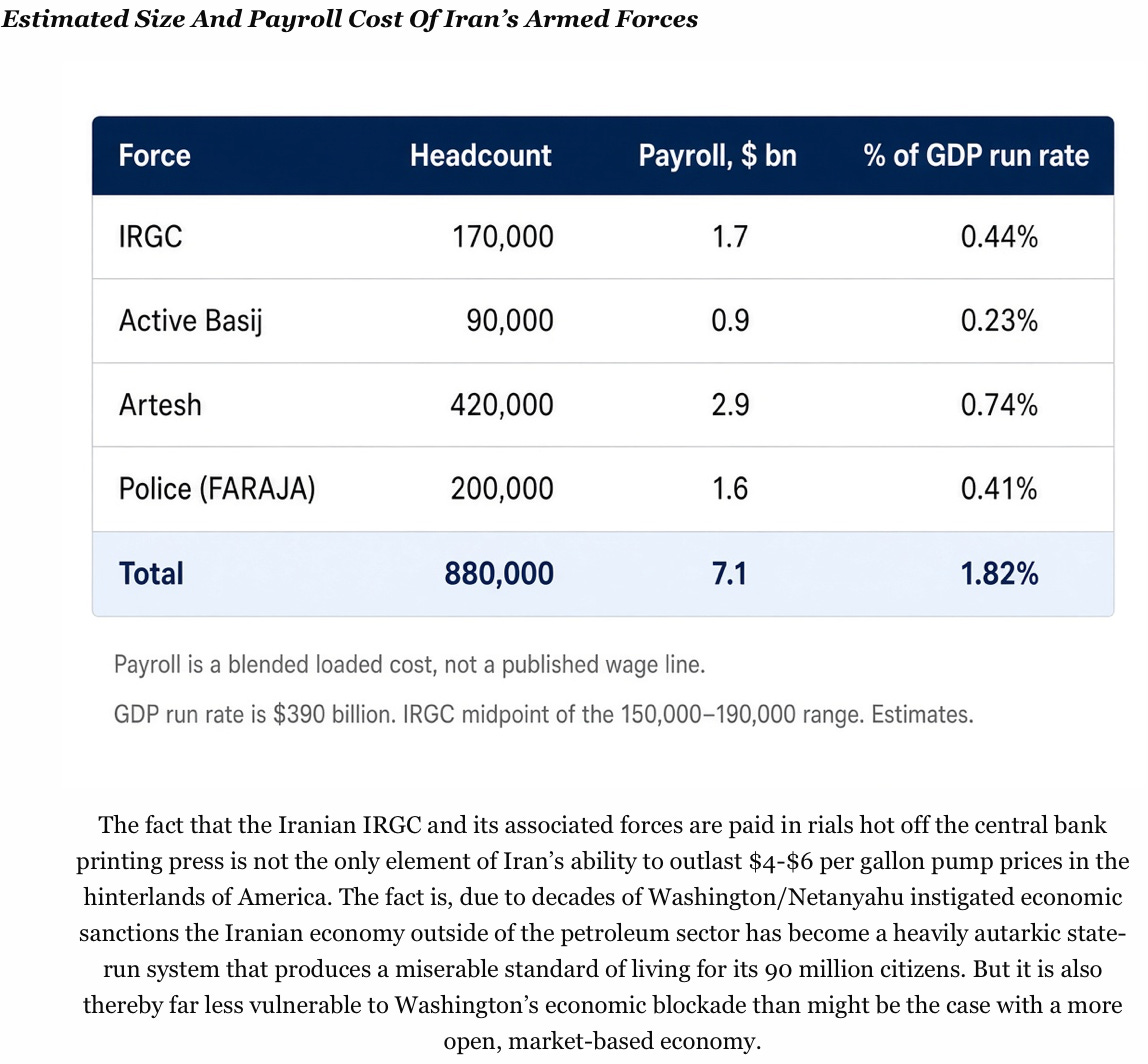
We therefore start with a tally of Iran’s standing military force and the resulting payroll cost at current rates. It consists of about 880,000 active full-time soldiers, in four blocks.
These include the IRGC (Iranian Revolutionary Guard Corps) proper at about 170,000, including the ultra vicious Quds Force that sits inside that total at 5,000 to 15,000. The internal paramilitary force known as the Basij adds another 90,000.
Beyond that the regular military, or Artesh, numbers around 420,000 according to the Washington-based Institute for Strategic Studies (IISS). This consists of roughly 350,000 ground troops, of whom about 220,000 are conscripts, plus 18,000 navy, 37,000 air force, and 15,000 air defense. Most of the latter, according to Trump, have been obliterated or sent to the bottom of the Persian Gulf, but for our purposes we assume they are still being paid, nonetheless.
Finally, there is the FARAJA, which is a considerable less lethal domestic police force, consisting of a 60,000 core of career officers and NCOs. The headcount then expands to about 200,000 when border guards and conscripts are included.
In all, that’s an 880,000 man armed force, which is more than enough to keep an unarmed 90 million civilian population in thrall to the regime.
Nor does meeting payroll break the bank over any plausible period of time or even require a single barrel of oil exports. And this conclusion starts with the fact that at current pay rates for the aforementioned Iranian military arms, the payroll expense tab is not all that great.
Thus, based on Iranian rial-based payroll cost estimates from a range of Warfare State think tanks, and at the current open-market FX rate (2.5 million rials per USD), the average fully loaded payroll cost per head is no greater than $10,000 even under a generous estimate.
In this context, the reported rial pay for professional soldiers and officers when translated into dollars at current FX rates amounts to around $185 a month, or about $2,200 a year in USDs. Broader public-sector pay in Iran also sits around $300–500 a month, or $3,600–6,000 a year at the now wartime-depressed FX rates.
Those figures represent cash wages, of course. They leave out rations, housing, transport, medical care, bonuses, and the family stipends that make up a large share of the standard pay package in the high-inflation Iranian economy. Nevertheless, doubling the known rial-based cash salary schedules for in-kind benefits gets an active force soldier’s pay toward $5,000 per year.
Beyond that, these current FX-based figures are also misleadingly low, owing to the severity of the Iranian rial’s war-and-embargo impaired rate. Thus, we assume a higher, more steady-state FX rate would double the above dollar-based figures, thereby generating our all-in $10,000 per head payroll cost estimate for the IRGC and active Basij, as shown in the table below.
At $10,000, the military manpower itemized in the table costs $1.7 billion for the IRGC and $0.9 billion for the active Basij. In addition, the lower-compensated Artesh at about $7,000 per head generates a payroll of about $4.2 billion and the domestic police at $8,000 per head adds another $2.0 billion.
In all, Grok estimates the active, full-time armed forces of the Iranian regime cost about $7.1 billion per year, which computes to just 1.82% of Iran’s war-impaired GDP. By point of contrast, the current fully loaded wage bill for the US armed forces is about $200 billion annually or nearly 30X more.
And that gets to the skunk on Secy Bessent’s jerrybuilt woodpile. To wit, there has never been an authoritarian regime in modern history – good, bad or indifferent – that has not been able to run the printing presses for a few months – or even years – to pay the armed forces that keep it in power. And when it comes to a tab at less than 2% of GDP, it’s a no-brainer.
Indeed, to paraphrase Bill Clinton’s long ago adviser, it’s the printing press, stupid!
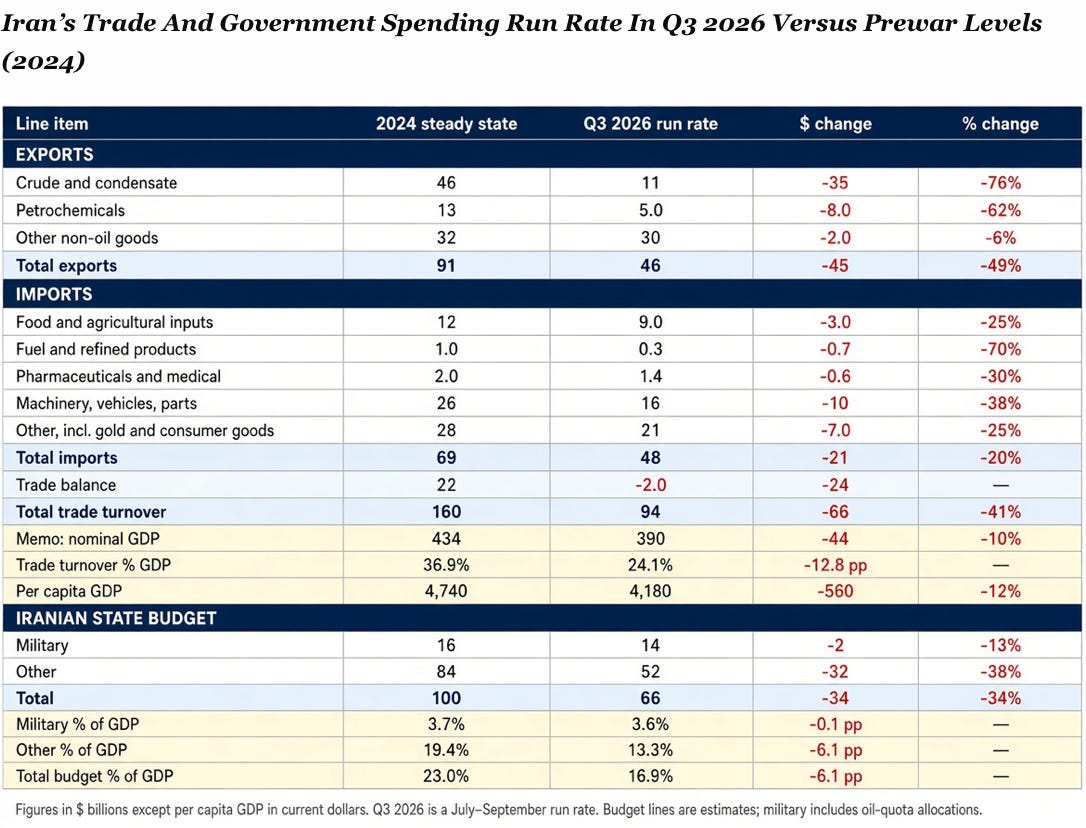
Accordingly, the table below compares the autarkic pre-war economy as of 2025 with the estimated war and embargo-impacted annualized run rates estimated by Grok for Q3 2026.
What stands out immediately is that Iran’s economic numbers have been largely stripped bare of oil-based output, but that the balance of the economy appears to be stumbling forward at close to pre-war rates.
For instance, oil and petrochemical exports of $59 billion in 2024 have fallen by -73% to just $16 billion at an annual run rate during Q3 2026. By contrast, Iran’s modest level of $32 billion in non-oil exports during 2024 has fallen by only -6%, mainly owing to continued overland trade through Iraq, Turkey, Afghanistan and Pakistan.
At the same time, non-oil imports have falling modestly, from $68 billion in 2024 to $48 billion at current Q3 run rates. Accordingly, food imports are down by 25%; machinery and vehicles are down 38 percent; pharmaceuticals fell by 30 percent, and fuel imports, small to begin with, have collapsed entirely.
The country is poorer and more closed. It is not sealed.
Still, the composition matters for the payroll argument. The import bill is food, parts, medicine, and consumer goods. It is not the wage bill of the IRGC.
A tighter import constraint raises the rial price of tradable goods and makes the patronage economy less comfortable. It does not, by itself, stop a direct deposit to an IRGC unit’s payroll account. The regime can ration machinery imports and still pay the unit. That is what a state-controlled economy does.
At the end of the day, the US Naval blockades and tightened economic sanctions have, ironically, caused Iran’s non-oil trade deficit to be cut in half, from a -$36 billion deficit in 2024 to a very survivable -$18 billion at present.
Here’s the spoiler alert, therefore, for the alleged hedge fund maven and George Soros protege holding court on the 5th floor of the US Treasury Department building: To wit, a state dominated autarkic economy like Iran’s essentially needs exports in order to generate the FX to pay for imports. So to the extent it can do without normal levels of imports for an intermediate period of time, the only thing that gets squeezed is the living standard of the civilian population on the margin.
Moreover, in this case Iran’s heavily sanctioned economy actually had a trade surplus of +$22 billion in 2024. That’s because the leaky pre-war US sanctions interfered far less effectively with its black market oil and petrochemical exports than with its imports of food, pharmaceuticals, machinery and consumer goods.
However, now that oil exports have been been cut by 73% as of Q3, and putatively by 100% going forward, Iran’s trade surplus has been eliminated. But the pain was not felt in the IRGC payroll accounts – it was incurred in higher prices or diminished availability of imported goods on retail shelves.
Even then and with virtually no oil export earnings during Q3, Iran was still running only a small $2 billion trade deficit at an annual rate. And, as shown in the table, the latter would rise to about -$18 billion per year if 100% of the remnant of oil and petrochemical exports were eliminated entirely.
To be sure, a trade deficit of -$18 billion would be no fun for an economy being battered by the Washington War Machine. But even then it would amount to just -5%of war-impaired GDP.
That wouldn’t break the bank; it would only further reduce the foreign exchange earnings needed to pay for the current non-oil import level of $48 billion annualized, thereby forcing Iran into more barter deals or further domestic austerity.
But what it would most certainly not do is defund the Iranian military and the arms of the state which have all the guns, prison cells and hangman’s nooses. As always, therefore, Operation Economic Outcast will turn the screws yet another notch tighter on the civilian population by forcing a further reduction of imports of food, pharmaceuticals and consumer goods without curbing the Iranian police state to any material degree.
The table below, therefore, tells the real story of “zero” oil exports. Iran’s sanctions-generated trade surplus has been eliminated and modest non-oil imports have and will continue to reach the street level economy, albeit at significantly diminished rates. What will be left is a largely autarkic state-run domestic economy that can stumble forward on popular grit, state economic allocations and a printing press being run at a goodly pace.
In this context, we look at the government sector stats in the table below, which are what really matters in an authoritarian police state. To wit, after the 10% drop in nominal GDP to $390 billion, the overall Iranian military budget of $14 billion amounts to just 3.6% of GDP, but this is not the IRGC wage bill.
It is the whole military claim, including Artesh, IRGC, oil-barter allocations, procurement, operations, ammunition, construction, and the part of the security state that sits in the defense envelope. Weapons, maintenance, and operations take a large share of any military budget. If those non-payroll claims are even a third to a half of the envelope, the payroll residual is on the order of 2 percent of GDP at the outside, and likely around 1.8% of GDP per our payroll estimates above.
Furthermore, the civilian wings of the state have also been cut, from $84 billion in 2024 to a current estimate of $52 billion, representing a 38% cutback, meaning, again, more hardship for the civilian population. But taken together, the military payroll, other military spending and the civilian government are now absorbing just 16.9% of GDP or, ironically, far less than Washington 24% claim on US GDP.
Stated differently, the Iranian government’s budget spending has fallen from $100 billion to $66 billion, and from 23 percent of GDP to 16.9 percent. The military share of the shrinking budget, however, rose smartly even as its dollar value dipped. That is what prioritization looks like: Subsidies, development projects, and civilian payrolls have already given way – obviating any need to cut back on the armed core of the regime.
What this partial re-prioritization of state spending means as a practical matter is that the Iranian central bank will be required to print new rials to cover the budget shortfalls. According to the latest estimates gathered by Grok, Iranian government revenues are now running at about $26 billion per year against the remaining $66 billion outlay level shown in the second column below.
So the deficit financing requirement is $40 billion or about 10% of GDP. In the very long run that would be catastrophic for Iran – just as it would be for any other country. But under the short-term, muddling through modality now actually in operation in Iran, it something the printing press can handle with aplomb.
For want of doubt, recall that even in the US, the average deficit during FY2020 to FY 2022 amounted to slightly more – 11%of GDP. In dollar terms that added $7 trillion of cumulative debt, of which roughly $5 billion or 71% was monetized by the Fed.
This, of course, was not a good deed for future US taxpayers, but in the interim the American economy bumbled along with alacrity.
So we will go with Bank Markazi (Iran’s central bank) on the regime’s current 10% of GDP fiscal deficit. They will monetize it as needed, undermine living standards a bit further, and keep the regime’s monopoly on violence fully funded and its payrolls timely meant.
At the end of the day, a police state that wants the Guards and related agencies of control paid, does not need this month’s tanker loadings to do it. Nor those of November, December, January or the whole year ahead to meet payroll.
It needs rials. Rials are a liability of the central bank. The government can pay the payroll by transferring reserves, by directing banks to credit accounts, or by issuing debt the banks are told to hold. The resource cost shows up later, as inflation, as a weaker rial, and as fewer imported parts. It does not show up as a failed payment on payday, unless the regime chooses to let it.
Of course, the longer-run inflationary bill is not trivial, and it should not be waved away. Iran already lives with high inflation. Adding a monetized claim equal to the 5% to 10% of GDP needed to keep the military in paychecks and the wheels of stare turning at current spending and revenue levels (i.e. Q3 2026 run rates) makes the rial wage worth less in goods.
Indeed, food imports are already down a quarter on the run rate. A printed payroll buys fewer meals. Over a long enough period, that erodes the value of the regime’s patronage and can produce the kind of discontent that coercion is meant to suppress.
That is a real political risk, but it is also a lagged, diffuse, indirect one. It is not a kill-switch with anything like the efficacy our wanna be economic warrior at the Treasury Department imagines.
None of this says the Bessent’s economic missiles are fake. The export column is the evidence that they are not. A 76 percent drop in crude and condensate revenue, a vanished trade surplus, and a fall in openness of almost 13 points of GDP are a serious external shock.
But the “shock” from Washington lands on the external accounts, on the import basket, and on the civilian share of the budget. It lands weakly on the military share of GDP, which in these estimates barely moves, from 3.7 to 3.6 percent. It lands more weakly still on the payroll residual inside that share.
Bessent’s phrase claiming he’s hitting the “most critical source of revenue,” is fair if the subject is foreign exchange. It is not even close to the mark if the subject is the ability to pay the lethally armed people who keep the regime in power.
To return to our metaphor, Don Quixote’s error was not a lack of force. It was a category error. He had a real lance and an imaginary giant. Bessent has a real sanctions apparatus and an imaginary transmission belt from tanker loadings to IRGC payday.
The step-by-step version is short. Oil was the surplus, not the military wage bill. Exports have been hit harder than imports, which is the opposite of a clean import embargo and also the opposite of a payroll embargo. The broader military envelope is about 4 percent of GDP, and the payroll inside it is unlikely to be even 2 percent once weapons, ammunition, and operations are allowed for
At the end of the day, an embattled police state can monetize 2 percent of GDP for a prioritized wage bill if that’s required to stay in power. The cost is inflation and a thinner civilian state and reduced living standards for the broader population.
But suggesting that a month (or two or three) of zero oil loadings amounts to the defunding of the Iranian war machine is to tilt at the windmill. While the latter does give rise to a great charge and a loud impact, alas, the Iranian military payroll remains standing and the neocon dream of regime change in Tehran is foiled yet again.
David Stockman was a two-term Congressman from Michigan. He was also the Director of the Office of Management and Budget under President Ronald Reagan. After leaving the White House, Stockman had a 20-year career on Wall Street. He’s the author of three books, The Triumph of Politics: Why the Reagan Revolution Failed, The Great Deformation: The Corruption of Capitalism in America, TRUMPED! A Nation on the Brink of Ruin… And How to Bring It Back, and the recently released Great Money Bubble: Protect Yourself From The Coming Inflation Storm. He also is founder of David Stockman’s Contra Corner and David Stockman’s Bubble Finance Trader.