There is no room in the Republican Party today for a noninterventionist conservative, at least in presidential politics.
This flies in the face of many hopeful signals and predictions over the last year among conservative and libertarian writers — including some on these pages — that the Tea Party zeitgeist, combined with a federal budget crisis and malaise over seemingly unwinnable wars overseas, could shift the tide among voters and candidates along the right side of the political spectrum.
But the explosive rhetoric that has transpired after President Barack Obama announced the “final” withdrawal of American troops from Iraq last month was the latest — and greatest — indication that the Republican needle is still stuck on the same broken record and that this presidential election will prove to be no different from any other in the last decade.
“The idea that a commander in chief would stand up and signal to the enemy a date certain of when we’re going to pull our troops out I think is irresponsible … it’s putting our kids’ lives in jeopardy,” proclaimed Gov. Rick Perry, Republican candidate for president from Texas, only days ago on Fox News Sunday.

“He has lost his standing from the standpoint of being a commander in chief who has any idea about what’s going on in those theaters,” Perry added smoothly.
Ah, warmed-over Republican campaign
talking points — comfort food for the unreconstructed primary
electorate! Let’s take a listen to some more of these oldies-but-moldies.
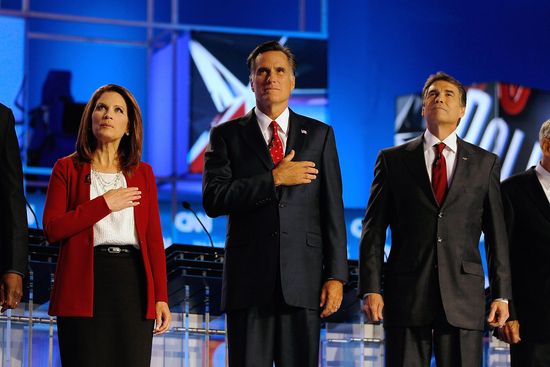
“President Obama’s astonishing failure to secure an orderly transition in Iraq has unnecessarily put at risk the victories that were won through the blood and sacrifice of thousands of American men and women,” charged former Massachusetts governor Mitt Romney, Republican candidate for president, in a statement after Obama’s Oct. 21 announcement.
“[It’s] a political decision and not a military one; it represents the complete failure of President Obama to secure an agreement with Iraq for our troops to remain there to preserve the peace and demonstrates how far our foreign policy leadership has fallen,” chirped presidential candidate Rep. Michele Bachmann of Minnesota.
Presidential candidate Herman Cain did not hesitate before postulating that withdrawing troops was a “dumb thing to do.” This from a man who once said there were “easy answers to fighting the terrorists” — just “kill all the terrorists. ” Recently he compared his addled approach to foreign policy to his first foray into the pizza business.
Perennial candidate Newt Gingrich, caught by a reporter in a seemingly lucid moment, actually agreed
with Obama’s withdrawal strategy — on Oct. 21.
“This is not about Obama,” he pontificated.
“This is about the general effort that far transcends Iraq. That we have to really reassess our strategies in the region and what we think we’re accomplishing. The president is right. You can’t just leave 3,000 or 5,000 troops there. They would simply become targets. If you’re not going to occupy the country, you have to withdraw.” Gingrich also said it was time to assess “what we are doing” in Afghanistan.
That was Gingrich before he hit the campaign stage at the Iowa Faith & Freedom Coalition, where he really turned up the gas.
“The president has announced what will be seen by historians as a decisive defeat for the U.S. in Iraq,” declared the former speaker of the House, who fancies himself a historian. “After eight years, thousands of lives, hundreds of billions of dollars, we will leave in defeat. Don’t kid yourself, it is defeat. Iran is stronger.”
Even Jon Huntsman, whom realists in the conservative ranks had suggested was the best shot for transcending the schizo hawkishness of the last two presidential elections, climbed onto the bandwagon from his dreadful poll numbers in the presidential campaign.
“President Obama’s decision, however, to not leave a small, focused presence in Iraq is a mistake and the product of his administration’s failures,” he said Oct. 21. “The president’s inability to reach a security agreement leaves Iraq vulnerable to backsliding, thus putting our interests in the region at risk.”
Most candidates haven’t bothered to answer to the fact that Obama’s “decision” was based on the 2008 status of forces agreement that President George W. Bush agreed to with Iraqi Prime Minister Nouri al-Maliki. It requires that American troops leave Iraq — now a sovereign, independent country that can make its own decisions — by Dec. 31, 2011. Negotiations to keep a small force there after December broke down, reportedly, after Maliki would not acquiesce to criminal immunity for U.S. soldiers, a privilege they enjoy now.
When confronted with this inconvenient truth, Cain tried valiantly to blame Obama anyway. It was “irresponsible for George Bush to set a date certain,” Cain said on CBS’ Face the Nation, adding that “a responsible commander in chief” would have asked, “Should we continue with this or should we modify it?”
We mustn’t forget Republican Rep. Ron Paul — though the national party would like to. He sure gets presidential candidate Rick Santorum sore. Poor Rick seems so consternated by Paul’s firm resistance to Republican national security orthodoxy during the debates that he sometimes appears on the verge of a temper tantrum.
In his most recent column, Paul declared, “It is not too often I am pleased by the foreign policy announcements from this administration, but last week’s announcement that the war in Iraq was in its final stage and all the troops may be home for Christmas did sound promising.”
However, like many here at Antiwar.com, he doesn’t altogether buy what he sees as window dressing. “Better late than never, but, examining the fine print, is there really much here to get excited about? Are all of our men and women really coming home, and is Iraq now to regain its sovereignty? And in this time of economic crisis, are we going to stop hemorrhaging money in Iraq? Sadly, it doesn’t look that way.”
Sadly, too, Paul remains an outlier, a noninterventionist standard-bearer in the company of hawks. While he stands alone on the presidential stage, the rest of the field is bolstered by the same old surrogates representing the defense industry, neoconservative zombies (yes, sometimes they do come back), Kool-Aid drinkers, and other zealous interests and crass opportunists on Capitol Hill.
It’s no surprise that the likes of Max “Jack” Boot, the Flying Kagans, Charles Krauthammer, Stephen Hayes, and Sens. John McCain and Lindsey Graham were all over Obama’s plans like pepperoni on a pizza.
But what does this relentless predictability say about the Republican Party? That it is obdurate? Reactionary? Cut off from reality? When 60 percent of Americans say they approve of how the president is handling Iraq, can flinging red meat to a small pack of primary voters really win the hearts and minds of the nation? Furthermore, how far does this set back real progress for conservatives who want to get it right, finally, where foreign policy and national security is concerned?
Republican Politics, as Usual
“The rhetoric is crowding out any alternative in the Republican primary campaign. It turns the Republican Party platform and the candidates’ statements on defense into largely irrelevant mush that is way off the point,” said Gordon Adams, American University professor of foreign policy and co-author of the book Buying National Security: How America Plans and Pays for its Global Role and Safety at Home (2010).
So, again, reasonable voices that reflect the country’s angst over recession and war, not to mention a defense budget any judicious mind would recognize as bloated and unchecked and beleaguered by waste and cronyism, are squeezed from the public definition of “conservative” and drowned out in the Thunderdome of 21st-century electoral politics.
“There is no question [that the noninterventionist wing] has lost a lot of ground here,” Adams told Antiwar.com in a recent interview.
“Let’s look at the Republican candidates and the debate. Who is the noninterventionist? Ron Paul. And how much play and press does he get? Close to none,” blasted Chuck Peña, senior fellow at the Independent Institute, author of The Un-War: A New Strategy for the War on Terrorism, and Antiwar.com contributor.
“First and foremost, [the candidates]
need the backing of the party faithful — it always works when you
wrap yourself in the flag and make it sound like we are under siege.”
Thus the hyperbolic talk about how withdrawal from Iraq will “embolden” the Iranians, which will in turn put our Israeli allies more at risk.
Peña says it was “naïve” to think the Republican power brokers and major fundraisers would heed the growing anti-interventionist streak among grassroots conservatives and libertarians. As for the Tea Party, “I think there was a lot of wishful thinking when they thought the Tea Party would be a natural ally — not! All they care about is reducing taxes, first and foremost, not cutting defense spending, especially if it is defense spending in their own districts.”
While he doesn’t call the optimism of the last year “naïve,” Adams does say conservatives could have seen what was coming easily enough. Bigger than the wars themselves is the Republican Party’s quadrennial need to puff out its chest, flex those muscles, and pose among the markers at Arlington National Cemetery. It’s all about defining who is the “strongest” leader, all reason and practicality be damned.
“It’s 99 percent about leadership and 1 percent about policy,” he said. “That’s why all these guys are trying to position themselves with ‘I’m a tough leader, I won’t make wishy-washy decisions. You don’t make nice with people, you tell them what to do; you don’t build coalitions; you make policy and go out and look for people who are willing to play. Obama is the weak one.‘”
They’re not entirely wrong, either. “Toughness speaks to the male vote,” and polls prove it, Adams added. Unfortunately, this kind of superficial talk is making for “silliness” in the candidates’ supposed platforms. “It reduces Republican national security thinking to Jell-O.”
Critics say Republicans are digging themselves into a hole on this issue, and that might not be such a bad thing. “The polls show overwhelming opposition to the Iraq War, and if the Republicans want to say that ‘Obama lost Iraq,’ Lord let them,” quipped Conn Hallinan, a writer for the liberal Institute for Policy Studies.
It’s time for noninterventionists and libertarian-leaning conservatives to look elsewhere if they want party representation — if they haven’t already.