Peter Van Buren is not your typical American bureaucrat. As a foreign service officer with the U.S. State Department, he does not put his head down, he does not keep his mouth closed, and he doesn’t put his 23-year career in front of the good of the country.
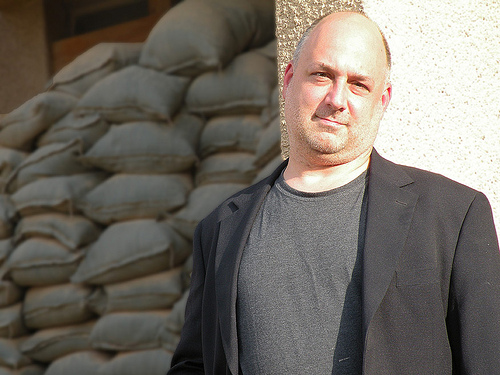
He doesn’t even know how long it will be before the ax comes down and he no longer has a job.
His forthcoming book, We Meant Well: How I Helped Lose the Battle for the Hearts and Minds of the Iraqi People, appears to be one part exposé, one part confession, because when talking to Peter, it’s clear (not just from the title) that he wants you to know that for a time, he willingly participated in the failure of U.S. policy in Iraq and truly believes that if he does not tell his story, the government will continue to repeat the same mistakes in Afghanistan, unchecked by an American public kept largely in the dark about the ugly facts on the ground.
To start, there is something strangely satisfying in hearing Van Buren talk, as if everything we already knew—from Inspector General reports, numerous congressional hearings and Government Accountability Office (GAO) reports—were fleshed out in color and narrative. In essence, made real.

A foreign service officer who went from helping Americans mitigate problems and emergencies overseas (and not in the Middle East) to serving for a year on a Provincial Reconstruction Team (PRT) in Iraq, Van Buren was like a hayseed getting dropped into the middle of Times Square. What he witnessed, and is too eager to tell in wry detail, is the dysfunctional, uninformed, venal and altogether impossible way in which the U.S. government approached its “liberation” of the Iraqi people, and why it’s not so surprising to see how Iraq is struggling dangerously behind a Potemkin Village of success today.
“What you have to understand is we were not ‘doing good.’ The Iraqis were not stupid people. They weren’t naïve people. They saw what was going on. We acted like carpetbaggers, thieves, flimflam artists,” he told Antiwar.com in a recent interview, “while they didn’t have clean water, electricity, food and medicines.”
“Time and time again I heard that ‘Saddam was an evil guy, but at least I had medicine for my kids, I had clean water running, I could go over to the Shia side of town and not have to worry about getting killed.’
“I’m not a Saddam apologist,” Van Buren insists. However, after being told the mission was “freeing Iraq,” he now recoils at the blunders and insensitivities he says led to an occupied state on the brink rather than a liberated one with a future: the abuse of prisoners at Abu Ghraib, the building of the largest embassy in history squat in the middle of where Saddam’s notorious palaces used to stand, to name a few.
“It just didn’t work—I was part of it and I contributed to it, and I thought, when I came home, I had to tell people,” he recalled. “Because we’re doing it again, we’re doing it in Afghanistan.”
Van Buren volunteered to take on a PRT assignment in 2009 because, well, in a way he had to. PRTs are teams consisting of both civilian and military officers whose primary mission is to help empower local governments through reconstruction and development—in other words, the “hearts and minds” leg of the three-legged counterinsurgency stool we’re always hearing about. There were 10 PRTs in Iraq as of 2007.
“Eventually, around the time of The Surge it appeared that was needed was a civilian response and that fell to the Department of State,” he said. At the time, there were only 5,500 foreign service officers and they were stretched across the globe.
“We had burned through the smart folks early on in our adventures in Iraq—they moved in and out fairly quickly. By 2009 the State Department was scratching around about how they were going to staff these civilian positions in Iraq. They changed around a lot of personnel rules to make it pretty impossible to advance your career without hopping through parts of Iraq, Afghanistan or Pakistan,” Van Buren recalled.
Not that he hadn’t bought into the idea of “whole of government” counterinsurgency—at first. When it looked like the department wouldn’t send him because he had been honest and noted on his application that he had a prescription for antidepressants, he took his beef to the Web. He told Powerline (see comments section) that he desired a job on a PRT because “PRTs are the very edge of our efforts in Iraq (and Afghanistan). While the kinetic side of the military can attack the bad guys directly, it is through the PRTs that State and the military work with local leaders to directly help the people establish themselves free from al Qaeda and the Taliban through aid, advice and help in setting up governance, functioning police, schools, etc. This is the critical ‘soft’ side of counter-insurgency warfare, making peoples’ lives better and more stable so that they are not drawn to the terrorists and their appeal.”
Van Buren eventually got the job in 2009 leading a PRT for a year, mostly from a headquarters at Forward Operating Base Hammer in Iraq and embedded in turn with the 82nd Airborne, the 10th Mountain Division and the 3rd Infantry Division. But the red flags went up even before his plane left the United States. At one point during the training, in which they took the State Department guys “and taught us how to shoot guns,” they were scuttled into a room to learn about Muslim culture. Word was that Secretary of State Clinton was on the premises. “She wanted to visit the Afghan training group down the hill. She walked right past us in the Iraqi group and never said anything at all. There was a message there.”
Next thing, Van Buren was on a plane for Iraq. “I left wondering what it was I was supposed to do.” When he got there, the uneasy feeling became more intense. “No one had a plan, nothing like I was going to pick up where the last guy left off.”
What became clear, Van Buren charges without hesitation, is that he was expected to rubber-stamp projects and dole out money like an ATM. He recalled his first revelation, the Baby Sheep for Widows project. While the effort was supposed to encourage independent livelihoods for widows with no pensions, Van Buren had a few questions, like, “How do we find these widows? How many times of year do these sheep have babies?”
On the first question Van Buren was advised there was a “widow broker” on hand—for a fee—to find the PRT widows. The rest of his questions were answered with a repeated “we don’t know.”
“I refused to sign” the papers releasing the funds, he said, “I said you don’t know what you are doing. They said, ‘but the previous boss signed everything.’ All of a sudden a tornado erupted around me. I was brought into my boss and he yelled at me… I was told I was disrupting the process—get with the program. The ‘program’ meant that I should sign things. So I did. That seemed to make them happy.”
He talks about this time as going from Phase 1 to Phase 2 of his experience in Iraq. Phase 3 was when he suddenly got “this terrible sensation that I had participated in something that wasn’t just a waste of money or a source of funny stories, but in fact did a lot of harm,” Van Buren said ruefully. They weren’t “building” anything of lasting substance, much less a nation, but people all around him “were giving up their lives for these projects… so I could do this ‘reconstruction.’ Really, it was a betrayal.”
His favorite story is the about the $2.5 million chicken processing plant boondoggle, otherwise known as the gift that kept on taking. The military, he said, got the idea to help turn the Iraqi’s ancient system of independent poultry farming into a local industry. “It was a complete failure” because there “was truly not a market for it.” The state-of-the-art plant remained unused and stainless—until U.S. government bigwigs starting to drop by for a visit and to boast about the project’s “successes.” Then the military would be forced to buy hundreds of chickens at inflated local prices just to push through the plant for show. Soon journalists came and the process was repeated. “We didn’t accomplish a thing over time and I was afraid we were doing more harm than good” by spending all this money, skewing the local poultry market and neglecting other viable economic development opportunities, he added.
One of the reasons why the American public has heard so little about these sordid epic fails is not just because the bureaucracy worked overtime to put a pretty face on all of its overspending in Iraq, circling the wagons anytime SIGIR (Special Inspector General for Iraq Reconstruction) issued a report about the waste, fraud and abuse associated with reconstruction projects, but because the embedded media was so conflicted about writing anything critical of their military handlers. Since the military had dominated everything on the ground there—including public diplomacy and reconstruction—to call out PRTs was to call out the Army and Marines and journalists were unlikely to go there.
In a recent column titled “The War Lovers: Why it Feels so Good to be Embedded with the U.S. Military,” posted on his blog and in various other venues, Van Buren unlocks the mystery of the pedestrian and sympathetic, if not sycophantic coverage of the war by media embeds over the last 10 years. You might be surprised—Van Buren says it’s less about military censorship and strict stage management than the way reporters are made to feel when they are brought into the bosom as an embed with no military background—like one of the boys. Call it the brilliance of “soft power” in the military’s strategic communications machine:
You arrived a stranger and a geek. Now, you eat their food watch their TV, and sleep, pee, and work together every day. These are your friends, at least for the time you’re together, and you’re never going to betray them. Under those circumstances, it’s harder than hell to say anything bad about the organization whose lowest ranking member just gave up his sleeping bag without prompting because you were too green and dumb to bring one with you…
take my word for it, it’s really, really hard to write about the military objectively, even if you try…
I respect my military colleagues, at least the ones who took it all seriously enough to deserve that respect, and would not speak ill of them… But in order to understand these men and women and the tasks they are set to, we need journalists who are willing to type with both hands, not just pass on their own wet dreams to a gullible public.
And when someone like Michael Hastings at Rolling Stone, who, despite his generous access to the brass overseas, wrote the blistering “Runaway General” that got Gen. Stanley McChrystal fired—in other words “betrayed” his handlers—the mainstream media turned on the messenger with the ferocity of a guard dog.
But interestingly, Van Buren saves much of his ire for not the military or the suck-ups in the media, but for the State Department itself, which takes a lot moxie for a guy with more than two decades on the job and a wife and two daughters at home. He insists that his views are his own and not the government’s and that he is exercising his First Amendment right to free speech as long as the department will let him.
He’s angry. He blames the department as part of the greater botched policy in Iraq, for going into Iraq as a civilian force without a clear plan and trained people (“State had it’s chance and it failed in reconstruction”), and for building an embassy “worthy of the over-the-top optimism and bravado that characterized the invasion itself” for which the department must field its own mercenary army to secure. “It’s the largest embassy in the world and you still can’t figure out what they do. I don’t know what they do,” he complained. He provides an excellent tutorial on Foggy Bottom’s contribution to the indefinite U.S. occupation of Iraq here.
He remains one of the few American bloggers still devoted to talking about the War in Iraq. To him, it is all of a piece, Afghanistan and Iraq, Afghanistan and Pakistan, so-called modern counterinsurgency.
“I do think I’ve already lost some friends. When people find out I’m writing this book, all they can say is, ‘are you in trouble yet?’ So far, not yet,” says Van Buren.
“I love my country and care very much about it. (The book) will probably torpedo what’s left of my career. I just see us as repeating the same mistakes in Iraq and Afghanistan and getting ready to start with Libya and Pakistan,” he added. “I know we can do better. I know the State Department can do better.”
Note: We Meant Well will be released Sept. 27.