The Donald pulled no punches at the UN today. It was all hell and brimstone on the Iranian War file.
Once again, and perhaps for the 15th time, he promised to “annihilate” a nation that arose originally upwards of 2,700 years ago:
I have a big decision to make. Will a deal be made with Iran that lets them rebuild and create a far greater country than it ever was before — maybe one of the greatest in the Middle East, or even the world? Or do I annihilate the Islamic Republic, and do it quickly, never giving them a chance to kill and destroy people and countries again? Do I drive them into hell, with no chance of survival and no hope of future greatness for generations?”
Here’s the thing, however. Our loud-mouth school-yard Bully Boy, who still has the temperament of a 13-year old, is apparently not watching the gauges on his dashboard. After all, they show clear as a bell that the US military’s weapons stockpiles and the nation’s work-a-day fuel tanks of diesel oil are plunging toward empty. Rapidly.
As for the former, it’s no secret that He-Man Hegseth and the Donald have burned the Pentagon’s supply of crucial interceptor missiles and attack weapons at red hot rates. Thus, based on public information, if the burn rates of the first seven months of the Donald’s disastrous war on Iran continue at current levels, to say nothing of escalate into the promised hell on earth, America’s entire stockpile of crucial attack and interceptor missiles will be depleted within a matter of months.
For instance, since Washington began its Forever Wars in the middle east in the 1990s, the go-to attack weapon designed to substitute for boots on the ground, surface warships in harm’s way and even traditional fixed wing and rotary attack aircraft has been the Tomahawk Cruise Missile. The latter is often launched from submarines hiding in the ocean deeps far way from battlefield targets and the reach of enemy counter-measures.
Yet 50% of the entire US stockpile of Tomahawk missiles has been consumed during the first 7 months of the war, bringing, presumably, hell up close and personal to the Iranian regime. In fact, the average consumption rate of 221 tomahawk missiles per month has been so heated that there is only 7 months of US stocks left at that rate.
And that’s before the Donald goes into the threatened “annihilation” mode— to say nothing of stocks needed for the Far East, Europe and other theaters of Uncle Sam’s misbegotten Global Empire.
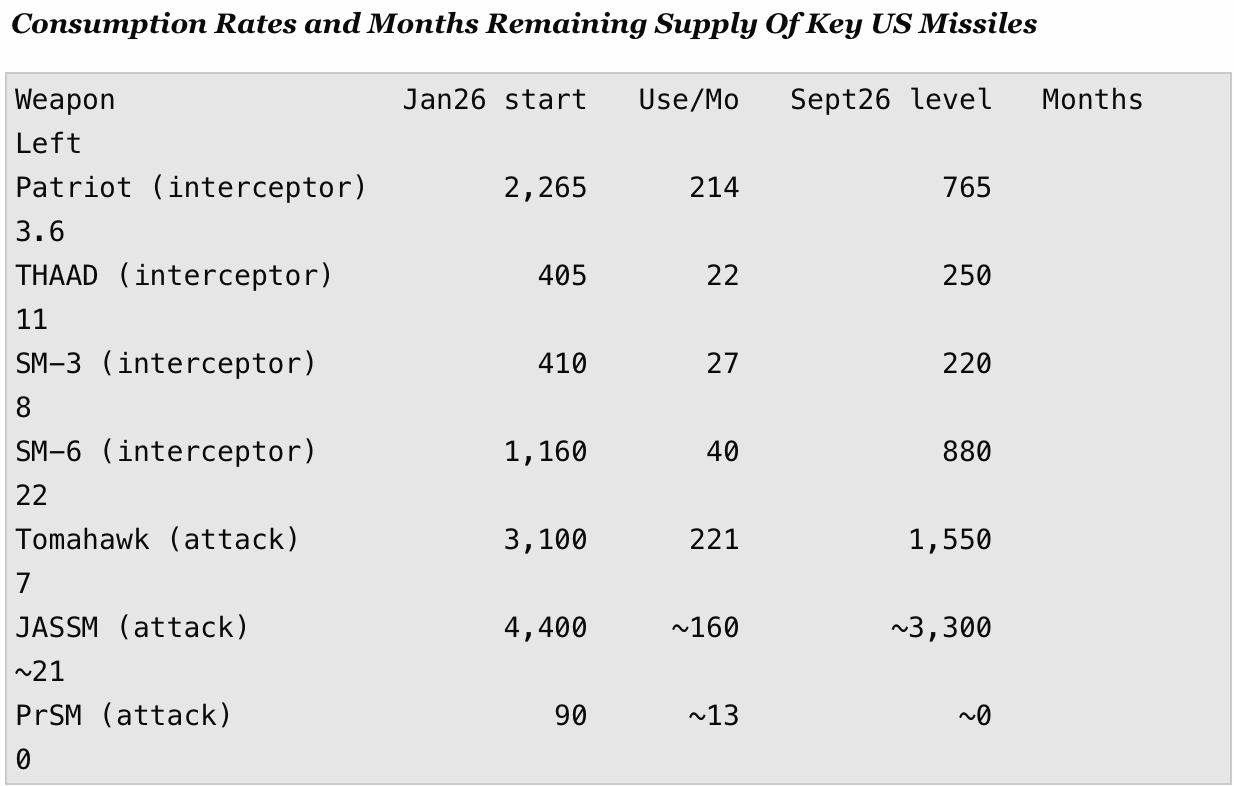
Indeed, the approaching bottom of the weapons tank cannot be gainsaid. Since the war opened on February 28 Washington has self-evidently – per the table above – expended a large share of the magazines that make American long-range strike and missile defense so formidable.
Open-source midpoints put the prewar Patriot stock near 2,265 interceptors and the Tomahawk pile near 3,100. Seven months later the implied remainders are about 765 Patriots and 1,550 Tomahawks, down 66% and 50%, respectively. At the war-to-date average, therefore, what’s left is just 3.6 months of Patriots and the aforementioned 7.o months of Tomahawks before those two accounts hit zero.
THAAD and SM-3 last a bit longer on the same arithmetic—roughly 11 and 8 months – because the monthly burn is smaller, not because the stocks are actually at healthy levels. PrSM, which is Washington’s ground attack missile against air defenses, ships and bases is already effectively gone.
Likewise, JASSM, which is a stealth air-launched attack missile versus bunkers and airfields, looks to have materially more stocks remaining. But the early-war (March/April) clip of 1,000-plus rounds in 39 days is a warning, not a comfort. That is, if the Donald goes full frontal after the election, as he now told the world he intends, there truly wouldn’t be anything left in most of these key missile categories.
In short, while there are still enough rounds to keep fighting this war at a conserved rate, there arenot remotely enough rounds to keep fighting it the way the first month was fought. Yet the only route to military “annihilation” of the Iranian nation, in fact, would be to re-embrace the first months’ rate, and then double or triple it from there.
On the other hand, what the first seven months of war/pause/strike/truce/strike again have bought about in total is not mysterious. Ships and aircraft used Tomahawks and JASSMs to hit air defenses, missile plants, naval targets, and command nodes aplenty. Patriots, THAAD, SM-3, and SM-6 were fired at prodigious rates in order to keep Iranian ballistic missiles and drones off American bases, Israeli cities, and Gulf infrastructure.
The Congressional Budget Office, in fact, put the Defense Department’s cash cost through August 1 at about $38 billion, of which munitions replacement was the largest single piece: $13.1 billion for interceptors and $7.3 billion for land-attack cruise missiles.
So the accounting bill grossed-up to mid-September is undoubtedly $50 billion and counting. Yet after all this firepower expended, the Iranian military capacities—which have been clearly wounded – have not been disabled nearly extensively enough to bring the regime to its knees.
Indeed, by mid-spring, U.S. intelligence assessments still credited Tehran with on the order of 70 percent of its prewar missile stockpile and most of its mobile launchers, and with recovered access to a large share of underground storage and launch sites.
Likewise, oil still moves through the Strait only under heavy US naval escort. The regime is under inflation measured in the hundreds of percent, a smashed navy in official American telling, and a leadership that has been attrited via Israeli style assassination of enemy leaders targeted for death.
Yet the IRGC is also still firing. A September engagement over Jordan that consumed 60 to 70 Patriots and more than a dozen THAAD rounds against an Iranian salvo of about 20 ballistic missiles is the opposite of a spent adversary.
Indeed, one-way drones that cost tens of thousands of dollars still force the firing of US interceptors that cost millions each. That hideously adverse exchange rate is why the US interceptor column in any honest table declines faster than Iranian political will.
The deeper problem is structural. Precision magazines are built for short, intense campaigns against a target set that can be finished on a “one and done” basis. But Iran is a large country with dispersed launchers, a deep bench of short- and medium-range missiles, an incredibly resilient missile and drone production system buried in deep mountain redoubts, a population that has already absorbed years of sanctions, and a theory of victory that does not require air superiority.
You can burn a third of the Tomahawk stock and half to two-thirds of the combined interceptor family and still not get it done. That is, have –
- an occupation force in control of the countryside.
- a government-in-waiting that can hold Tehran.
- a leak-proof blockade that seals Iran off from the outside world in an airtight manner.
The February–April surge showed what the high-end weapons can do in 39 days. But it wasn’t dispositive. It generated nothing that even remotely resembled capitulation in Tehran – even as Bibi’s opening day assassination of the Ayatollah generated an outpouring of national patriotism that had the very opposite effect.
By the same token, the recent months after the ceasefire show that Iran still has the capacity to regenerate its unique forms of fighting capacity. So more Tomahawks in month eight and month nine would hit more buildings. They would not, on the evidence to date, collapse the system that keeps on firing.
Running the remaining Patriots for another quarter at the seven-month average, or the remaining Tomahawks for another two quarters, would therefore most likely purchase a continuation of the current military stalemate at a higher residual risk.
At the end of the day, surrender is a political act. Nothing in the public record of this war suggests the Islamic Republic’s threshold for that act lies just a few hundred more cruise missiles away. The Donald’s own framing at the United Nations about annihilation this time and for sure was actually an admission that seven months of the most expensive munitions in the American arsenal did not close the file.
So emptying what is left of those same weapons’ accounts is not a new theory of the war. It is the White House’s existing seat-of-the-pants theory with a far thinner magazine.
As it happen, of course, the ultimate cost of the Donald’s proffered choice of a deal or annihilation after the election sits outside Iran. That’s because Patriot and THAAD are not Iran-only weapons.
They are the upper tier of American and allied ballistic-missile defense in the Pacific, on the Korean Peninsula, in Europe, and around the homeland architecture that was already thin before February. CSIS’s warning after the July drawdown was not that CENTCOM would run out tomorrow. It was that diminished stockpiles force riskier intercept doctrines and leave far less for any contingency that may arise in a second theater.
In this context, a recent CBO analysis of the “rebuild clock” for these interceptor stockpiles is at least five years even if production rates rise appreciably. THAAD deliveries were already frozen into 2027. Tomahawk output in recent peacetime years was on the order of 90 to 200 rounds per year against a wartime clip above 200 per month. Raytheon and Lockheed, of course, can be ordered to surge production. But metal does not appear in a vertical-launch cell on a press release.
A China contingency has been central to the planning case for these weapons for a decade. Pacific war games consume Tomahawks, JASSMs, SM-6s and Patriots at voracious rates in a matter of days, not quarters. North Korea is a missile problem that lives on the same THAAD and Patriot accounts.
The planned Europe air-defense rebuild after Ukraine already leaned heavily on the Patriot production line. Likewise, every interceptor fired at a Shahed or a medium-range ballistic missile over the Gulf is an interceptor that is not in Guam, Poland, or a CONUS battery.
The United States can still fly, steam, and drop cheaper munitions. What it cannot do, once the specialty magazines are gone, is recreate the combination of long-range conventional strike and high-end missile defense that is supposed to make opponents tremble in their boots.
There is also a narrower operational point. Global inventory is not the same as usable rounds on station. Ships cannot yet reload Tomahawks at sea. A theater can “go Winchester” (use the last weapon in the magazine) while crates still sit on shipping docks in the United States.
That is how a seven-month national average of 221 Tomahawks a month can coexist with local shortages after the first month. Stretching the remaining 1,550 rounds across another two quarters of “average” use assumes the Navy will keep feeding the same theater at the same pace.
But the first time a carrier strike group has to leave station to rearm, the average becomes fiction and the exposure becomes immediate. That is to say, the first thousand Tomahawks and the first thousand-plus Patriots bought suppression, defense of bases, and a demonstration. The next five hundred of each, at this stage of the war, buy more of the same against an opponent that has already shown it can eat that punishment and keep a missile force in the field.
In short, the thoroughly depleted missile inventories in the table above cannot buy a surrender document from Tehran. The Iranian regime has already proven that in spades.
They only thing they can buy, in fact, is a thinner American position against every other missile power that can read a production schedule. The rational use of the months-left column is therefore conservation and a political off-ramp from an utterly unnecessary and pointless war, not a sprint to an empty missile tank under the Donald’s juvenile war cry of “annihilation”.
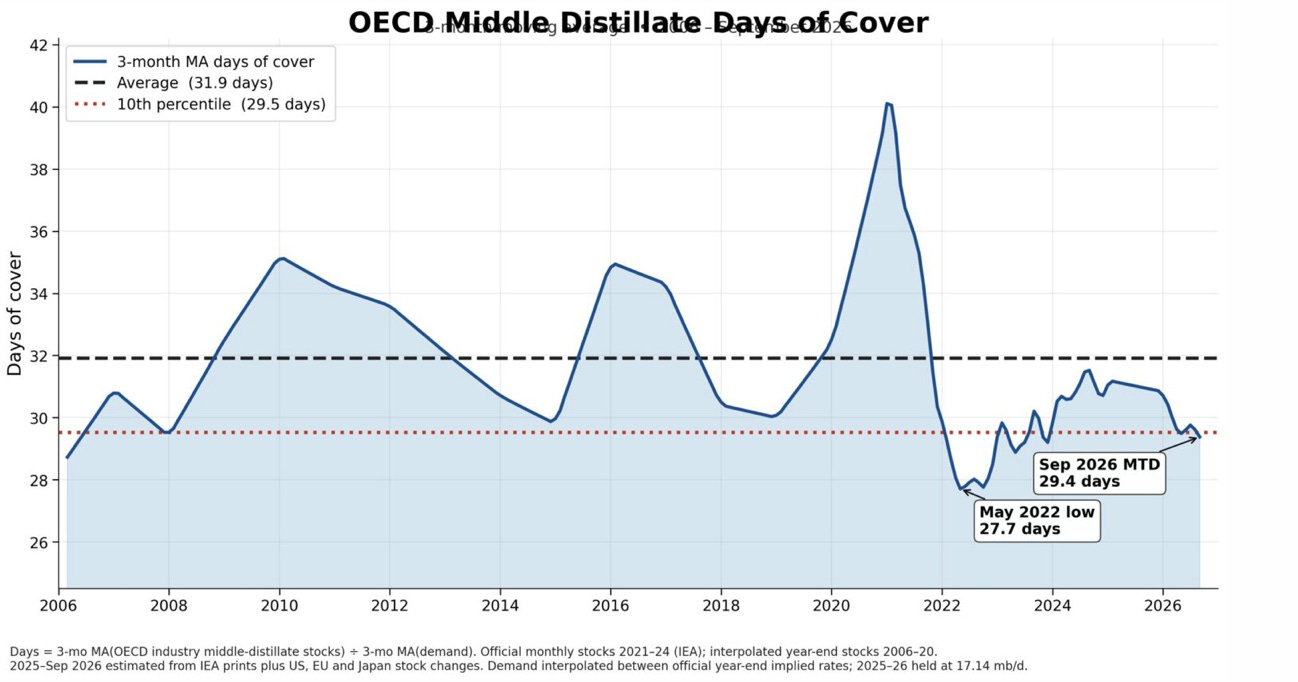
Moreover, an empty missile tank would only be the half of it. The fact is, middle distillate inventories have fallen so far and so rapidly that only an immediate end to the war and complete re-opening of the SOH can likely prevent an even worse calamity.
To wit, the life blood of the US economy today is diesel fuel because that’s what every farm tractor, work truck and semi-truck hauler in the US economy now operates on. And as shown in the graph below, we are already down to the 10th percentile of days cover for current daily consumption rates.
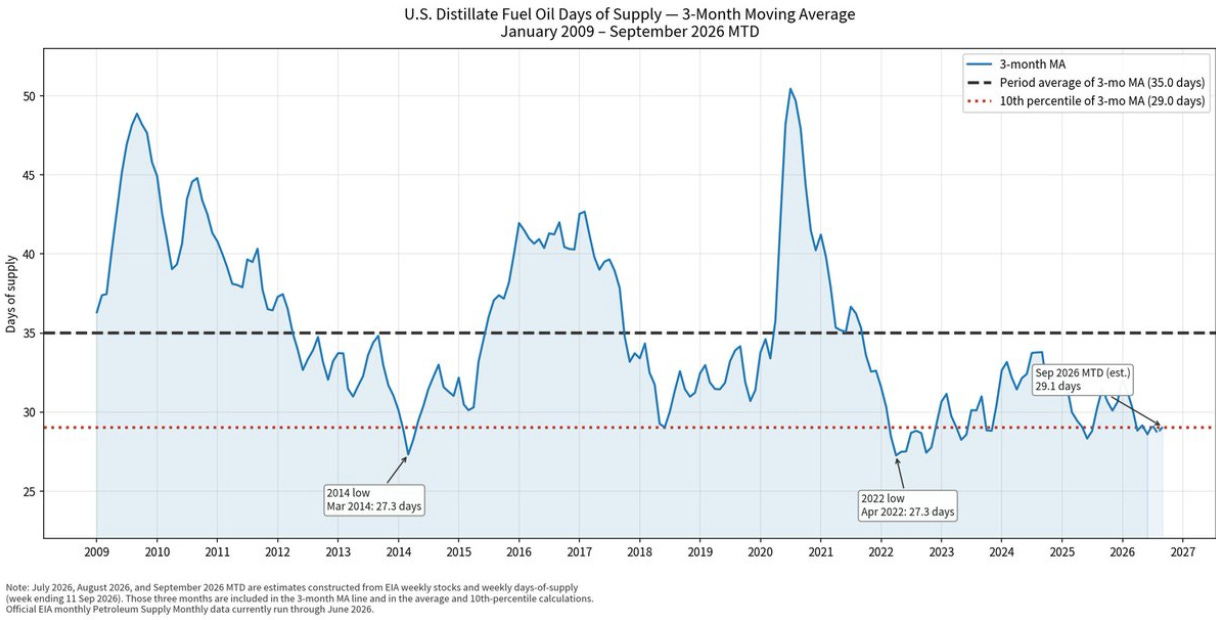
In short, the U.S. middle distillate sector is now sitting on the ragged edge. EIA’s latest weekly print, for the week ending 11 September 2026, put commercial distillate stocks at 107.9 million barrels (mb).
Four-week average product supplied was 3.60 million barrels a day, which is only 29.9 days of cover. That is not a surplus number. It is a late-summer tank that looks full only if you ignore how fast the fuel is leaving.
Moreover, most of that 107.9 mb is not spare product, anyway. Pipeline fill is about 25 mb, refinery working tanks another 22–26 mb, and terminal heels and minimum operating stock another 30–40 mb. Call the immobilized stock 80–90 mb.
So what you can actually draw-down without draining the pipes is a thin layer on top of that. In fact, using the 2022 break point of 25.9 days, or about 93 mb at today’s run rate, the usable surplus is barely 15 million barrels.
That is four days of demand, which is not a strategic reserve by any stretch of the imagination. A hiccup in the world market would blow that away in a heartbeat.
One Gulf Coast outage, a sudden export pull into Europe or Latin America, or a cold winter week that lifts heating-oil and diesel use together would take down the usable 15 mb in a matter of days and hours.
Then you would not be debating days of cover. You would be in the 2022 tape that took prices sky high under the hapless Joe Biden: That is to say, at 93 mb and 26 days, price would be doing the rationing and the sight would not be pretty.
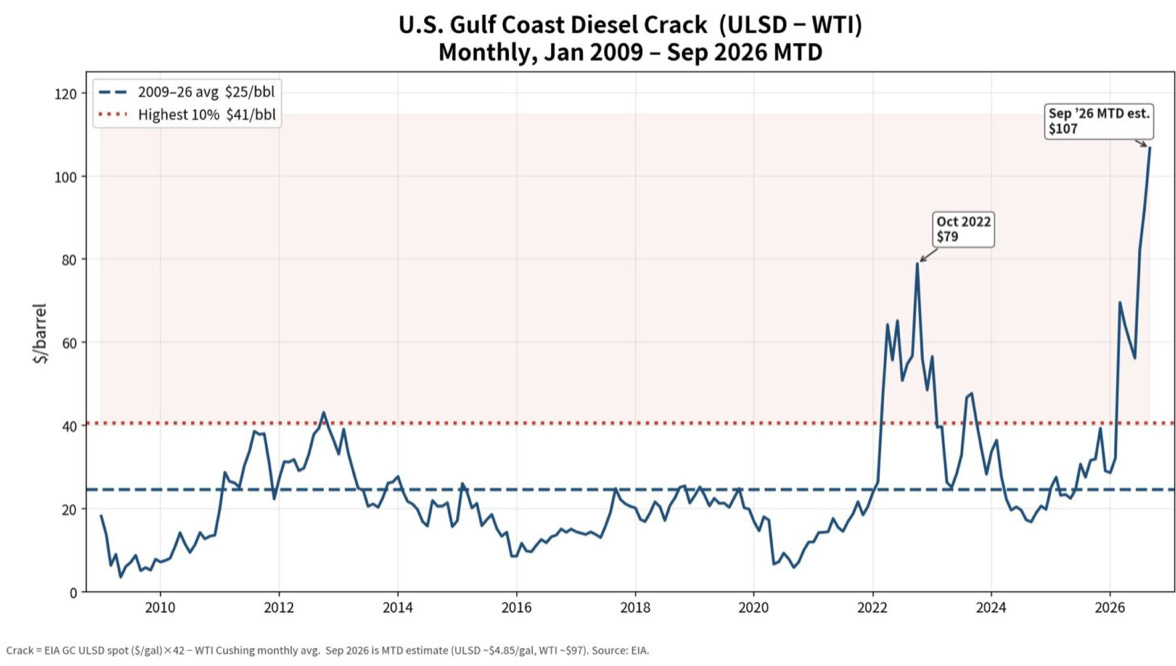
For want of doubt, here is the refinery crack spread for US middle distillates. The current level of $107 per barrel is already off the charts of history. It stands at more than 4X the average of $25 per barrel since 2009 and 2.6X the cut-off line for the highest 10% of monthly averages at $41 per barrel over the last 17 years.
As the man said, let that sink in!
The crack spread sits on top of the benchmark crude oil prices such as WTI or Brent. But what really counts for the overall economy is not the crude price going into the refineries but the post-crack spread product price – which measures the true level of scarcity or surplus in product markets – going out the refinery gate.
In truth, this is the real gauge on the middle distillate or diesel tanks in the domestic US economy. The indicator arrow is actually hugging the bottom and threatening to break-on-through.
As it happens, there is no precedent for the current discombobulation in the petroleum product markets. If we reach back 50 years, there have been only two other brief periods which stood anything close to the thin days of cover shown above.
So yes, POTUS, prolong the war until election day and then attempt the annihilation strategy shortly thereafter. But the military assault won’t work, and Mr. Market will then ravenously take the hindmost.
On a per gallon basis, diesel could go to $10 or even $20 per barrel, sending the US economy into the drink like, perhaps, NEVER BEFORE.
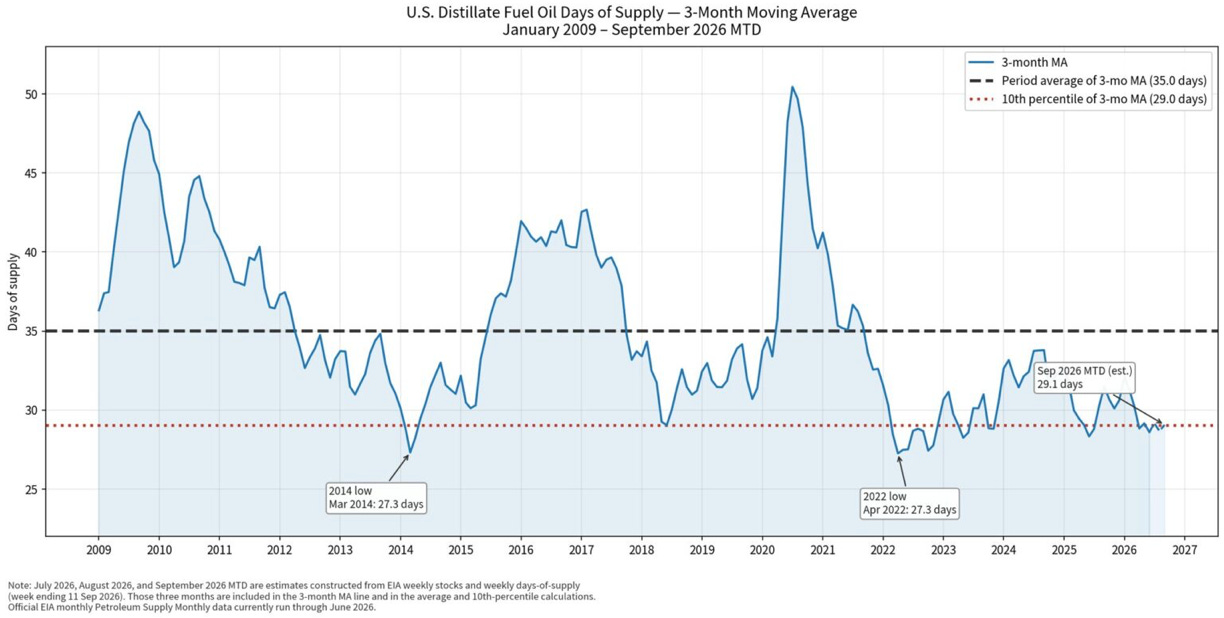
And there wouldn’t be any respite in the world market, either. Middle distillate inventories are scraping the bottom of the barrel on a worldwide basis, too.
The critics, of course, say the bombastic fool who showed up at the UN today is wholly innumerate and appropriately so. After all, with two empty tanks who in their right mind would shout “flank speed ahead”!
David Stockman was a two-term Congressman from Michigan. He was also the Director of the Office of Management and Budget under President Ronald Reagan. After leaving the White House, Stockman had a 20-year career on Wall Street. He’s the author of three books, The Triumph of Politics: Why the Reagan Revolution Failed, The Great Deformation: The Corruption of Capitalism in America, TRUMPED! A Nation on the Brink of Ruin… And How to Bring It Back, and the recently released Great Money Bubble: Protect Yourself From The Coming Inflation Storm. He also is founder of David Stockman’s Contra Corner and David Stockman’s Bubble Finance Trader.