At some point it is wise indeed to pay heed to the numbers – and that’s overwhelmingly true with respect to the battling narratives about the Donald’s Iran War now raging in the Persian Gulf. The fact is, the Iranian “threat” is almost entirely an ideological and political sham confected by Bibi Netanyahu and his neocon fifth columns on the banks of the Potomac.
They would have you believe that Iran is some kind of super-Evil Empire that is a military threat to the whole world, including way over here 10,000 kilometers from Tehran.
We beg to differ. Completely. And Defiantly, Too.
At the end of the day, a realistic, deliverable, sustainable military threat to the Homeland territory of America – the only valid reason for military action by a peaceful Republic – must necessarily be anchored in a robust economic base of GDP. That’s the only place from which the advanced technology, professional military manpower, abundant tax revenues and other economic resources needed to support a massive War Machine can be obtained.
Yet without massive defense budgets and weaponry – both a nuclear first strike capacity and an overwhelming conventional armada of invasion and occupation – no nation on planet earth would have the capacity to threaten America. Not way over here inside the safe harbor of the great Atlantic and Pacific Moats.
Based on the hard economic data for the last 53 years, therefore, one thing is crystal clear: When it comes to the economic girth needed to support a true military threat to US citizens on American soil from sea-to-shinning-sea, Iran is, was and always has been a Flyspeck.
And, ironically, Washington’s decades of brutal economic warfare against Iran has drastically weakened its economic strength relative to that of the US, even as it has solidified the rule of the religious mullahs, who’s theocratic regime has further throttled Iran’s economy.
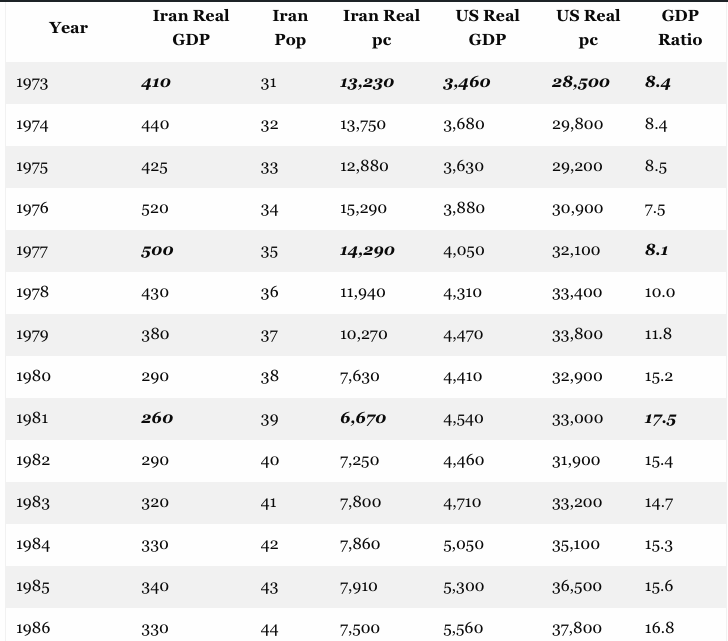
Thus, back on the eve of the oil crisis in 1973 and notwithstanding 20-years of the Shah’s systematic larceny, US GDP was only 8.4X that of Iran. Likewise, Iran’s respectable real GDP per capita of $13,239 was nearly half that of the USA at $28,500.
At the time, the Iranian $410 billion economy ($2025 USD) was also the most robust in the middle east by a long shot. Stated in 2025 USD, the Iranian economy was orders of magnitude larger than any of its regional rivals:
1973 Real GDP In 2025 $:
- Iran: $410 billion.
- Saudi Arabia:$170 billion.
- Egypt: $130 billion.
- Israel:$75 billion.
- Syria: $30 billion.
- Jordan: $10 billion.
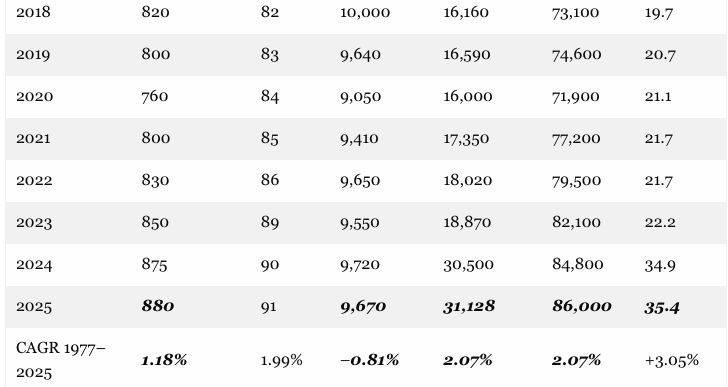
But that’s all she wrote. For nearly the entire past half-century the girth of Iran’s economy has been steadily and relentlessly shrinking relative to that of the United States. Accordingly, there is now (2025) a staggering difference in the final column, which measures the real GDP of the US in 2025$ versus that of Iran. Today that crucial ratio now stands at 35.4X or more than four times greater than it was in 1973.
That’s right. Iran’s economy is now a flyspeck compared to that of the US, and it has been systematically eroding and weakening ever since the 1979 Islamic Revolution. Thus, by 1981 when the US embassy hostages had been released, the chaos from the first years of the mullahs’ regime and the initial US economic sanctions had caused the real economy of Iran to virtually collapse.
Real GDP fell to just $260 billion in 1981 and per capita GDP shrunk to just $6,670, meaning these key metrics had already contracted by -48% and -53%, respectively, from their 1977 levels. And notwithstanding America’s own bout with double digit inflation and the double-dipping 1981 recessions, US real GDP was now 17.5X larger than Iran’s.
Needless to say, Iran’s brush with nearly existential threat during its 1980-1988 war against the combined powers of the US military and Saddam’s air force and invasionary land troops, did nothing for its economic vitality. In fact, Iran’s 1988 GDP at $350 billion was still down by 3o% from its 1977 level and the girth of the US economy remained 17.6X larger.
Now here’s the thing. During the first decade of Iran’s so-called War on America, it had not made any kind of war on the US homeland at all, and the economic basis of its ability to do so had been sharply reduced, to boot.
To wit, Washington had blown the chance to return the Shah to face justice in Tehran and thereby end the Embassy standoff with the students peacefully; it had foolishly put American personnel in the middle of Israel’s invasion of southern Lebanon and its war with its indigenous Shiite population (Hezbollah) for no reason whatsoever of America’s Homeland Security; and it had absurdly linked arms with Saddam Hussein in his invasion of Iran during the 1980s that was unaccountable even at the time, and pure barking idiocy in the light of subsequent history.
By the time of 9/11 in 2001 and the onset of the Sunni jihadist era of terrorism, therefore, Iran’s economy was dead in the water. And that was in large part because the combination of a devastating war on its home territory and 7th century religious doctrine were not an especially solid foundation for national economic policy.
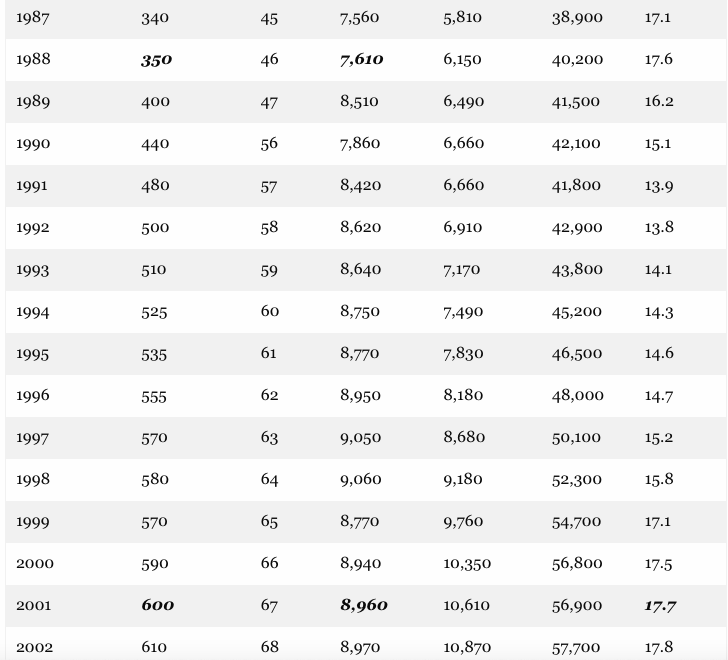
Iran’s 2001 real GDP of $600 billion, in fact, represented a mere 0.76% per annum growth rate since the 1977 pre-Revolution base, yet its population had nearly doubled from 35 million to 67 million. Accordingly, real per capita income had plunged to just $8,960 or by nearly -40%.
That is to say, the mullah’s may have known their Koran and the Shiite version of Islam’s doctrinal history, but they sure as hell didn’t know how to run an economy. For want of doubt consider that Iran’s mere 20% gain in real GDP during the quarter century between 1977 and 2001 compared to a 162% gain for the US economy and a 262% gain in real GDP in Israel during this period.
Moreover, this severe relative economic decline had occurred in a country blessed with a huge natural hydrocarbon endowment that had supported upwards of 6 mb/d of production in the mid-1970s.
Indeed, the deterioration of Iran’s oil sector was alone decisive evidence of its drastic economic decline under the mullahs. Production had reached 6.02 mb/d in 1974, and had it been maintained at that level through 2001 (it had plenty of reserves – so the issue was investment and economics, not its resource base) it would have generated $55 billion per year of oil revenue at the $25/barrel world price of 2001.
As it happened, however, production had fallen to just 3.78 mb/d by 2001, meaning that annual oil revenues of $35 billion per year were down by $20 billion or -36% from pre-Revolution levels.
In short, when it came to sheer economic and industrial throw-weight – which is the ultimate basis for military power in the 21st century world – the mullahs had pretty much throttled their own capacity to be a threat to the outside world. And most especially to the USA 10,000 kilometers away.
After all, the Islamic Republic by then was a religiously benighted, repressive regime in most respects. But it wasn’t a Stalinist totalitarian dictatorship, either. To have any sustainable capacity to threaten the US it needed to deliver steadily improving living standards and daily life for what by then was a population of 67 million people.
But on that score it was failing miserably. That means at the time the real War on Sunni Terror began post 9/11, Iran was in no position to drastically upgrade a bedraggled military. The latter had been decimated on the battlefield by the Iraqi’s during the 1980s and had never recovered thereafter.
In objective terms, of course, there had been no Shiite terrorism on US soil as of September 2001 anyway, and the Iranian economy and military were now pretty much a shambles.
Accordingly, there was no basis for the next 26-years of the so-called Iranian War on America, either. In fact, the damnable lie that there was a threat was confected by Bibi Netanyahu and the Washington neocons. And, at the end of the day, it was most especially the doings of the mad man who has dominated Israeli politics, policy and its Warrior State posture for better than three decades.
As it happened, Netanyahu’s rise to power in the 1990s was closely tied the success that the hapless Jimmy Carter had made tempering the historic Israel/Arab conflict during the last years of his presidency. On the one hand, the Carter peace deals had drastically reduced the threat of Israel’s so-called “near enemies” – the conventional Arab military powers of Egypt and Syria. That is, after the 1979 Egypt-Israel peace treaty and the weakening of Syria after the 1982 Lebanon War and the 1991 Gulf War, Israel had no serious military threat on its borders for the first time since 1948.
At the same time, the legacy of Carter’s breakthrough, as it was enhanced further by Clinton’s Oslo peace process, was that internal politics in Israel became dominated by the latter.
Needless to say, Bibi Netanyahu, then a rising Likud star and former UN ambassador (1991–1992), plunged straight into the aggressive exploitation of both matters. That is, he argued that while Israel was making peace with its Arab neighbors, a new and more dangerous “far enemy” had emerged: the Islamic Republic of Iran and the radical Islamist ideology it championed. From the early 1990s, Netanyahu repeatedly warned that Iran through its nuclear program and alleged sponsorship of terrorist groups, which were simply Shiite kinsman located throughout the region, posed an existential threat far greater than the fading conventional Arab armies.
In his 1993 book “A Place Among the Nations” and later in “Fighting Terrorism”(1995), he framed radical Islam and Iran as the new civilizational challenge to the West and Israel. This narrative gained traction after the 1995 assassination of Prime Minister Yitzhak Rabin. Of course, the vilification of Islam as a religion has always been a tool of aggrandizement by Washington and Israel that bore no relationship to the underlying military and economic threats posed by Iran or any of its so-called “proxies”.
In the subsequent 1996 election against acting Prime Minister Shimon Peres, Netanyahu ran a campaign centered frontal attack on the Oslo Accords. This thrust was unfortunately enhanced by a series of devastating suicide bombings in early 1996, carried out by Palestinian groups, which created a climate of fear, badly damaging Peres’ image as a peacemaker.
Netanyahu capitalized on this, portraying Peres as naive about the true threats. He positioned himself as the strong leader who understood that the real danger was not the Palestinian Authority, but Iran and its proxies – the “head of the snake.”
Netanyahu narrowly defeated Peres in May 1996, becoming Israel’s youngest prime minister at age 46. His victory marked a sharp turning point: it legitimized the strategy of prioritizing Iran as the primary long-term threat, even as the Palestinian track remained unresolved.
This “Iran first” approach became a defining feature of Netanyahu’s political brand, allowing him to sideline the Palestinian issue while projecting strength against a distant but ideologically scary adversary. By elevating Iran as the Far Enemy, Netanyahu successfully reframed Israeli politics around existential threat rather than territorial compromise. This strategy not only won him the 1996 election but laid the foundation for his decades-long dominance in Israeli politics.
As time went on, Netanyahu carried his demonization one step further. To wit, he claimed virtually year upon year upon year that Iran was within months or weeks of a having a nuclear bomb. But that was an outrageous, baseless Big Lie from beginning to end, as we will amplify in Part 8.
In any event, Netanyahu’s demonization of Iran and the false claim that it would soon have a nuke was purely the propaganda fodder of Israel’s unique multi-party coalition form of governance. As of 2001, there was no basis whatsoever for the next 25-years of anti-Iran policy including endless economic warfare in the form of Washington-imposed embargoes and sanctions.
What the latter did accomplish, of course, was an even further weakening of Iran’s economy beyond the long-running damage from its mullah and IRGC dominated regime. Thus, as of 2025 Iran’s real GDP of $880 billion was up barely 1.1% per year from the pre-revolution level of 1977, while its per capita real GDP of $9,670 had shrunk by 0.81% per annum for 48 years running.
Even more importantly, US real GDP of $31.1 trillion in 2025 was now the aforementioned 35.4X larger than Iran’s economic base. So aside from the Great Big Lie about the NUKE, the Iranian situation before the Donald and Bibi started dropping their bombs three weeks ago was not remotely what it was cracked up to be: Namely, Iran had no blue water Navy; no long range bombers; no missile carrying a full payload with a range of greater than 2,000 kilometers or one-fifth of the way to Washington DC; and a mere flyspeck of an economy relative to the might of the USA.
Accordingly, never before had there been a more unjustified attack on a foreign country by Washington DC. It was only the threadbare and utterly untruthful narrative about Iran’s 47-Year War on America that provided even a thin fig-leaf of explanation for the Donald’s hideous attack done by, for and at the instigation of Bibi Netanyahu.
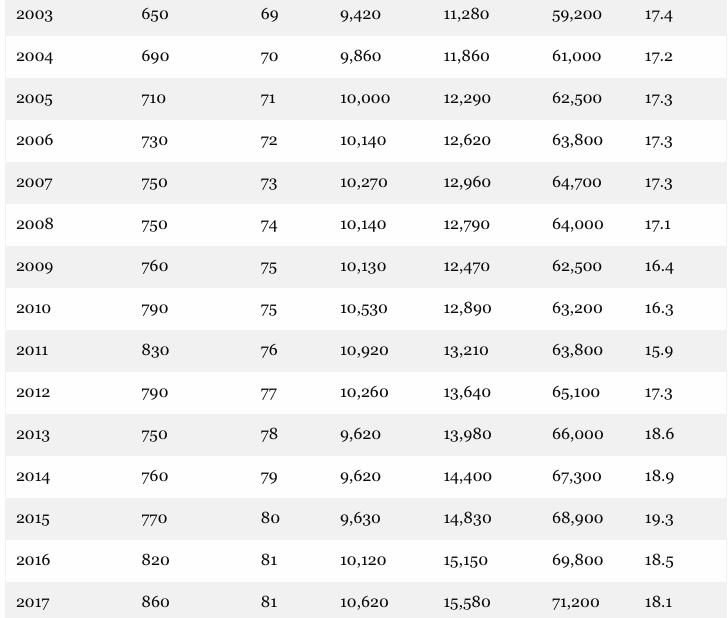
Economic History Of Iran Versus USA, 1973 to 2026
Footnotes
¹ Iran Real GDP: in constant 2025 US$ billion (World Bank constant 2015 US$ series rebased to constant 2025 US$ prices; actual output volume).
² Iran Pop: in millions (UN/World Bank mid-year estimates, rounded).
³ Iran Real pc: real GDP per capita in constant 2025 US$ (real GDP ÷ population, rounded to nearest 10).
⁴ US Real GDP: in constant 2025 US$ billion (FRED GDPCA chained 2017 dollars annual, rebased to constant 2025 US$ using consistent CPI inflation factor 2017–2025; 2025 is BEA annual estimate).
⁵ US Real pc: real GDP per capita in constant 2025 US$ (BEA chained 2017 dollars annual averages, rebased to constant 2025 US$).
⁶ GDP Ratio: US Real GDP / Iran Real GDP (to one decimal place).
CAGR: Compound Annual Growth Rate from 1977 to 2025 (48 years).
David Stockman was a two-term Congressman from Michigan. He was also the Director of the Office of Management and Budget under President Ronald Reagan. After leaving the White House, Stockman had a 20-year career on Wall Street. He’s the author of three books, The Triumph of Politics: Why the Reagan Revolution Failed, The Great Deformation: The Corruption of Capitalism in America, TRUMPED! A Nation on the Brink of Ruin… And How to Bring It Back, and the recently released Great Money Bubble: Protect Yourself From The Coming Inflation Storm. He also is founder of David Stockman’s Contra Corner and David Stockman’s Bubble Finance Trader.