If Palestinians could have a democratic election, the 66-year-old Barghouti, their charismatic leader in the West Bank prior to his imprisonment, would the absolute winner. That is why Israel announced last Thursday that Barghouti will not be among the 2,000-odd Palestinian prisoners who will be released as part of the ceasefire deal with Hamas.
Since 1948, Israel’s grand strategy has been the fragmentation of the Palestinians and their dream of statehood that most nations recognize today. A popular unifying Palestinian leader is a great concern to the Netanyahu cabinet.
The 2006 election and the West’s blockade
Despite Israeli Prime Minister Arik Sharon’s unilateral disengagement from the Gaza Strip in 2005, Israel continued to control its airspace, territorial waters and the movement of goods and people in and out of Gaza. Hence, the status of Israel as the effective occupation power has prevailed.
The withdrawal did set the stage for the first Palestinian election in a decade. The original election had taken place in 1996, when the peace process still fueled the PLO’s predominance, while its main adversary, Hamas, refused to participate, due to the former’s “unacceptable negotiations and compromises” with Israel.
Postponed for years as a result of disagreements between the two adversaries and the Second Intifada, the elections took place in 2006. The results – the electoral victory of Hamas (44% of the vote) against the ruling Fatah (41%) in the West Bank and Gaza, occupied by Israel since 1967 – was enough for Hamas to run the government without forging a coalition.
U.S. President George Bush had presumed that democratic election would result in a pro-Western government. Similarly, Arafat’s successor Mahmoud Abbas felt confident that Fatah would win the election. The result was a triple-whammy. Israel felt vindicated, the U.S. humiliated, and the EU lost.
War against Palestinian democracy
As Ismail Haniyeh, the political leader of Hamas, prepared to take power, the West shunned Hamas’s triumph. Following the crackdown by Hamas’s leadership on Fatah, which had not taken its electoral defeat easily, Israel and the Middle East Quartet—the U.S., Russia, UN and EU – introduced economic sanctions against Palestinians and there have been no new elections.
After January 2009, the PLO’s Mahmoud Abbas stayed president after the expiration of his term, then refused to hold elections, even supporting the blockade of the Gaza Strip to weaken Hamas.
Among Palestinians, such conduct was widely condemned. In Israel and the West, it was broadly supported. Most Palestinians in both the West Bank and Gaza do not see Abbas as their prime representative, as evidenced by public surveys ever since then.
It was these fatal, flawed decisions that paved the way to October 7, 2023, and Israel’s subsequent decimation of Gaza’s infrastructure and the genocidal atrocities of its Palestinian residents.
Despite the calls by Israel and the West for a “reformed PLO leadership,” most Gazans have supported and continue to support the Hamas offensive, even at the risk of their lives, as evidenced by the latest Palestinian polls.
What Palestinians really want
If the two presidential candidates were Marwan Barghouti of Fatah and Khaled Meshaal of Hamas, Barghouti would garner 58% of the vote and Meshaal 39%. These results indicate a 6-point rise in the percentage of votes for Barghouti and an 8-point drop in the vote for the Hamas candidate.

Barghouti’s electoral dominance. Source: PCPSR, May 2025
Since the late 1990s, the Netanyahu cabinets’ strategy has been to assassinate Hamas’s leaders, particularly those regarded as more moderate. From 1996 to 2017 – after the Israeli assassination of Sheikh Ahmed Yassin, the founder of Hamas and his successor – Meshaal served as the second chairman of the Hamas Political Bureau until he was succeeded by Ismail Haniyeh. In 1997, Mossad tried to assassinate Meshaal in Jordan and he fell into coma. It was only after King Hussein threatened Netanyahu that he would void the historic 1994 bilateral peace treaty and President Bill Clinton’s intervention that the Israeli PM turned over the antidote.
Meshaal served has been the acting leader of Hamas since 2024. He is regarded as one of the most prominent leaders of Hamas since the death of Ahmed Yassin, assassinated by Israel in 2004, and Ismail Haniyeh and Yahya Sinwar, assassinated by Israel in July and October 2024, respectively – amid ceasefire talks between Israel and Hamas.
Subsequently, Meshaal faced several new assassination threats and attempts. On September 9, 2025, Meshaal was reportedly in the Hamas HQ when it was struck by Israeli air strikes.
Like other Hamas leaders, Meshaal is often demonized in Israel and the West. But like his peers, including Sheikh Ahmed Yassin, Meshaal has occasionally alluded to peace options in exchange for ceasefire and the end of Israeli occupation. As he put it in a 2008 op-ed for Los Angeles Times, “our message to the U.S. and EU is this: Your attempt to force us to give up our principles or our struggle is in vain… Our message to the Israelis is this: Our conflict with you is not religious but political. We have no problem with Jews who have not attacked us – our problem is with those who came to our land, imposed themselves on us by force, destroyed our society and banished our people.”
The Hamas leaders
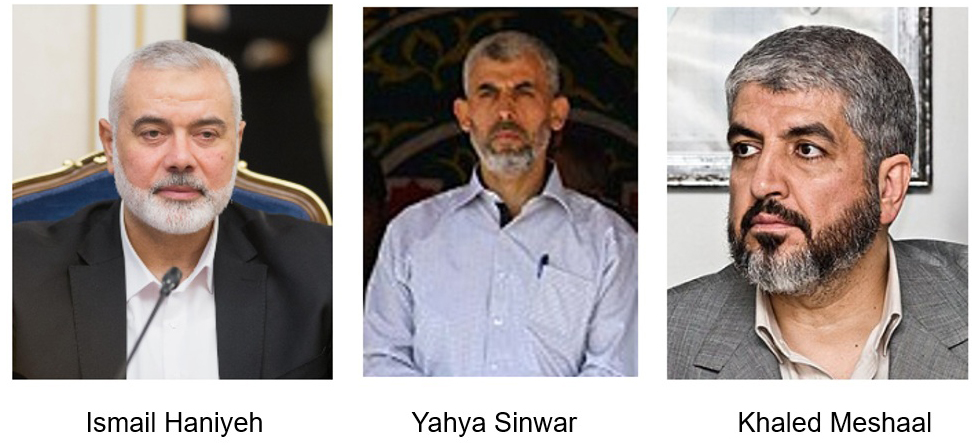
Three Hamas leaders and assassination targets
The parallel of Nelson Mandela
Marwan Barghouti remains convicted of killing and injuring Israeli civilians, with five consecutive life sentences. Unlike PM Netanyahu’s hard-right Likud, Israeli peace activists and leaders have seen him as a moderate who is trusted by Palestinians and could play a role in peace talks.
The Palestinian leader has lived a significant part of his 23 years of incarceration in solitary confinement. The 66-year-old Barghouti, who was Fatah’s charismatic young leader in the occupied West Bank prior to his imprisonment, is one of nearly 10,000 Palestinian prisoners languishing in Israeli prisons.
Born near Ramallah into the influential clan, Barghouti joined Fatah at 15, became the co-founder of its youth movement, was first sentenced at 18 and gained fluency in Hebrew while in prison. After studies in Birzeit University, he became one of the Palestinian leaders in the West Bank amid the First Intifada. During the uprising, he was arrested and deported to Jordan for incitement but eventually permitted to return, thanks to the Oslo Accords.
In the aftermath of the 1996 election to the Palestinian Legislative Council, he began to push for the creation of an independent Palestinian state. Campaigning against corruption in Arafat’s administration and human rights violations, Barghouti established relationships with a number of Israeli politicians, authorities and members of the peace movement. When the Camp David summit failed to bring about the peace deal, Barghouti became disillusioned.
Providing tacit support to Hamas, Netanyahu cabinets’ goal became to undermine PLO’s popular young leaders such as Barghouti, while supporting their older, compromised incumbents. Hence, the first Israeli effort to blow Barghouti to pieces in a missile attack. According to Israeli security sources, there were several attempts to assassinate Barghouti. After that failure, the IDF hoped to neutralize the leader Western media called “Palestine’s Nelson Mandela.”
Typically, the international campaign to free Marwan Barghouti and all Palestinian prisoners was launched in 2013 from Nelson Mandela’s former prison cell on Robben Island. As Barghouti wrote about his hunger strike in New York Times at the time: “Rights are not bestowed by an oppressor… Only ending occupation will end this injustice and mark the birth of peace.”
Following Israel’s devastating 2014 Gaza War, Barghouti urged the Palestinian Authority to immediately end security cooperation with Israel and called for a Third Intifada. Today, he is seen as a viable Palestinian leader even by the European Union. Unlike any other incumbent Palestinian leader, Barghouti could bring Palestinian people together in an enduring peace deal, a process that China’s intermediation made more viable in summer 2024.
Likud supporters and the Messianic far-right do not want a unified Palestinian front. In February 2024, amid the Israel-Hamas war, when Hamas called for Barghouti’s release, he was placed in solitary confinement.
Keep hope alive, or else…
When Marwan Barghouti was imprisoned in 2002, he did not have a fair trial nor was the evidence persuasive. Through two decades, he has held his head high and, against all odds, tried to advocate a constructive, peaceful solution between Israel and the Palestinians. Ever since October 2023, he has been beaten several times by the prison guards, held in solitary confinement and he has not seen his family. In the past year, the brutal assaults have been intensified.
Why this horrible, inhumane torture? Because Barghouti continues to have a huge political clout. The Israeli cabinet is afraid of him because he can do what Prime Minister Netanyahu has struggled against since the late 1990s: he can unify the Palestinians, as Nelson Mandela once united the anti-apartheid movement in South Africa.
In a brief video circulated in August, Israel’s far-right minister Itamar Ben-Gvir threatened the frail-looking Marwan Barghouti inside the infamous Ganot prison, known for its repressive measures, assaulting detainees and tightly shackling them.

Marwan Barghouti in 2001 and threatened by Minister Ben-Gvir in 2025
Barghouti gives the Palestinian cause and resistance leadership, direction and integrity. To those Palestinians (and Israelis) who seek for peace, he gives hope.
If that hope dims, the net effect will be violent.
The author of The Obliteration Doctrine (2025) and The Fall of Israel (2024), Dr Dan Steinbock, a strategist of the multipolar world, is the founder of Difference Group and has served at the India, China and America Institute (US), Shanghai Institute for International Studies (China) and the EU Center (Singapore). For more, see https://www.differencegroup.net/.