I found myself talking with a rather prominent journalist in Washington the other night. The subject was the war in Iraq and in Afghanistan. And COIN — counterinsurgency imagined and inculcated as the new (Petraeus) Doctrine, the new field manual, the new heroic battlefield narrative, made entirely so because of the 2007-2008 Surge operations in Iraq.
It’s population-centric counterinsurgency that clears, holds and builds, while winning hearts and minds, turning local populations against the bad guys and building up civic institutions and the legitimacy of the central government. Certainly not new theory, but dusted off and tweaked by Gen. David Petraeus & Co. for the Army’s new field manual released in December 2006, dovetailing conveniently with the Surge plan crafted by the neoconservatives at the American Enterprise Institute (and ultimately appropriated by the Bush Administration) in the same month.
Today, it is the blueprint du jour for President Barack Obama’s inherited Long War, in fact, supporting it is a litmus test for one’s position and status in his national security apparatus.
So what? — the journalist seemed to suggest, looking incredulous that there was even a hint of drama here. The Surge was a success, how could there be anyone or anything to legitimately take on the bright lights of the COIN constellation now orbiting the President? Players like Michele Flournoy, undersecretary of defense for policy at the Pentagon and Kurt Campbell, the co-founder of their think tank, Center for a New American Security (now a greased-up policy feeder for the administration). He’s been nominated by Obama to become the Assistant Secretary of State for East Asian Affairs.
As a reporter myself, I was a bit nonplussed. A quick Google search would find that there is indeed an energetic debate — not only about the aforementioned "COINdinistas," now shaping policy for "Af-Pak," but more importantly, about the validity of COIN and of the vaunted Surge itself.
Hadn’t you heard of Gian Gentile?
He shook his head.
He’s active duty. He’s West Point, I pressed on. He’s at the forefront of this pushback against COIN.
The journalist shook his head. He let me write down Gentile’s name. Looking skeptical, he moved on.
It really shouldn’t be a surprise, that members of the elite news media — particularly the ones who don’t necessarily focus on a national security beat — fasten easily onto the conventional narrative and "move on" condescendingly, satisfied their knowledge is au courant and complete.
Army Colonel Gian Gentile just doesn’t fit into their equation, though his name is known well enough, if only at the U.S Military Academy, military journals, critical foreign policy webzines like Antiwar.com, and as a foil and vexation for the COIN-centric blogs, the doctrine’s biggest promoters, like Small Wars Journal and Abu Muqawama (a moniker for Andrew Exum, Iraq war veteran and senior fellow at Flournoy’s CNAS).
To the rest of the world, the mainstream media included, Col. Gentile is kind of a ghost. Persistent and clever, sometimes noisome and everywhere. That he might remain invisible to people inside-the-beltway is only a problem in that information gatekeepers like the aforementioned journo, craft narratives about the war — about future wars — without the consistent insight of the contrary view. As consumers of the news — as Americans — we should demand the whole scoop.
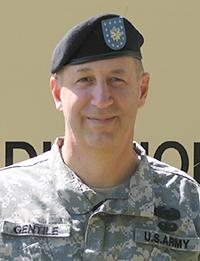
The scoop is that Gentile, a 51-year-old former cavalry squadron commander in Iraq, now director of the military history division at West Point, has been putting his job in the Army on the line everyday, doing interviews with people like me, questioning the emerging historical record on the War in Iraq, the Surge and COIN. He challenges the historical pretexts used to merchandise and sell COIN, particularly by chief operators like retired Lt. Col. John Nagl (formerly with Sec. Def. Donald Rumsfeld, now president of CNAS). He throws cold water on the inescapable panegyrics to Petraeus and Gen. Ray Odierno (see Tom Ricks, a senior fellow at CNAS and a Washington Post military correspondent).
He warns that under the current influence of these "crusaders" (as tagged by Professor Andrew Bacevich back in October 2008), the military is shifting headlong and too far into COIN, bleeding the conventional force in favor of what he fears is a institutionalized role of global security change agents, nation-builders and cops.
He says the emperor has no clothes.
"I try to apply an historian’s sensibility to problems and in my writing, to make arguments based on the evidence available," he tells Antiwar.com. "When I got back from Iraq, there wasn’t much ‘otherwise thinking’ going on. There wasn’t much questioning of the direction we were heading. One can end up with this group think approach."
Gentile has written extensively about why the Petraeus Surge narrative has become both a symbol and byproduct of group think, and is now seemingly impenetrable thanks to a growing canon of after-action literature that place the "success" of the operation squarely on clear, hold and build — including of course, more boots on the ground.
"First of all, that didn’t happen in Iraq. But you pick up any number of books," he said, "they basically accept the standard Iraq War narrative." Which is, in short: before 2007, the Army didn’t prepare or focus on counterinsurgency. The Army finally sees the light, and wielding the updated counterinsurgency manual (FM 3-24) (co-written by Petraeus, with the aid of officers like Nagl), leads five additional brigades "surging" into Baghdad and pursuing new COIN principles in Al Qaeda strongholds. Violence is reduced to acceptable levels, providing "space" for political reconciliation.
First of all, Gentile says, "it places too much emphasis on the role of the additional brigades, armed — the narrative goes — with the new COIN doctrine," said Gentile.
Aside from the sectarian cleansing in Baghdad — where the few remaining Sunnis now live walled off, and in tiny urban enclaves — Gentile zeros in on what he believes were the two critical events that made the real reduction in violence happen. First, Muqtada al Sadr’s decision to stand down his rebel forces in the summer of 2007. Second, the U.S Army’s decision to start paying off some 90,000 Sunni militiamen and former insurgents to turn against al Qaeda.
"In my opinion, the two necessary and controlling reasons for lowering the violence in Baghdad in the second half of 2007 had little to do with the increased number of U.S. combat brigades practicing so-called new counterinsurgency tactics," Gentile said in an interview a year ago.
He hasn’t changed his mind. Instead, he’s spent the last 12 months arguing his points, and taking quite a few personal hits along the way. Most publicly, in Thomas Ricks’ much-celebrated, The Gamble: General David Petraeus and the American Military Adventure in Iraq, 2006-2008, the author takes aim at Gentile by throwing into question his command in West Baghdad in 2006 (indeed, Gentile has argued that the Army was already adapting and practicing counterinsurgency methods on a general basis long before the Petraeus Brain Trust moved in. Ricks’ book clearly disputes this).
"Certainly, I have received pushback from other forums, and other media," Gentile says. "The Gamble, the way (Ricks) wrote about me and my squadron in 2006, I think it was a direct pushback against me for being critical of the counterinsurgency doctrine and the sort of triumphal narrative that has emerged over the last year or so."
Gentile’s own attacks against COIN standard-bearers have been both withering and precise. In his counterpoint to Nagl’s "Let’s Win the Wars We’re In" for the current Joint Force Quarterly:
"Retired Army lieutenant colonel John Nagl, author of Learning to Eat Soup with a Knife, is so cocksure of the efficacy of Army combat power that he believes it will have the ability not only to dominate land warfare in general but also to ‘change entire societies’… We are organizing ourselves around the principle of nationbuilding rather than fighting. For defense thinkers such as Nagl, that principle has turned into a synthetic consensus. To repeat, how else can one explain his most profound and deeply troubling statement that the Army, in the future, will have the capability to ‘change entire societies’? In this sense, the caricature of Nagl as a ‘crusader’ seems correct."
For his part, Nagl has not backed down. "We need the ability to kill people and break things with our Army, absolutely. But we also need, in this modern era, we need an Army that can protect people and build things. And what we’re doing is looking for the right balance between those two," he told PRI’s The World radio program earlier this month.
Velvety smooth, and hardly unpalatable to an American public with no more appetite for blood and bombs, say critics, but it cannot perfume the stinky reality that this is Bush Doctrine, with a few new liberal bells and whistles, all over again.
"Gentile is one of the few officers with the guts and brains to tell the truth at a time when the truth is very unpopular," says Ret. Army Col. Douglas MacGregor, another dissident voice in the beltway wilderness. Like Gentile, he struggled to be heard during the Bush years against the preponderant neoconservative din. Today, it is the liberal interventionists, mostly Clinton-era throwbacks with a taste for nation building from the Balkan Wars. "Sadly, men like Gentile are currently in short supply."
Gentile became a commissioned officer through the ROTC program at UC Berkeley in 1986, and received his masters and PhD from Stanford University after three years in the field in Germany and Korea. While teaching at West Point, where he says "academic freedom really does mean something," he frequently dusts it up on the milblogs, where he is alternately excoriated and saluted, if not a bit patronized, even by his friends.
"Now here’s a question: Isn’t there anyone other than Gian Gentile willing to take up the anti-COIN crusade? Where is everyone else? I want to ask him that when he visits the 202 area code in the next few weeks," wrote Abu Muqawama, aka Exum, back in January.
But public sentiment may be shifting closer to Gentile and MacGregor, as current events — foreign and domestic — threaten the durability of the Surge success story and the open-ended military and civilian commitment Obama’s policymakers are setting up for Pakistan and Afghanistan.
"I don’t think the fundamental issues that have divided (Iraq) have been resolved. I think what we have done over the last year is frozen those issues in place, but we haven’t resolved them," Gentile charges. "I think, what you are seeing with the increasing attacks today, are the emergence of those differences again," he said. Pointing to recent reports that the Sunni Awakening, now abandoned by the Americans to the hostile Shia authority, are becoming restive, he said, "I think there may be some cooperation there — some cooperation between Sunni and al Qaeda elements there."
Deny it they may, says Gentile, but today’s policymakers are promoting a similar Surge strategy for Afghanistan (See congressional testimonies by Flournoy and Chief Af-Pak envoy Holbrooke this week: clear, hold and build, with more boots on the ground, more civilian experts, more COIN). As an active duty officer, Gentile won’t question current plans outright, but he left me with this:
"As soldiers, our role is to do whatever we are told to do by our civilian masters. However, my experience is, that the idea of using military force to change entire societies — to use John Nagl’s words — at the barrel of a gun, is highly problematic and it is not as clean and as clear and as sensible as I think our own COIN doctrine makes it seem to be," he said. "I saw what it is like changing the entire society at the barrel of a gun in Baghdad in 2006, it wasn’t as simple."
Gentile laughed when he thought of the ribbing he might get among the COIN-set, being interviewed by a site with the name "Antiwar." Ultimately, he doesn’t care. He is driven by a sincerity his detractors cannot touch, and a personal mission not to let current war doctrine go unchallenged. He might just have a ghost of a chance.