Reprinted from Andy Worthington’s website.
In the Gaza Strip, the remaining Palestinian population, who have survived two years and three months of the most diabolically well-publicized and even relentlessly celebrated genocide in history, which is still ongoing, albeit at a slower pace than before, are squeezed into just 42% of their homeland — 60 square miles in total, less than the size of Washington, D.C.
The rest, the other 58%, has been occupied by Israeli forces since a ceasefire was declared on October 10, when they withdrew to an arbitrary “Yellow Line” that was meant to be temporary, a phase in a staged withdrawal from the whole of the Gaza Strip, but which is regarded by the occupiers as a new and permanent border with Israel.
Under the terms of the ceasefire deal, which was mainly negotiated by Qatar, Egypt and the US, although Donald Trump, predictably, made it all about himself, even staging a “Peace Summit” in Egypt to which world leaders were invited to fawn over him, Israel was prevailed upon to stop its relentless bombing raids, and its ongoing and merciless ground invasion of Gaza City, in return for the immediate release of all the surviving Israeli hostages seized on October 7, 2023.
This was a considerable achievement, given how enthusiastically Israel had sunk into relentless genocidal depravity over the previous seven months since it deliberately broke the terms of an earlier ceasefire deal at the start of March, resuming its slaughter of Palestinians with horrific brutality.
However, although the death toll has dropped over the last three months from a daily average of somewhere between 60 and a hundred Palestinians, Israel has never honored the ceasefire in any meaningful sense, and has continued to break its terms on an almost daily basis, killing at least 465 Palestinians and injuring 1,287 since October 10.
In addition, Israel has resolutely refused to allow the unimpeded access into Gaza of 600 trucks a day of humanitarian aid, as stipulated in the ceasefire deal, including desperately needed shelter, medical supplies and medical equipment, as well as food and fuel, all very deliberately to try to ensure that the Palestinians will continue to die in significant numbers, as though the latest confirmed death toll of 71,548, with 171,353 injured, many grievously so — and itself a massive undercount — is still insufficient to placate its incessant bloodlust.
Israel is perpetually triggered by a refusal to recognize that the 1,200 or so people killed in the October 7 attacks on southern Israel cannot be perpetually obsessed over as the victims of an unprovoked day of horror, entirely unconnected to the previous 75 years of Israel’s genocidal ethnic cleansing and dispossession of the Palestinians from their own land, and their relentless oppression and arbitrary imprisonment. Nor too, can they realistically be allowed to demonstrate a callous indifference, almost beyond belief, to the catastrophic death toll in Gaza over the last 27 months, which dwarfs the death toll on October 7 to a sickening degree.
A welcome for the creation of the Palestinian National Committee for the Administration of Gaza
On January 14, Steve Witkoff, Donald Trump’s Special Envoy, declared “the launch of Phase Two of the President’s 20-Point Plan to End the Gaza Conflict, moving from ceasefire to demilitarization, technocratic governance, and reconstruction.”
Under the terms of the “Peace Plan” agreed at the start of October, and approved by the UN Security Council in November, the second phase was meant to involve the establishment of a Palestinian Technocratic Committee to oversee the day-to-day administration of Gaza, although the committee itself was to be made deliberately subservient to an international “Board of Peace” presided over by Trump himself.
Also envisaged was an International Stablilization Force to maintain security, while the long-term future of Gaza’s governance was meant to eventually be entrusted to the Palestinian Authority, at some undetermined point when it had undertaken an undefined process of “reform.”
The problems with this scenario were many. The Palestinian Authority is already, and accurately regarded in Gaza as a toothless collaborator in Israel’s illegal occupation of the West Bank, and any “reform” would, therefore, only be intended to make it even more toothless and subservient, rather than asserting the rights of the Palestinians in Gaza, and acting robustly on their behalf.
As even more glaring omission, however, concerned the role of Hamas, the de facto government of Gaza, who, in conjunction with Gaza’s other Palestinian factions, only agreed to the first phase of the ceasefire deal in October on the basis that negotiations regarding its proposed disarmament, and the handing over of power, would be negotiated during the second phase, and not before.
In candid interviews with Drop Site News (which I covered here), Hamas and other Palestinian faction leaders stressed that disarmament would only be contemplated if there were to be some sort of unbreakable guarantee that Israel would not be free to resume its genocidal assault on Gaza, which was completely understandable. The leaders also declared that they were perfectly amenable to a transfer of power, but only to a new system of governance run entirely by Palestinians.
Two days after Witkoff’s announcement of Phase Two of the “Peace Plan”, the White House issued a statement that carefully sought to put the main focus on “the formation of the National Committee for the Administration of Gaza (NCAG)”, the formal name for the Palestinian Technocratic Committee, consisting of 15 Palestinian technocrats under the leadership of Dr. Ali Shaath, a civil engineer, born in Khan Younis in Gaza, but now based in the West Bank, who was formerly the Deputy Minister of Transportation of the Palestinian Authority.
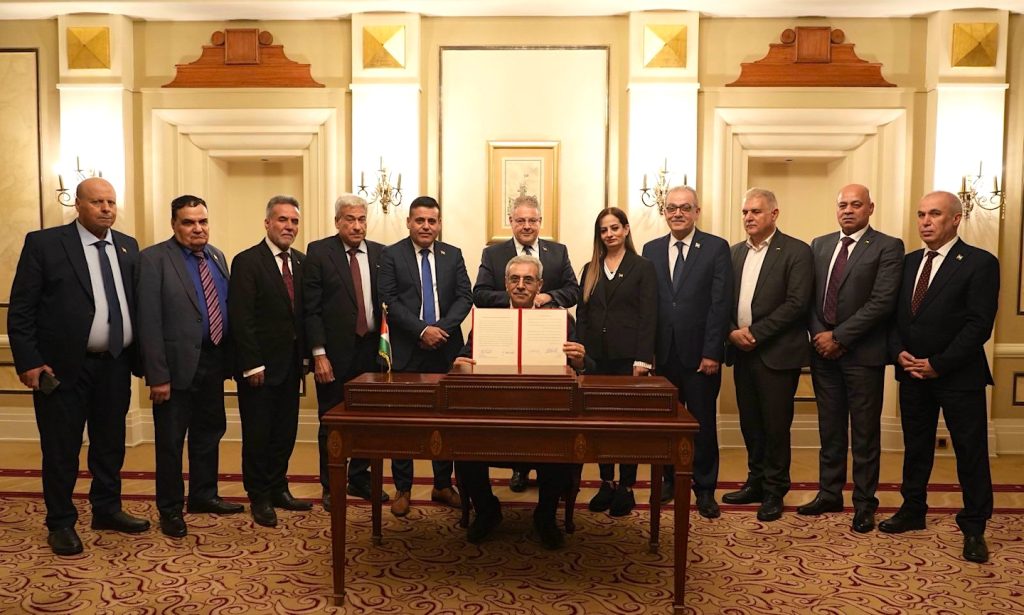
The National Committee for the Administration of Gaza (NCAG) at its inaugural meeting in Cairo on January 15.
The White House described him as “a widely respected technocratic leader”, who will “oversee the restoration of core public services, the rebuilding of civil institutions, and the stabilization of daily life in Gaza, while laying the foundation for long-term, self-sustaining governance”, adding that he “brings deep experience in public administration, economic development, and international engagement, and is widely respected for his pragmatic, technocratic leadership and understanding of Gaza’s institutional realities.”
The other members of the committee are also originally from Gaza, and, like Dr. Shaath, seem mostly to be individuals with long professional careers. When he announced the names on January 17, Dr. Shaath said that the committee had “adopted Egypt’s reconstruction and recovery plan for Gaza as the basis of its work”, which was “launched in Cairo in March and adopted by the Arab League and the Organization of Islamic Cooperation (OIC)”, and had been “welcomed by several international actors, including the EU.”
He said that the plan ”begins with an emergency shelter phase, providing temporary housing until homes destroyed in the Israeli onslaught are rebuilt”, noting that the current tents “are inadequate and prefabricated housing units need to be brought in through the Rafah Crossing under a coordinated plan with Egypt.”
“Opening the crossing”, he added, “tops the committee’s priorities” and he called it “Gaza’s most vital lifeline for humanitarian aid, essential goods and civilian movement.” In addition to providing shelter, the committee’s immediate work would also involve “restoring basic services, particularly health and education.” He explained that discussions were underway “to deploy field hospitals and medical teams from Egypt, Palestine and other Arab countries and to evacuate 20,000 wounded Palestinians for treatment abroad.”
In a statement issued on behalf of the newly-formed committee on January 18, Dr. Shaath said, “We are committed to establishing security, restoring the essential services that form the bedrock of human dignity such as electricity, water, healthcare, and education, as well as cultivating a society rooted in peace, democracy, and justice”, adding that the committee will “embrace peace, through which we strive to secure the path to true Palestinian rights and self determination.”
There is no reason to doubt the sincerity of the committee, or its aspirations, and it is reassuring that Hamas announced on January 11 that it would “dissolve its existing government in Gaza once a Palestinian technocratic leadership committee takes over the territory”, as, under its senior negotiator, Khalil al-Hayya, it prepared to “meet with other Palestinian factions” to “finalize the committee’s formation.”
On January 19, the heads of prominent Palestinian families and clans within Gaza also “publicly endorsed” support for the committee, at “a large solidarity gathering at Al-Aqsa Martyrs Hospital in Deir al-Balah.” As the Daily Sabah described it, “Alaa al-Din Al-Aklouk, head of the Families’ Gathering, described the committee’s formation as a ‘pivotal national milestone’ born out of intense regional and international engagement”, although he added that its task was “enormous”, involving “shattered infrastructure, mass displacement, entrenched poverty and widespread hunger” after 27 months of Israel’s genocide.
Al-Aklouk “urged immediate humanitarian action, including debris removal, emergency relief and the launch of a serious recovery and reconstruction process to restore dignity and hope to Gaza’s residents”, also noting that the families and clans “were prepared to provide ‘all possible forms of assistance’ and serve as a form of popular oversight to ensure transparency and effectiveness.”
Hosni Al-Maghni, the head of the Palestinian Clans Committees, echoed Al-Aklouk’s message, calling support for the committee a “final opportunity that must not be squandered”, and describing the clans’ role as a “safety valve” that can “ease social tensions while helping rebuild communities left without shelter.”
Al-Aklouk also warned, however, that “political rivalries could derail the effort”, and called for “a broad political umbrella to protect the committee’s work”, also stressing that the committee should only “be treated as a temporary framework”, amid “renewed calls for rebuilding Palestinian legitimacy through comprehensive elections.”
Palestinian autonomy is, however, buried under two layers of neo-colonial management
While all of this is positive news, the most glaring problem with all of the Palestinians’ aspirations is that whatever power and authority the committee will have is entirely subservient to not one, but two layers of neo-colonial governance, dominated, in the top tier, the “Board of Peace”, by Americans, and in the second, the “Gaza Executive Board”, by a mixture of Americans and representatives of the various Middle Eastern countries involved in the long negotiations for an end to Israel’s genocide in Gaza.
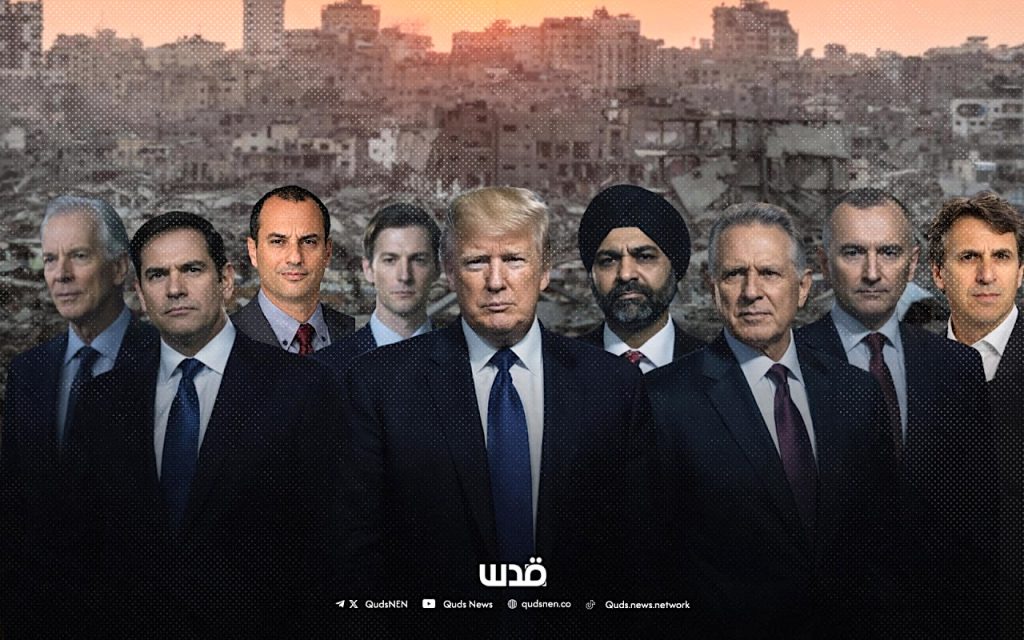
Trump’s “Board of Peace”; an image via the Quds News Network.
The chair of the “Board of Peace” is Donald Trump, described as “asserting direct political authority over Gaza’s post-war framework while framing the project as a US-led peace, reconstruction, and demilitarization initiative”, while the other seven members of the Executive Board are the US Secretary of State Marco Rubio, Trump’s envoy Steve Witkoff, his son-in-law Jared Kushner, Marc Rowan, the US billionaire CEO of Apollo Global Management, Ajay Banga, the Indian-American President of the World Bank and Robert Gabriel Jr., the US Deputy National Security Advisor and Assistant to the President for Policy. The only non-American is former UK Prime Minister Tony Blair, still mainly remembered as a war criminal for his role in the illegal invasion and occupation of Iraq in 2003.
Two more Americans are senior advisors to the “Board of Peace” — US businessman and rabbi Aryeh Lightstone, implicated in the establishment, last year, of the reviled Gaza Humanitarian Foundation, which purported to replace established aid agencies in Gaza, including the UN, but which was notorious for what Médecins Sans Frontières (MSF) described as a “system of institutionalized starvation and dehumanization”, and the “orchestrated killing” of Palestinian civilians, and Josh Gruenbaum, a Trump advisor “who authored the Gaza reconstruction plan”, according to Axios.
When it comes to the “Gaza Executive Board”, there is some overlap. Steve Witkoff, Jared Kushner, Tony Blair and Marc Rowan are all included, as are representatives of the governments of Qatar, Egypt, Turkey and the UAE — as Drop Site News described them, Ali Al-Thawadi, a Qatari official “linked to mediation efforts, reconstruction funding, and Gaza aid coordination”, Hassan Rashad, a senior Egyptian intelligence official “involved in ceasefire enforcement, border control, and security coordination”, Reem Al-Hashimy, the UAE minister of state for international cooperation, “overseeing Emirati aid and development engagement”, and Hakan Fidan, Turkey’s foreign minister and former intelligence chief.
Also included are Nickolay Mladenov, a Bulgarian and the former UN Special Coordinator for the Middle East Peace Process, who has been appointed as the horribly colonial-sounding “High Representative for Gaza”, and who will, apparently, serve as “the on-the-ground political liaison between the Board of Peace and Gaza’s interim administration”, as well as Sigrid Kaag, a former Dutch politician and, since January 2025, the current UN Special Coordinator for the Middle East Peace Process, who has “extensive experience coordinating humanitarian operations in Gaza and the region”, and Yakir Gabay, a Cypriot-Israeli businessman “connected to infrastructure, energy, and real estate ventures.”
An additional appointment is Jasper Jeffers, a US Major-General “appointed to command a proposed multinational force tasked with security, demilitarization, and protection of aid and reconstruction flows.” However, as this “proposed multinational force” has not emerged over the last three months, this aspect of Gaza’s potential future doesn’t need much scrutiny at present, especially as the US continues to maintain that it will not be assigning any US soldiers to any kind of active duty in Gaza.
However, all the alarm bells set off by the majority of the appointments to the “Board of Peace” and the “Gaza Executive Board” are worth heeding. No one should forget that, last February, when Trump welcomed Benjamin Netanyahu to the White House, he surprised everyone — including, it seems, Netanyahu himself — by suggesting that the US would take over the Gaza Strip and turn it into “the Riviera of the Middle East.”
The presence of Witkoff, Kushner and Yakir Gabay, all involved in real estate, as well as all the other individuals involved in international finance, suggests that Gaza’s would-be neo-colonial overseers are only really interested in Gaza as a real estate and business opportunity. This was also made clear in the White House statement on January 16, which referred to each Executive Board member’s role as overseeing “a defined portfolio critical to Gaza’s stabilization and long-term success, including, but not limited to, governance capacity-building, regional relations, reconstruction, investment attraction, large-scale funding, and capital mobilization.”
As the Gaza-based political analyst Iyad al-Qarra told Al Jazeera, the structure of Trump’s three-tier governance model for Gaza reflects a “corporate takeover” of the Palestinian cause. “Trump treats Gaza not as a homeland, but as a bankrupt company in need of a new board of directors,” he said, adding, “He has placed the strategic decision-making in the hands of investors and foreign politicians, turning sovereignty into a commercial venture.”
Israel, sidelined, responds with threats and obstruction
Perhaps even more significant than Trump’s neo-colonial ambitions is what appears to be his general indifference to Israel’s position on Gaza, despite so many of his appointees being Jewish.
Already, the fault lines are becoming readily apparent, as senior Israeli government officials have been responding to Trump’s plans with criticism ranging from the diplomatic to expressions of belligerent fury.
On the diplomatic front, Netanyahu condemned the inclusion of Qatar and Turkey in the “Gaza Executive Board”, with his office publicly stating that the announcement “was not coordinated with Israel and runs counter to its policy”, and adding that Netanyahu had “instructed the Foreign Minister to raise this matter with the US Secretary of State.”
According to Axios, a senior US official responded by rebuking Netanyahu, saying, “This is our show, not his show. We managed to do things in Gaza in recent months nobody thought was possible, and we are going to continue moving.”
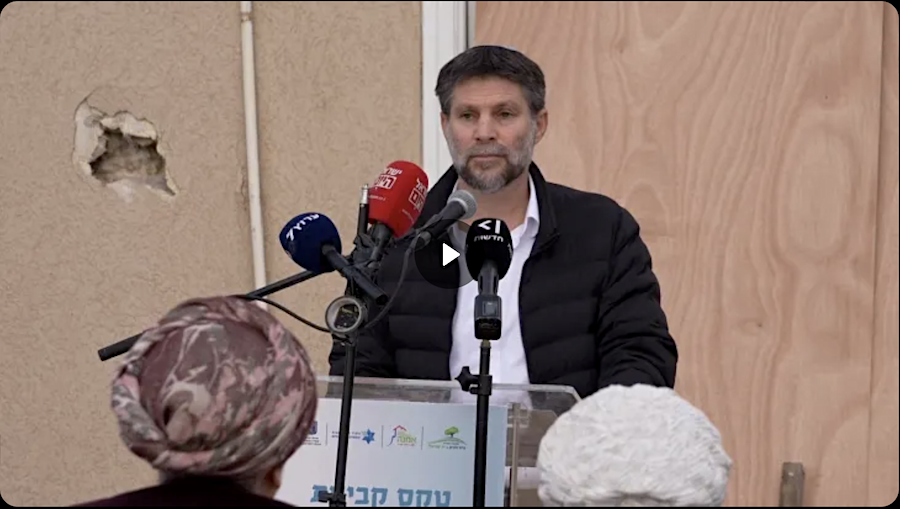
A screenshot of Bezalel Smotrich condemning Donald Trump’s plans for Gaza on January 19.
Elsewhere, however, Bezalel Smotrich, the far-right settler minister who is obsessed with Israel taking over the whole of the Occupied Palestinian Territory, and removing all the Palestinians, either through extermination or through the chimera of “voluntary emigration”, issued a fiery condemnation of the US’s actions in a speech at the inauguration of a new — and illegal — Israeli settlement in the occupied West Bank.
“Gaza is ours, and its future will affect our future more than anyone else’s,” he said, adding, “Therefore, we must take responsibility for what happens there, impose a military government and complete the mission.”
He also called for the closure of the US base in Kiryat Gat in southern Israel, the Civil-Military Coordination Centre, where, since the ceasefire began in October, personnel from around 60 states and organizations have been working on US-led plans for Gaza’s future.
Smotrich insisted that the Israeli government “must explain to Trump that his plan is bad for the State of Israel and cancel it”, adding, “The time has come to dismantle the headquarters in Kiryat Gat”, a move that, he added, would also enable Israel to remove representatives from “countries like Egypt and Britain that are hostile to Israel and undermine its security.”
His reference to the UK, in almost all respects a staunch supporter of Israel’s genocide, was in response to sanctions imposed on Smotrich and his fellow far-right minister Itamar Ben-Gvir last year by the UK and other countries for “repeated incitement of violence against Palestinian civilians” in the West Bank.
Today, Israel’s latest efforts to undermine the US-led plans for Gaza have involved blocking the members of the National Committee for the Administration of Gaza from entering Gaza to begin their work. As Haaretz reported, the committee members were “set to enter the enclave and assert administrative control by the end of the week”, with the cooperation of Hamas, but were prevented from doing so as Israel still refuses to reopen the Rafah Crossing, even though that was also a requirement of the October ceasefire deal.
In addition, Trump himself has now waded in to damage what remains of his own strained credibility — after the recent debacles involving Venezuela and Greenland, as well as his war on the people of Minneapolis — by suggesting that the “Board of Peace” should expand beyond Gaza to become a rival to the UN, presided over by himself, as a kind of world king for life, and with prospective members being urged to pay him £1bn for the privilege of joining.
Despite all of the above, it can only be hoped that, for the Palestinian people themselves, caught between Israel, which still wants to kill them all, and the US, which, fundamentally, regards them as either peripheral or irrelevant to its neo-colonial ambitions, the establishment of the Palestinian committee will not be entirely toothless, and that it will not end up, as the Palestinian researcher Jihad Harb fears, being under “international trusteeship” instead of securing self-determination.
Closer to hand, the biggest problem ahead may be the question of Hamas’s disarmament and Israel’s further withdrawal from Gaza. As The New Arab reported on January 18, although Phase Two of the “Peace Plan” “requires Israel to withdraw from Gaza’s southern and eastern border areas and large parts of the north”, this is “a step which Israel’s Channel 12 reported will not be implemented unless Hamas is completely disarmed within two months.”
Political and security sources told Channel 12 that “Israel insists that the disarmament of Hamas is not merely a declaratory goal, but a binding condition for any political or civilian progress in the Gaza Strip.” They claimed that “Israel will retain full control over defining disarmament — the criteria, how it is verified, and what constitutes genuine dismantlement of weapons”, and added that “Israel stresses that it will not accept partial disarmament or a symbolic step, and that there will be no withdrawal from the Yellow Line as long as Hamas retains military capabilities.”
Will Trump agree, or will some sort of sanity prevail? What is certain is that the Palestinians of the Gaza Strip are in no position to endure a further resumption of genocidal hostilities on the part of Israel, whose moral sickness ought, by now, to have become apparent to everyone who, 27 months ago, rallied to support its claimed “right to defend itself”, apparently not realizing that what that meant was the “right to defend itself” from the very existence of the Palestinian people.
More than anything, a resumption of Israel’s “hostilities” cannot be allowed.
Andy Worthington is a freelance investigative journalist, activist, author, photographer (of a photo-journalism project, ‘The State of London’, which ran from 2012 to 2023), film-maker and singer-songwriter (the lead singer and main songwriter for the London-based band The Four Fathers, whose music is available via Bandcamp). He is the co-founder of the Close Guantánamo campaign (see the ongoing photo campaign here) and the successful We Stand With Shaker campaign of 2014-15, and the author of The Guantánamo Files: The Stories of the 774 Detainees in America’s Illegal Prison and of two other books: Stonehenge: Celebration and Subversion and The Battle of the Beanfield. He is also the co-director (with Polly Nash) of the documentary film, “Outside the Law: Stories from Guantánamo”, which you can watch on YouTube here.
To receive new articles in your inbox, please subscribe to Andy’s new Substack account, set up in November 2024, where he’ll be sending out a weekly newsletter, or his RSS feed — and he can also be found on Facebook (and here), Twitter and YouTube. Also see the six-part definitive Guantánamo prisoner list, The Complete Guantánamo Files, the definitive Guantánamo habeas list, and the full military commissions list. Please also consider joining the Close Guantánamo campaign, and, if you appreciate Andy’s work, feel free to make a donation via PayPal or via Stripe.