Reprinted from Gary Taphorn’s Substack:
As we approach the three-year mark of the start of Israel’s genocide in Gaza, Israel has signaled that it has every intention of continuing its massive bombing campaigns against Gaza, Lebanon, Iran, and possibly other countries. And Donald Trump has signaled that he is ready to help. On September 15, the Washington Post reported a decision by the Trump administration to provide Israel with some 40,000 of the US Air Force’s massive 2,000-pound bombs, the largest such transfer to any country in many years.
Bombs Away for Zion
Specifically, the administration announced that it was prepared to “sell” to Israel a $2.8 billion package of US Air Force 2000-pound bombs, consisting of 20,000 MK-84 bombs and another 20,000 BLU-117 bombs. The two versions are similar in size, weight, and functionality. Although both models are considered “general purpose” and “dumb” bombs, they can be configured with various guidance kits into precision guided munitions, aka “smart bombs.” Presumably, Israel will use its own guidance kits which it produces domestically. The administration’s package for Israel also includes 20,000 of the USAF’s I-2000 penetrator warheads, which function as a heavy-duty bomb body for the MK-84 or the BLU-117, effectively converting the munition into a hard target penetrator or “bunker buster.”

Palestinians inspect damage at the site of an Israeli strike on a house at the Nuseirat refugee camp in the central Gaza Strip, December 12, 2024. REUTERS/Ramadan Abed
Israel’s profligate use of massive munitions on civilian populations has drawn international criticism since the opening weeks of the Gaza conflict. According to CNN, “In the first month of its war in Gaza, Israel dropped hundreds of massive bombs, many of them capable of killing or wounding people more than 1,000 feet away…. Satellite imagery from those early days of the war reveals more than 500 impact craters over 12 meters (40 feet) in diameter, consistent with those left behind by 2,000-pound bombs. Those are four times heavier than the largest bombs the United States dropped on ISIS in Mosul, Iraq, during the war against the extremist group there. Weapons and warfare experts blame the extensive use of heavy munitions such as the 2,000-pound bomb for the soaring death toll. The population of Gaza is packed together much more tightly than almost anywhere else on earth, so the use of such heavy munitions has a profound effect.”
“The use of 2,000-pound bombs in an area as densely populated as Gaza means it will take decades for communities to recover,” said John Chappell, advocacy and legal fellow at CIVIC, a DC-based group focused on minimizing civilian harm in conflict. Such massive bombs are “normally used sparingly by Western militaries, experts say, because of their potential impact on densely populated areas like Gaza. International humanitarian law prohibits indiscriminate bombing.”
Separately, a writer for the Concord Monitor has described the catastrophic effects of a MK-84 2000-pound bomb being dropped on a crowded residential area such as Gaza: “The detonation will create an instantaneous fireball that will lash out at temperatures exceeding 8,500 degrees Fahrenheit. The explosion will carve a crater 50 feet wide and 35 feet deep and hurl 10,000 pounds of rock and dirt debris at supersonic speed. The lethal radius will be a quarter-mile wide and will kill all the people within that area. But the destruction will not stop there. The bomb will rip through thick concrete and metal, creating a wider blast radius. The blast waves will be felt up to half a mile away, rupturing lungs and tearing off limbs. A single bomb will destroy entire city blocks.”
Israel regularly boasts about the professionalism of its military and likes to call the IDF the “most moral army in the world.” Its record in action tells a vastly different story. One curious decision by the IDF that apparently has never been challenged by the US is why it has opted for 2000-pound bombs against “soft” civilian targets, when 250-pound, 500-pound and 1000-pound munitions, which are readily available from the US, are far cheaper and cause far less collateral damage. Could it be that Israel’s real goal is simply genocide, a charge that it has claimed is unfounded
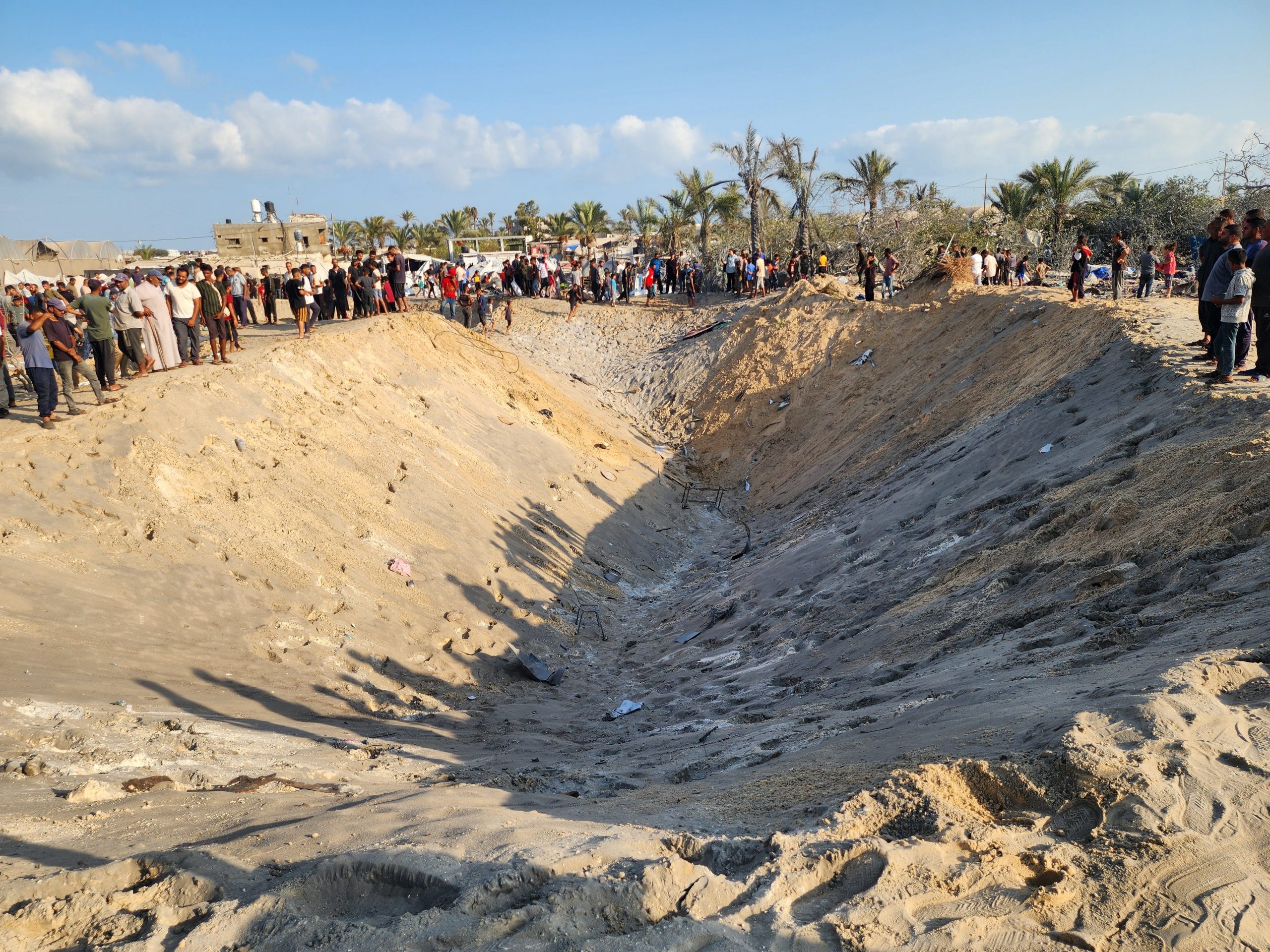
Palestinian civilians mourn the loss of at least 40 of their neighbors after the IDF dropped MK-84 bombs on their tent encampment in Khan Younis in the southern Gaza Strip in September 2024. Image from aa.com.tr.
The only possible advantage to the heavier bomb would be its deeper penetration into the ground where it could be more effective against the well-known Hamas tactic of digging tunnels. However, the IDF’s indiscriminate use of the heavy bombs, favoring them against almost all targets, says otherwise. For example, according to the Euro-Mediterranean Human Rights Monitor, a Geneva-based human rights group, Israeli warplanes dropped three US-made 2,000-pound MK-84 bombs on a Palestinian tent camp in a so-called “humanitarian safe zone” in southern Gaza in September 2024. The attack occurred after midnight, and buried members of about twenty families as they were sleeping (picture above). To say that this is “overkill” is putting it mildly. On the other hand, the bombs are free!
Budget Busting
Speaking of free bombs… the word “sell” (above) referring to US military transfers to Israel is standard terminology in the Foreign Military Sales (FMS) program. It allows the receiving country to use Congressionally appropriated funds (known as Foreign Military Financing or FMF) to pay for the transfer. In Israel’s case, its $3.3 billion in annual FMF (along with other US funding sources) means that the “sale” to Israel is actually paid for, not by the Government of Israel, but by American taxpayers. So not only is Israel laying waste to its neighbors virtually unchecked, but it is doing so at American expense. For a detailed look at the overall US costs for supporting Israel, see my Substack post of November 2025 entitled Israel’s Free Ticket to Regional Supremacy.
The level of US military aid to Israel, despite the ten-year memorandum of agreement which fixed it at a total of $3.8 billion annually, has exploded far beyond that since the start of hostilities in Gaza in 2023. Notably, in April 2024, President Biden signed a supplemental appropriations bill providing $14.1 billion of FMF to Israel. In 2025, the new Trump administration notified Congress of some $12 billion in potential sales to Israel. For 2026, through the month of July, another $7 billion was notified. And now, another $2.8 billion, specifically for heavy bombs. Interestingly, Prime Minister Netanyahu has floated the idea of weaning Israel off the military aid trough by 2028 and “re-orienting” the relationship so that the American and Israeli military-industrial complexes are essentially fused together. Such a catastrophic (and probably unconstitutional) proposal is now under consideration by Congress in the National Defense Authorization Act (NDAA) for 2027. (See my Substack post of July 2026 entitled Israel’s Plan for a Trojan Horse in the Pentagon). The constant resort to supplemental funding wildly beyond what has been agreed upon for years surely belies Netanyahu’s absurd assertion that Israel has “come of age.”
Bypassing the Congress
It is bad enough that budgetary planning constraints are being ignored by both the administration and the Congress. However, both the Biden and Trump administrations have already exacerbated the problem by claiming a presidential waiver permitted under Section 36 of the Arms Export Control Act. In exercising such a waiver, the president merely states that “an emergency exists” which requires the sale to be made immediately “in the national security interests of the United States.” In so doing, the president deprives Congress of a specified number of calendar days in which to review, debate, and potentially block or amend the proposed sale. Having invoked this waiver, the president (i.e., the executive branch) is free to proceed with the sale without further delay. Earlier this year, the Trump administration pushed through a sale of 35,500 2000-pound bombs to Israel by exercising that same presidential waiver. In such instances, the president must provide Congress at the time of the notification a “detailed justification for his determination, including a description of the emergency circumstances” that necessitated his action and a “discussion of the national security interests involved.” If the president does invoke the emergency waiver, Congress has one remaining card of its own to play. Specifically, it can enact a joint resolution of disapproval against the proposed sale, a truly last resort measure, which has never permanently succeeded in blocking a sale.
What’s Next?
However, according to Fox News, the administration has not yet decided whether it will invoke the waiver option again for the current sale of bombs. In any event, very few members of Congress want to be on record as opposing a military sale to Israel. Nonetheless, this is yet another example of the executive branch effectively circumventing Congress as it caters to Israel’s now three-year-long “emergency.”
A handful of lawmakers have spoken up in opposition to the proposal. According to NBC, Senator Chris Van Hollen (D-MD) said that he would work to stop the sale. “Donald Trump is sending bombs paid for by American taxpayers to a government led by a wanted war criminal — all while the Netanyahu government continues to bomb Gaza and Lebanon, and block justice and accountability for Americans killed on its watch,” he said. “This is not putting Americans first. We will work to stop it.” A similar statement came from Senator Bernie Sanders, who has led three unsuccessful attempts to stop recent arms sales to Israel. On the House side, Representative Gregory Meeks (D-NY), ranking member on the House Foreign Affairs Committee, also opposes the sale, despite his staunch pro-Israel record. Meeks has said the proposal raises “grave, unresolved concerns” about how the heavy bombs would be used in the densely packed neighborhoods of Gaza and Lebanon.
Meanwhile, in Washington, the House of Representatives has adjourned until after the November elections, as the re-election of its members takes priority — as always — over legislative issues. Should Trump opt to pursue the emergency waiver on the latest bomb sale, most lawmakers will no doubt be quietly delighted that they won’t be held accountable for a vote. Back in their districts, congressmen can feel free to wring their hands and deplore the violence in the Middle East while not antagonizing the Israeli lobby with a “no” vote on the sale. On the other hand, should the president not pursue the waiver, there will no doubt be much wailing and gnashing of teeth among lawmakers about their pending votes, which in any event would not occur until after the November elections. Even should the Democrats capture control of both houses of Congress, defeating the latest bomb sale to Israel is surely an uphill battle.
Summary
Israel’s international isolation continues to grow because of its actions in Gaza and elsewhere. Both governments and human rights organizations have condemned what is increasingly acknowledged as a genocide. Perhaps no single image has alienated more observers than that of a Palestinian neighborhood devastated by overwhelming Israeli airpower after IDF warplanes drop massive explosives on a helpless civilian community below.
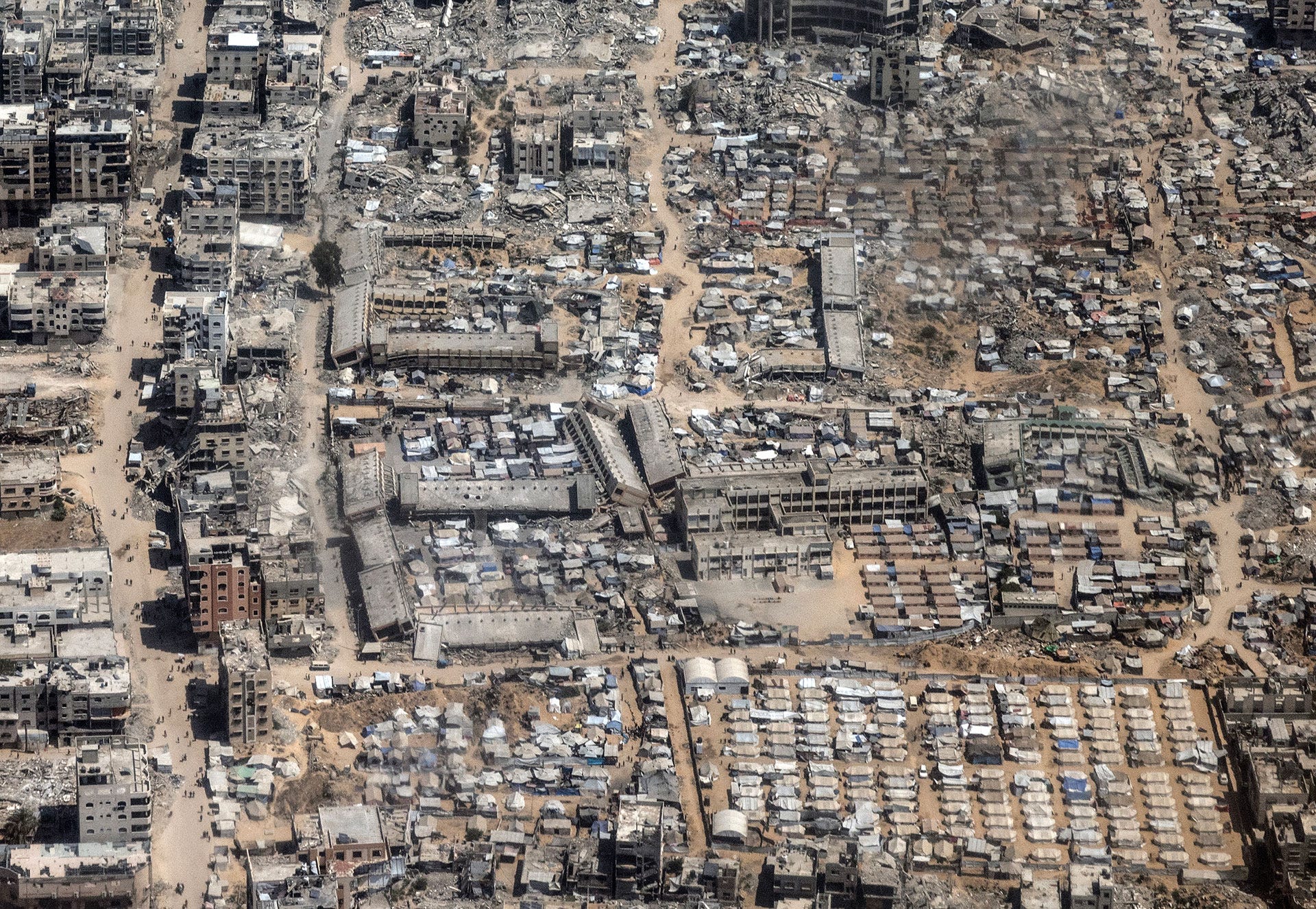
Photo of Gaza on July 30, 2025 showing an aerial view of destruction by IDF bombing, taken during a Royal Jordanian military flight for a humanitarian aid mission. (Photo courtesy of Brown University: Costs of War).
Gary Taphorn is a retired US Army lieutenant colonel with three tours of duty in the Middle East, as well as CENTCOM and the Pentagon. You can follow him at https://garytaphorn.substack.com/