Reprinted from Andy Worthington’s website.
962 days since Israel’s genocide in Gaza began, and 227 days since a ceasefire took effect through the implementation of the first phase of Donald Trump’s “Peace Plan”, Nickolay Mladenov, the Bulgarian former UN official who is now the “High Representative of Gaza” in Donald Trump’s “Board of Peace”, has alarmed those seeking a balance between Israel’s obligations under the ceasefire deal and an acceptable response by Hamas by telling the UN Security Council on May 21 that Hamas was the “principal obstacle” to the continued implementation of the next phase of the “Peace Plan” because “it refused to accept verified decommissioning, relinquish coercive control and allow a genuine civilian transition.”
Mladenov’s speech to the UN followed what Drop Site News, on May 22, described as a “15-point roadmap” that he delivered to Hamas in April, which “amounted to an ultimatum: If the Palestinian resistance does not surrender its weapons, no meaningful reconstruction will be permitted in Gaza and Israeli forces will not withdraw.” In his report to the UN Security Council, Mladenov described the total disarmament of Hamas and other resistance groups as “the single factor that unlocks every other element of the plan.”
As Drop Site News proceeded to explain, however, “disarmament was categorically not a part of the phase one deal signed by Hamas and Israel in Sharm El-Sheikh, Egypt in October 2025.” As they added, “Despite repeated claims by US and Israeli officials that Hamas agreed to all of Trump’s terms, [they] and other Palestinian factions did not sign an agreement beyond a ceasefire, exchange of captives, and an initial framework for the redeployment or withdrawal of Israeli forces from some parts of Gaza.” The limited deal, they added, “also included the opening of the Rafah border crossing with Egypt and the resumption of deliveries of life essentials and equipment to clear rubble and begin early reconstruction efforts.”
Israel continues to block the promised amount of humanitarian aid to Gaza
Noticeably, however, the promised delivery of humanitarian aid at a scale appropriate to sustain the beleaguered population has manifestly not emerged. 600 trucks a day were promised, but, instead, only an average of 95 trucks a day have been allowed in. Similarly, although Israel belatedly reopened the Rafah Crossing with Egypt in February, to facilitate the departure of patients in need of urgent medical care, and the return of those seeking to come back home, the numbers allowed have, as with the humanitarian aid, fallen far short of what was promised, and over 18,500 patients, including 4,000 children, are still in need of urgent medical evacuation.
Similarly, hospitals and healthcare remain in a severe, Israeli-manufactured crisis. As OCHA (the UN Office for the Coordination of Humanitarian Affairs) reported in February, “none of Gaza’s 37 hospitals were fully operational, and only 19 were even partially functioning”, and in March, as the WHO (World Health Organization) reported, “Israeli delays in approving specialized surgical equipment [were] limiting complex care, and at least 46 percent of essential medicines [were] out of stock.”
More recently, as the WHO reported, “An estimated 43,000 people of the 172,000 people injured in Gaza since October 2023 have sustained life-changing injuries”, one in four of them children, and more than 50,000 “require long-term rehabilitation.”
As Drop Site News described the current situation, “The ground reality in Gaza is now one of suspended catastrophe. While the dire famine conditions have largely receded as a minimal quantity of basic goods have become available, Israel continues to block the entry of a wide range of medical supplies, fuel, shelter as well as heavy equipment to clear the rubble, dig for remains, and start recovery efforts. Much of the Strip remains a wasteland of devastation with Palestinians living in tents and makeshift shelters, some of which are infested with rats.”
Even that, however, seems to underestimate the gravity of the situation. In a report on May 19, Human Rights Watch warned that the risk of famine was returning to Gaza, and Adam Coogle, the organization’s Middle East deputy director, was scathing about the promises of the “Peace Plan”stating, “The plan was supposed to bring relief. Instead, Palestinians in Gaza are still hungry, still cannot reach medical care, and civilians are still being killed. Whatever the Board of Peace tells the Security Council, that is what life looks like six months in.”
In further condemnation, on May 21, representatives of number of NGOs — Oxfam, Refugees International, and Save the Children US — spoke to reporters at the UN in New York, when Janti Soeripto, the CEO of Save the Children US, said that her organization, among several others, had “reached out to the Board of Peace and offered meetings, expertise, and direct reporting from local staff on the ground”, but “Little to nothing has come of it.”
“Six months on, children in Gaza are still not in school, malnourished, and not being treated for their wounds. The electricity grid and water infrastructure is 90 percent still unusable”, she said, adding, “The [UN] resolution and the peace plan called for immediate full aid, no interference of aid, and the immediate rehabilitation of infrastructure. By all metrics, this has not happened.”
The increasing humanitarian catastrophe, as reported from the ground in Gaza
Behind these largely statistical analyses, voices on the ground are still crying out to be heard, and are able to articulate the urgency of the situation much more forcefully. On X, Tamer Nahed, a Gaza-based journalist I follow, who is one of the handful to survive Israel’s determined targeting and extermination of most of Gaza’s journalists, wrote this on May 25:
We are on the brink of a real humanitarian catastrophe in Gaza, and the coming days look far more harsh and difficult than we can imagine.
After the World Central Kitchen stopped cooking food in Gaza, the UNDB organization also announced yesterday the suspension of water distribution in Gaza City. We used to rely heavily on these aid services to secure the bare minimum for survival, and today there is no longer free food or free water available for many people.
The few remaining facilities that are still serving the population are also at risk of shutting down in the coming days due to the depletion of fuel and oils needed to operate them.
We are entering the summer under unbearable conditions: thirst, hunger, overcrowding, and burdens that increase day by day. It feels as if humanitarian organizations are withdrawing as if life here has returned to normal, while in reality we are still living through daily, severe suffering that in many aspects has become even worse than during the war.
We are not asking for the impossible. We want clean water, food, and a life that preserves our human dignity. Enough with ignoring and underestimating what people here are going through every single day.
The reference to the Gaza Food Kitchen, “the largest provider of hot meals in Gaza”, as NPR explained, follows the organization’s announcement that it was “slashing its distribution by half”, because “the war in Iran has driven up food and fuel costs, making its current pace impossible to sustain.” NPR added that what this means is that GFK has “cut its hot meals down from one million a day to half a million — a drastic reduction for Gaza’s population that relies entirely on aid for survival.”
No end to Israel’s killing of Palestinians, or its occupation of Palestinian land
In addition, although the relentless bombing that preceded last October’s ceasefire has stopped, 890 Palestinians have been killed and 2,677 wounded by Israeli forces in almost-daily infringements of the ceasefire deal. Israel has also, as Drop Site News described it, ”extended its military presence far beyond the agreed upon boundaries” of its initial withdrawal.
On May 21, regarding Israel’s expansion of control in Gaza, the Palestinian Christian commentator Ihab Hassan posted a map showing Israel’s ongoing theft of Palestinian-controlled land, and wrote, “This is the new map of Gaza. Nearly 2 million people — most of them displaced — are now crammed into just 133 square kilometres. That is nearly 15,000 people per km².” In response, the journalist Glenn Greenwald stated, “This has historically been referred to as a ‘concentration camp.’”
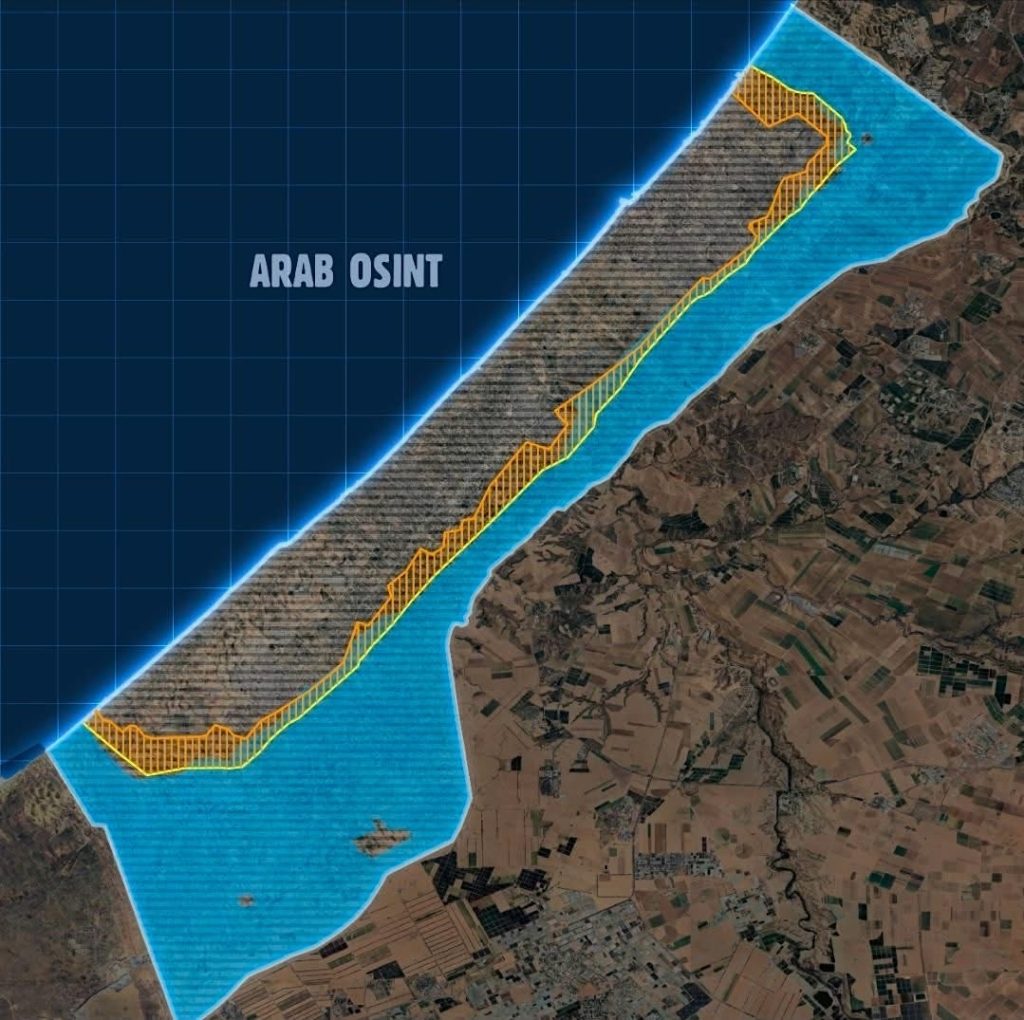
The “new map of Gaza”, showing the extent of Israeli control of the Palestinians’ land.
Drop Site News also noted that Israel “has actively threatened to launch a full scale invasion of the roughly one-third of the Strip it does not presently occupy”, as the BBC reported on May 7, when Israeli media reports suggested that it was “preparing to resume fighting in the Gaza Strip because of the impasse and Hamas’s refusal to give up its weapons.”
Michael Eisenberg, an adviser to Benjamin Netanyahu, who is also a member of the Executive Board for Gaza on the “Board of Peace”, told the BBC that Hamas were “an unrepentant terrorist group”, and said, “We understood, everyone understood that Hamas would not disarm, and they have followed through on their intentions,” completely misrepresenting the reality of the situation.
The disarmament demands, as discussed by senior Hamas officials
By way of confirmation, Drop Site News spoke to Dr. Khalil Al-Hayya, Hamas’s lead negotiator, who, in meetings with Mladenov and other officials earlier this montn, in Cairo, pointed out that Hamas “had not agreed to any negotiations about weapons until the first phase of the October deal was in place”, and reiterated that “any discussion of the weapons held by resistance forces must occur in the context of a political negotiation centered on the establishment of a Palestinian state.”
Basem Naim, a senior Hamas negotiator, also spoke to Drop Site News, stating, “We are talking about the continuous killing of Palestinians. Rafah is still blocked. The ‘yellow line’ is pushed into the Palestinian areas. Bombardment everywhere, attacking civilians everywhere. Nothing — zero — reconstruction material was allowed to enter the Gaza Strip. No caravans, no cement, no glass, nothing. You cannot pick and choose what you want and start to negotiate it. There is a first phase. What about the first phase? When it comes to the commitments, Hamas, you can say 99.99% was committed to its obligations. We have handed over all the prisoners, even the bodies. We were totally committed to the ceasefire.”
Soon after the Hamas delegation left Cairo, Israeli forces launched a targeted strike on a car in Gaza City, killing Al-Hayya’s son Azzam, and, a week later, targeted and killed Izz Al-Din Al-Haddad, the general commander of the Qassam Brigades, Hamas’s armed wing, in a strike on a residential building in Gaza City that also killed his wife and daughter and four other people, and wounded 50 others.
These attacks were interpreted as efforts by Israel to pressurize Hamas to accept the disarmament demands being pushed by Mladenev, but how could they be expected to have anything other than the opposite effect — encouraging Hamas to cling to their weapons as their only hope of defending themselves against an enemy that has repeatedly sought their death?
On September 9, 2025, as Drop Site News reminded readers, “Israel tried to assassinate Khalil Al-Hayya, Naim, and other senior members of the Hamas negotiating team” by bombing the group’s headquarters in Doha, Qatar. As they added, “Hamas had just received a new ceasefire proposal from Trump and had gathered to discuss the movement’s response when missiles fired from Israeli warplanes slammed into the building.” The attack failed to murder any Hamas officials, but another of Al-Hayya’s sons, and several administrative staff were killed.
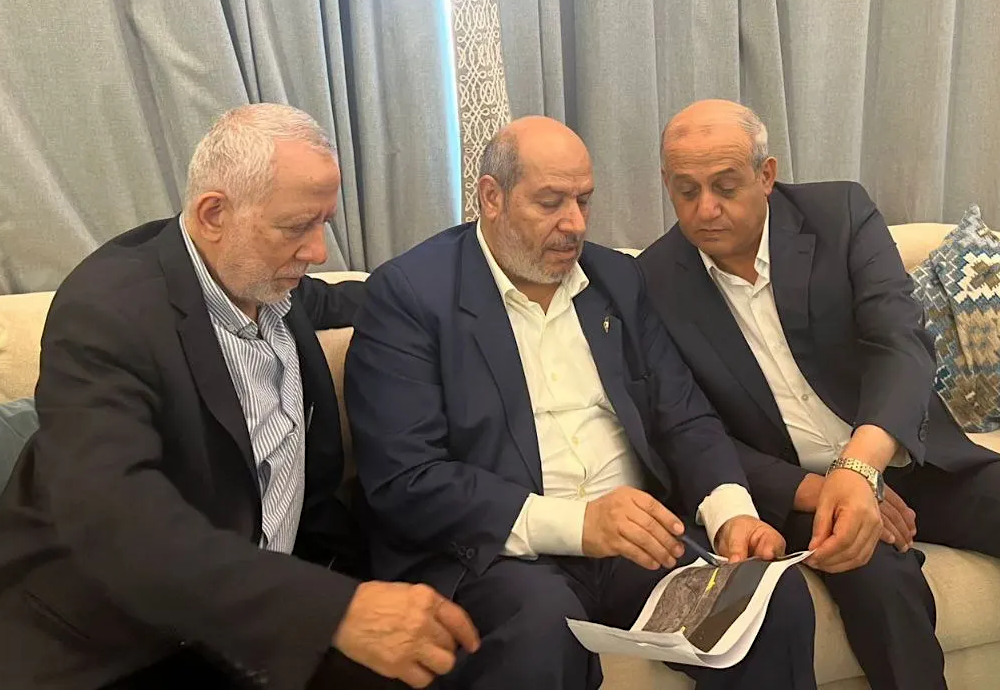
Israel’s failure to allow the National Committee for Administration of Gaza to enter Gaza
Throughout the entire process of negotiations, long before the ceasefire deal was reached, as Hamas made clear that there would be no deal on the terms of a “second phase”, including disarmament, until the first phase was complete, they always maintained that they would “formally recognize a newly established local police force as the law of the streets”, and would “hand over all governance responsibilities” to a Palestinian council; specifically, the 15 independent Palestinian technocrats, known as the National Committee for Administration of Gaza (NCAG), who were appointed to that role in Trump’s “Peace Plan”, and were, moreover, the only Palestinian representatives included in the entire plan.
Israel, however, “has refused to allow the NCAG members, currently based in Cairo, to even enter the Strip.” As the Guardian described it, “The limbo has left the Palestinians officials in the NCAG stuck in a hotel in Cairo. They have attended seminars on governance and state-building, and they recently flew to Brussels to meet EU officials, but they have been prevented from talking to the press.”
Muhammad Shehada, a visiting fellow at the Middle East programme at the European Council on Foreign Relations, told the Guardian that, exasperated by the lack of progress, “four NCAG members had threatened to resign.” As he explained, “With the lack of progress in Gaza, they came to realize that they are a distraction to buy Israel more time” — not for peace, but for a resumption of their genocidal hostilities. Mladenov persuaded them to stay, but a source close to NCAG said that its members “were aware their reputation for integrity was suffering among Palestinians by their association with the Board of Peace”, adding, however, that “They also know there is no alternative. If there is any hope of stopping the killing in Gaza, this is the only game in town.”
If so, then the “game” is so one-sided that it leaves NCAG with nothing but forlorn hope. As Osama Hamdan, a senior Hamas leader who spoke to Drop Site News explained, although Hamas agreed, in October, “to formally recognize a newly established local police force as the law of the streets and to hand over all governance responsibilities” to NCAG, the Board of Peace has “prevented Hamas from holding any meetings with the Committee.”
As Hamdan explained, “We want to see this administrative committee present in Gaza and carrying out its work there. Everything that needed to be prepared for this committee to function has already been done.” He added that Hamas “has created a mechanism for handing over power, guaranteeing the security of the Committee members, and facilitating them assuming control of the police”, as Drop Site News described it. As Hamdan put it, “Despite it being formed and approved, Israel still refuses to allow it to enter, and Mladenov has failed to convince the Israelis or compel them.”
On the ground, Hamas is, at present, “the only governing and security body in Gaza, responsible for overseeing everything from medical services to garbage collection to law enforcement”, and while both Israel and officials from the Board of Peace have sought to portray it as “refusing to relinquish power” that is simply untrue.
Al-Hindi, as Drop Site News described it, “confirmed that all resistance forces in Gaza have pledged to support the administrative committee.” As he said, “Committees were formed inside Gaza — including committees from Hamas, Islamic Jihad, the Popular Front, and Fatah — to facilitate the transition process and the transfer of full powers, including security and police authority, to the technocratic committee.”
“Despite all this” he added, “Israel is preventing it. It appears that Israel does not want any Palestinian body to govern the Strip, including the technocratic committee, nor does it want the resistance to retain weapons.” As he also explained, “At the same time, it is arming militias loyal to Israel — providing them with weapons, salaries, food, money, vehicles, and everything else — and wants them to administer Gaza instead.”
In addition, as Haaretz reported today, much of Israel’s targeted killings since the ceasefire began have been aimed at Gaza’s police, with 42 police officers killed, even though their only job is to “maintain some semblance of order in a tormented and fractured society”, something that the Israeli government, clearly, doesn’t want to allow.
More on disarmament, and the erasure of Israel’s culpability for the genocide
On disarmament, the Hamas leaders who spoke to Drop Site News have made clear that the only acceptable route to peace isn’t total and immediate disarmament, which would leave them startlingly vulnerable, but the ideas in a proposal that they have “repeatedly suggested to regional mediators”, whereby “the Palestinian resistance would agree to store or ‘freeze’ its weapons and not deploy them in any attacks against Israel as part of a long-term truce.” Crucially, however, the weapons “would potentially be accessible in the event that Israel violates the terms of the deal and resumes war against Gaza.”
Further articulating Hamas’ core insistence that “disarmament can only be negotiated in the context of the establishment of a Palestinian state with a security force capable of defending its people”, Drop Site News explained how the Palestinian leaders insist that armed resistance movements must be allowed to be transformed into national forces.
As Osama Hamdan described it, “If we are going to talk about weapons, then we must talk about Palestinian rights to independence, sovereignty, and the establishment of a Palestinian state”, and as Basem Naim added, “When we have the state, or at least an elected government, we can talk about giving up or handing over the arms to this elected government or state, and the fighters can be part of a national guard.”
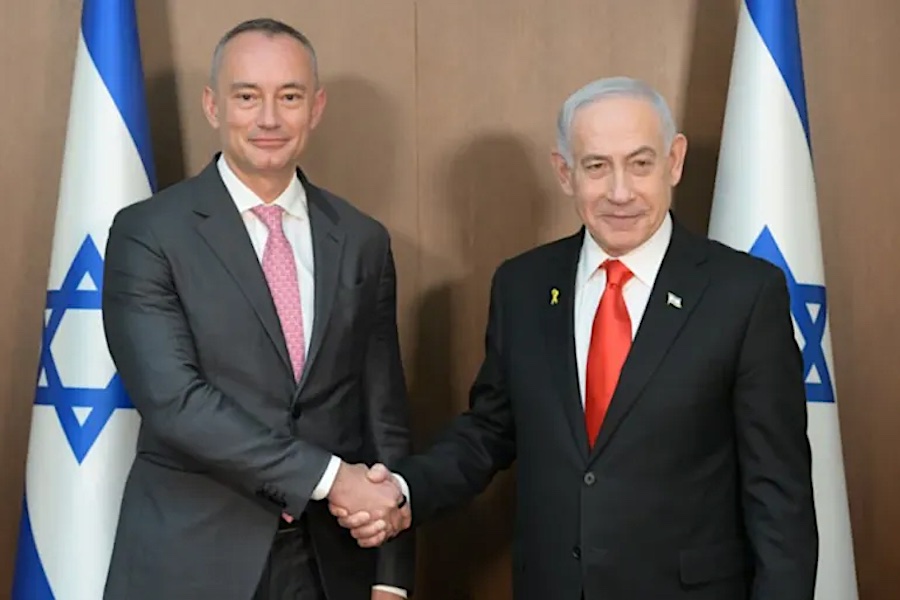
Nickolay Mladenov with Benjamin Netanyahu in Jerusalem, January 8, 2026.
As the situation currently stands, however, Mladenov, despite his claims to be balancing the interests of both the Israeli and the Palestinians, appears, in practice, to be solely serving Israel. As the former Israeli negotiator Daniel Levy explained, “The intention of this plan is to go to the next level of permanent Israeli control of redefining — in an even more egregious way — the nature of the Bantustan on offer, while keeping the further expulsion and displacement of Palestinians in the mix.” He added, “Mladenov’s the guy for that. And the Board of Peace is the vehicle for that. And the way Mladenov conducts himself is absolutely aligned with that Israeli project.”
The Palestinian analyst Muhammad Shehada added, “Mladenov wears multiple hats. At the UN he was, despite many flaws, still a UN official. So he was giving the pretense of being inclusive or objective or neutral to maintain access. But now that he’s a high representative of the Board of Peace — a title that sounds to be pulled out of colonial Congo — there is a total alignment between Mladenov and Netanyahu. This time around he’s more or less just delivering to [the Palestinian negotiators] the Israeli government position as his own initiative and asking them to take it or leave it.”
Hidden behind all this is also Mladenev’s role as a facilitator for the US’s plans for Gaza — the hideous plans for a techno-futuristic beach resort and business hub that were unveiled by Trump’s son-in-law Jared Kushner earlier this year, which require massive inward investment that can only be accomplished if there is peace — but not a fair and just peace, just one in which Hamas is fully disarmed, and cannot pose any threat to whatever Israeli- or US-led developments follow.
Apart from anything else, all of this is particularly sickening because it erases Israel’s culpability for the genocide, and portrays the only threat in Gaza as being Hamas, continuing the false narrative that the only terrorists in the region are Hamas — rather than Israel — and that the only party to blame for all the death and destruction of the last 31 months are, yet again, Hamas.
The ongoing complicity of western nations
On May 25, with an incisiveness that eludes most — if not all — of those commissioned to write western media reports about the situation, Tania Hary, the executive director of Gisha, the Legal Center for Freedom of Movement, an Israeli human rights organization focused on Gaza, wrote an article for Haaretz entitled, “Conditioning Gaza’s Survival on Hamas’ Disarmament Is Collective Punishment”, in which she cut through all the dancing around fundamental human rights violations that typifies the Board of Peace’s position regarding Hamas’ disarmament.
“Conditioning Gaza’s rebuilding on Hamas disarmament isn’t realpolitik”, she wrote, “it’s a moral failure, and the international community is complicit.”
As she proceeded to explain, “More than seven months into what can hardly be called a ceasefire between Israel and Hamas, not a single home in the Strip has been rebuilt. Over two million Palestinians are now concentrated into less than half the territory, hardly surviving amid more than 61 million tons of rubble where their homes, schools, hospitals, businesses and roads once stood.” She added, “Vital equipment and items needed for reconstruction of homes and maintenance, repair and rebuilding of civilian infrastructure continue to be held up by Israel’s restrictions on what can enter the Strip.”
According to Mladenov, as she added, “the reason for all this is straightforward: Hamas has not yet agreed to disarmament.” As she explained, “In a briefing to reporters in Jerusalem last week, Mladenov presented the false choice facing Gaza of continued misery or a ‘New Gaza’, in which Hamas relinquishes its weapons in exchange for reconstruction. This kind of framing isn’t surprising coming from Israel, which has consistently denied its obligations to the civilian population in Gaza. What’s disturbing is that it has become the consensus of polite international discourse. It might sound reasonable, even responsible, on first glance. It is neither.”
As she added:
The conditioning of reconstruction on disarmament perpetuates the same collective punishment that has characterized Israel’s war on Gaza since October 7. It treats the rebuilding of civilian life, of Gaza’s homes, hospitals, water and sanitation systems, as a reward rather than an obligation owed to a civilian population that has endured more than two years of catastrophic destruction. Israel, as the occupying power in Gaza, bears legal and moral responsibility for the welfare of the population under international humanitarian law. That obligation does not evaporate because Hamas is uncooperative. It does not become negotiable because the political situation is complicated.
In addition to holding up reconstruction, Israel is blocking entry of goods beyond its narrow definition of what constitutes humanitarian aid. In the drip feed of goods being allowed in, anything beyond basic food items is subject to Israel’s discretion. That includes thousands of civilian goods that Israel has said aren’t humanitarian, like educational materials, which weren’t allowed in until January of this year, and others that it classifies as “dual-use” — civilian goods it says can also serve a military purpose.
The list of items that have been heavily restricted or outright denied, as documented by the Gisha organization and others, has expanded since October 2023 to the point of absurdity. Items such as flashlights, tarps, sleeping bags, portable toilets, solar panels and non-electric wheelchairs have been barred even as the population has contended with mass displacement and a complete lack of electricity in the grid. Israel is limiting entry for items that are vitally needed to ensure the public health and safety of the population.
Noting that “The consequences are not abstract”, she revisited the roll-call of horrendous injuries in Gaza that I outlined above, adding that there are “more than 22,000 cases of major limb injuries, over 5,000 amputations and more than 2,000 spinal cord injuries”, and pointed out that, nevertheless, “not a single piece of rehabilitation equipment for health facilities has entered Gaza” over the last two years, and that, currently, there are “18 shipments of rehabilitation-related supplies, including wheelchairs, prosthetic limbs and stationary bicycles”, which “are pending clearance, with waiting times ranging from 130 to 520 days.”
As she stated, “A wheelchair is not a weapon. A child’s prosthetic leg is not dual-use. The 130 days a shipment of mobility aids or medicinal ointment spends waiting to enter is not a security measure. It is a policy choice, one that transforms the basic survival of the population into leverage.”
She added that a Western diplomat recently told her that “everything is held up” because Hamas “won’t disarm according to Israel’s terms”, and that, as a result, the international community is just “muddling along,” trying to “negotiate the entry of each item that can ameliorate or save a few more lives.”
“What makes the current moment particularly troubling”, she added, “is not only Israel’s behavior, but also the way the international community has normalized it.
She condemned Mladenov for framing the situation as one which “places disarmament, a legitimate political goal, at the center of a discussion about immediate humanitarian obligations, effectively endorsing the logic that Israel can continue to restrict life-saving aid and services until Hamas capitulates”, and added, “The international community, by lining up behind this framework without serious challenge, is not practicing realpolitik. It is providing diplomatic cover for a moral failure of epic proportions, particularly given that it didn’t intervene in the two years of Israel’s genocidal war on Gaza and the catastrophe it rained down on the population, half of whom are children.”
“The use of more than two million people’s suffering as a negotiating tool”, she concluded, “is not politicking; it is complicity.”
Will the west stand up and insist that, before anything else, Israel must fulfil its humanitarian requirements to the Palestinians of the Gaza Strip, or will they blindly follow Nickolay Mladenov in insisting that this basic obligation to keep the population of Gaza alive — before all the necessary discussions about disarmament and a just transition of power in Gaza, from which the Palestinians themselves must not be excluded — cannot take place until Hamas is completely disarmed, as though it is still, perpetually, eternally, October 7, 2023, and the genocide of the last 31 months continues to be largely irrelevant, or is even somehow magicked away?
Andy Worthington is a freelance investigative journalist, activist, author, photographer (of a photo-journalism project, ‘The State of London’, which ran from 2012 to 2023), film-maker and singer-songwriter (the lead singer and main songwriter for the London-based band The Four Fathers, whose music is available via Bandcamp). He is the co-founder of the Close Guantánamo campaign (see the ongoing photo campaign here) and the successful We Stand With Shaker campaign of 2014-15, and the author of The Guantánamo Files: The Stories of the 774 Detainees in America’s Illegal Prison and of two other books: Stonehenge: Celebration and Subversion and The Battle of the Beanfield. He is also the co-director (with Polly Nash) of the documentary film, “Outside the Law: Stories from Guantánamo”, which you can watch on YouTube here.
To receive new articles in your inbox, please subscribe to Andy’s new Substack account, set up in November 2024, where he’ll be sending out a weekly newsletter, or his RSS feed — and he can also be found on Facebook (and here), Twitter and YouTube. Also see the six-part definitive Guantánamo prisoner list, The Complete Guantánamo Files, the definitive Guantánamo habeas list, and the full military commissions list. Please also consider joining the Close Guantánamo campaign, and, if you appreciate Andy’s work, feel free to make a donation via PayPal or via Stripe.