Reprinted from Andy Worthington’s website.
In the long, dark farce of Guantánamo’s military commissions, the recently announced and almost entirely ignored decision by the Pentagon to turn down a plea deal for Abd Al-Rahim Al-Nashiri, a prominent CIA torture victim and the alleged architect of the Al-Qaeda attack on the USS Cole in October 2000, and to proceed, instead, with an unwinnable trial, is just the latest manifestation of a refusal by successive US administrations to reckon with the corrosive effects of the use of torture.
With this decision, the Trump administration has now embraced a sickening and enduring bi-partisan consensus that, when it comes to those accused of the gravest crimes at Guantánamo — including the terrorist attacks on September 11, 2001 — it is preferable to cling to an unworkable belief in vengeance, through a fantastical belief in successful prosecutions that involve the death penalty, than to admit that the use of torture on the defendants has thoroughly undermined that possibility.
The reality, which every administration has denied — from Bush to Obama, and from Biden to Trump — is that torture, undertaken over many years in the CIA’s global network of “black site” torture prisons, is so fundamentally incompatible with justice that the only viable way forward is to agree to plea deals that take the death penalty off the table in exchange for lifelong imprisonment at Guantánamo and full and frank confessions that bring some measure of “closure.”
The history of the military commissions — ill-advisedly revived in November 2001 under the direction of Dick Cheney, revived again in 2006 after a Supreme Court ruling that they were illegal and unconstitutional, and revived again under President Obama in 2009 — is one of almost entirely abject failure, despite the expenditure of billions of dollars to try to prove otherwise.
Only eleven men have been successfully prosecuted, with only two of those verdicts reached after a trial, and with the rest achieved through plea deals, and even this meager number has been undermined by successful appeals that have overturned three of those convictions, and left a fourth hanging by a dubious thread of legitimacy.
However, when it comes to the longest-running efforts to prosecute a handful of “high-value” individuals allegedly involved in major acts of terrorism — Abd Al-Rahim Al-Nashiri and five men accused of involvement in the 9/11 attacks — the weight of torture has been stifling efforts to proceed with successful prosecutions for 18 years.
After the men were brought to Guantánamo from the “black sites”, where Al-Nashiri had been held for nearly four years, in September 2006, they were initially charged in 2008, but had those charges dropped when President Obama took office. In November 2009, Obama’s Attorney General, Eric Holder, announced that the 9/11 trial would take place in a US federal court, while five others, including Al-Nashiri, would face trials in a third version of the military commissions.
The New York trial never went ahead. Obama crumpled under Republican pressure, and the trial was shunted back to Guantánamo, where eventually, in 2012, the five men were charged again.
Ever since, however — for 16 years in Al-Nashiri’s case, and 14 in the cases of Khalid Sheikh Mohammed and the four other men charged in connection with the 9/11 attacks — pre-trial hearings have inconclusively dragged on and on like a Groundhog Day of predictable futility, as the defense teams seek to expose the extent of their clients’ torture, while prosecutors try to keep it hidden.
In Al-Nashiri’s case, numerous international bodies have also, in these long years of unaddressed injustice, issued devastating rulings and opinions regarding his case. In July 2014, the European Court of Human Rights condemned the US for implementing a program of extraordinary rendition and torture, and Poland for hosting a CIA “black site” from 2002 to 2003, where he was held, and in February 2015 the Court ordered Poland to pay €100,000 in damages to Al-Nashiri.
In addition, in 2018, Al-Nashiri’s trial was engulfed in scandal, and there was further international outrage in May 2018, when the European Court of Human Rights condemned the US and Romania for holding Al-Nashiri in a “black site”, and ordered the Romanian government to pay him €100,000 in damages.
Further condemnation took place in June 2023, in another blow to the US government, when the UN Working Group on Arbitrary Detention condemned Al-Nashiri’s imprisonment as arbitrary and called for his release, including, in their opinion, a devastating declaration by Dr. Sondra Crosby, “an expert in internal medicine and the treatment of victims of torture,” who had met with him for approximately 30 hours, and described him as “one of the most severely traumatized individuals I have ever seen.”
The 9/11 plea deals
Finally, in February 2023, after, as I described it in my summary of the commissions, “convicted Al-Qaeda courier Majid Khan was released via a plea deal, having been allowed to deliver a devastating statement about his torture in CIA ‘black sites’, and at Guantánamo, which shocked his military jury to such an extent that seven of the eight jury members urged clemency for him, prosecutors recognized that a successful prosecution in the 9/11 trial was unviable.”
“As a result”, as I proceeded to explain, “they began negotiations with the defense teams, and the convening authority, Brig. Gen. Susan Escallier, for plea deals, in which, with the death penalty taken off the table, they would be imprisoned for life at Guantánamo, having provided a full and frank account of their actions. The plea deals were successfully concluded at the end of July 2024, but the defense secretary Lloyd Austin then tried to revoke them, even though it seemed clear that he had no authority to do so. Although the military judge overruled him, along with the military commission review court, the [Biden] administration then appealed in federal court, leaving the plea deals in limbo as they left office.”
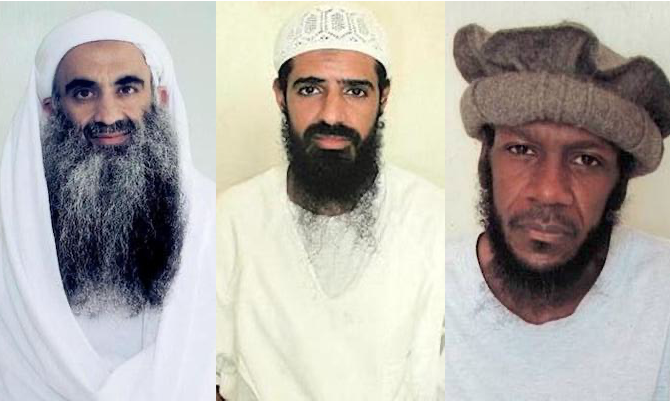
Khalid Shaikh Mohammad, Walid bin Attash and Mustafa al-Hawsawi, all photographed at Guantánamo in recent years by representatives of the International Committee of the Red Cross.
In July 2025, a three-judge panel in the D.C. Circuit Court (the Court of Appeals for the District of Columbia) ruled by 2 to 1 that Lloyd Austin “indisputably had legal authority to withdraw from the agreements.” The majority — Obama appointee Judge Patricia Millett and Trump appointee Neomi Rao — added that, “Having properly assumed the convening authority, the Secretary determined that the ‘families and the American public deserve the opportunity to see military commission trials carried out’”, adding, “The secretary acted within the bounds of his legal authority, and we decline to second-guess his judgment.”
The dissenting judge, Robert Wilkins, another Obama appointee, called it a “stunning” ruling (and not in positive sense), chastising his colleagues for not deferring to the decisions of military courts interpreting military rules.
The ruling hurled KSM and his two co-defendants — Walid Bin Attash and Mustafa Al-Hawsawi — back into the seemingly perennial uncertainty of pre-trial hearings, while the other two co-defendants, who had not agreed to the plea deals, continued to face their own ongoing travails. One, Ammar Al-Baluchi, has continued to pursue his own case against the government, while the other, Ramzi Bin Al-Shibh, was ruled unfit to stand trial by a DOD Sanity Board in August 2023, and, ever since, has been in legal limbo.
The plea deal for Abd Al-Rahim Al-Nashiri
Abd Al-Rahim Al-Nashiri, meanwhile, continued to challenge the government’s efforts to use information derived from so-called “clean team” interrogations after he arrived at Guantánamo as evidence in his case, a challenge that mirrored similar efforts by KSM and the 9/11 co-accused.
In August 2023, the judge in Al-Nashiri’s case, Col. Lanny J. Acosta Jr., had delivered a powerful ruling refuting the viability of the “clean team” interrogations, which had been designed to get him to replicate confessions he had made under torture without any coercion being used, on the basis that it was impossible for him to have delivered any kind of uncoerced self-incriminating statement after the torture to which he was subjected.
Prosecutors appealed the ruling, but on January 30, 2025, the appeals court, the Court of Military Commission Review, upheld Col. Acosta’s ruling, with Allison Miller, one of Al-Nashiri’s lawyers, telling the New York Times that the court had “unanimously rejected” the government’s request to “reinstate” the use of his discredited confession.
The decision confirmed a recognition by prosecutors — as with the 9/11 trial two years before — to abandon hopes for a successful prosecution, and, instead, to negotiate a plea deal. The deal, which, as with the 9/11 deal, dropped the death penalty in exchange for a full confession and lifetime imprisonment at Guantánamo, was announced by Allison Miller at the start of two weeks of hearings in March 2025, as reported by the New York Times, which also noted that Miller had said that a decision on the deal would need to be reached by Donald Trump’s defense secretary Pete Hegseth, but that, at the time, “a military chain of command ha[d] yet to send it to him.”
The plea deal had been agreed on December 12, 2024, but the chief prosecutor, Rear Adm. Aaron C. Rugh, had declined to present it to Lloyd Austin so close to the end of the Biden presidency, and the latest judge in the case, Col. Matthew S. Fitzgerald, had “acknowledged the political climate”, as the Times described it, stating, “We all realize we are operating in dynamic circumstances.” The Times also noted that the lead prosecutor, Capt. Timothy J. Stinson, a Navy lawyer, had “declined to comment on whether he had endorsed the agreement”, although Allison Miller “said in court that he had.”
Writing for the Times, Carol Rosenberg also noted that, since the USS Cole attack, “parents of sailors who were killed in the attack have passed away and many victims have stopped traveling to the Navy base to watch the painfully slow pretrial proceedings.”
Only one, Rosenberg noted, James G. Parlier, a retired Navy command master chief who survived the attack, had undertaken the difficult journey to Guantánamo to observe the proceedings. “For years”, she stated, “he had bristled at the delays and pressed for a capital trial”, but had finally “come to support resolving it through a plea agreement, at the risk of angering some of his former shipmates.”
“We’ve got to close that chapter of our lives,” he said, adding, “There are others who feel the same as me, want to get on with it. I know even if there’s going to be a death sentence we’ll be old men or dead by then.”
Having been told that “the proposed sentencing range would be 20 years to life imprisonment”, he said, “I’m fine with that”, noting that, by the time the sentence ended, “Mr. Nashiri would be over 80.”
Trump’s DOD rejects the plea deal
Despite the promise of “closure”, however, as with the 9/11 trial, when the Pentagon finally responded, the DOD, under Trump, took the same position as Lloyd Austin under Biden, rejecting the “plea agreement and a sentence of up to life in prison” and “setting the stage for the first death penalty trial at Guantánamo Bay to start this summer”, as lawyers explained to Rosenberg for the New York Times on February 5.
The decision, which was not taken by Pete Hegseth, was instead taken by Steve Feinberg, the deputy defense secretary, a businessman worth $5 billion, who, during his confirmation hearing, refused to acknowledge that Russia had invaded Ukraine, and also expressed support for large-scale firings within the Defense Department.
Although prosecutors acknowledged that they had supported the plea deal, they “notified the victims and relatives of those killed in the attack of the decision”, and “invited them to sign up to attend the trial, which is scheduled to start with the selection of a military jury on June 1 and could last six months.”
As Rosenberg explained, under the plea deal, “Mr. Nashiri would have admitted to his specific role in the attack and a military panel would have decided a sentence in the range of 20 years to life in prison. Victims would have testified to their loss, and defense lawyers and the defendant could have offered arguments for leniency that would probably have included descriptions of his torture.”
Instead, with his own discredited confessions excluded, “much of the trial evidence will likely involve US agents testifying about people they questioned at the time in Yemen, financial transactions and other documents they tied to an alias for Mr. Nashiri, who is accused of helping the bombers acquire vessels, explosives and safe houses.”
Another of the survivors, Paul Abney, a retired Navy master chief, expressed his disappointment with the decision, stating that he had “supported the plea bargain to resolve the case sooner ‘mainly for the family members, and for the survivors.’”
“It’s been a long, drawn-out process”, he added, further explaining that, although “there may be families that want to see the death penalty, personally I’d just like to see an end to this, to get some accountability and to give some finality to this thing.”
He said, however, that he would attend the trial “to represent the ship, those who had died and survivors who find the trip too painful”, although he made a point of noting that the prosecutors had “wanted the plea deal”, and had “spent a lot of time working on that.”
The disappointment was also summed up concisely by Allison Miller, who said it “would have brought actual finality to a nearly 26-year-old crime.” Instead, she predicted that the trial itself would air “the horrors perpetuated against Mr. al-Nashiri by the American government”, adding that, even if he is convicted, the case “will likely last through decades of appellate and post-conviction litigation.”
As with the aborted 9/11 plea deal, I can only, in conclusion, echo what I said about Lloyd Austin’s capitulation to notions of unfulfillable vengeance 18 months ago; that it was a shamefully missed opportunity to “redress the malignant folly at the heart of the detention policies undertaken in the ‘war on terror’: responding to terrorism with torture.”
Who knows, now, if there will ever be any closure or any kind of justice?
Andy Worthington is a freelance investigative journalist, activist, author, photographer (of a photo-journalism project, ‘The State of London’, which ran from 2012 to 2023), film-maker and singer-songwriter (the lead singer and main songwriter for the London-based band The Four Fathers, whose music is available via Bandcamp). He is the co-founder of the Close Guantánamo campaign (see the ongoing photo campaign here) and the successful We Stand With Shaker campaign of 2014-15, and the author of The Guantánamo Files: The Stories of the 774 Detainees in America’s Illegal Prison and of two other books: Stonehenge: Celebration and Subversion and The Battle of the Beanfield. He is also the co-director (with Polly Nash) of the documentary film, “Outside the Law: Stories from Guantánamo”, which you can watch on YouTube here.
To receive new articles in your inbox, please subscribe to Andy’s new Substack account, set up in November 2024, where he’ll be sending out a weekly newsletter, or his RSS feed — and he can also be found on Facebook (and here), Twitter and YouTube. Also see the six-part definitive Guantánamo prisoner list, The Complete Guantánamo Files, the definitive Guantánamo habeas list, and the full military commissions list. Please also consider joining the Close Guantánamo campaign, and, if you appreciate Andy’s work, feel free to make a donation via PayPal or via Stripe.