The New York Times columnist Bret Stephens recently claimed that Israel is “manifestly not committing genocide”. His key argument is that if Israel were committing genocide, the war would have been “vastly more deadly”. In actual fact, he notes, the death toll reported by the Gaza Health Ministry is around 60,000—not particularly large by the standards of modern warfare.
Stephens’s argument is flawed. The evidence we have indicates that the war in Gaza is very deadly indeed. (While establishing whether Israel is committing genocide is beyond the present author’s expertise, numerous genocide scholars and human rights organisations believe that it is.)
To begin with, the Gaza Health Ministry’s figure excludes those who died of disease or starvation, as well as those who have been reported missing. It is therefore a substantial undercount.
In a recent study, Michael Spagat and colleagues conducted a face-to-face survey of the Gazan population from 30 December to 5 January. Respondents were asked to list all household members who were alive on 6 October 2023, and then to say whether any of them had died. Based on their responses, the authors estimated that there were 75,200 violent deaths in Gaza up to January 2025, plus an additional 8,540 non-violent excess deaths. Extrapolating up to the present yields a death toll of about 100,000.
Even this figure isn’t the whole story—for three reasons.
First, it doesn’t take account of Gaza’s relatively small population. 60,000–100,000 deaths in a population of 2.1 million people represents a greater loss of life, in proportional terms, than a similar number of deaths in a much bigger population. This principle is widely recognised by supporters of Israel. For example, President Biden said of the October 7 attack that “for a nation the size of Israel, it was like 15 9/11s”.
Second, it doesn’t take into account the large number of young people who have died, including more than 18,000 children. Since young people have more years of life ahead of them, the number of deaths in Gaza represents a greater loss of life than the same death toll would in a war where few young people lost their lives.
Third, it doesn’t account for the level of mortality before the war began. Because Gaza has a youthful age structure and had high vaccine coverage thanks to UNRWA, there were only 6,454 deaths in the year preceding the war. An additional 41,615 in the first year of the war therefore represents a huge increase of around 640%.
A measure of deadliness that does take account of these three things is the change in life expectancy. According to a study by Michel Guillot and colleagues, life expectancy in Gaza nearly halved between October 2023 and September 2024. As The Economist notes, this is a bigger drop than occurred in China during the Great Leap Forward.
In his article, Stephens asks how “the United States would operate in similar circumstances”. Implying that it would not operate differently, he invokes the bombing of Mosul in 2016 and 2017. However, the War against ISIS in Iraq was associated with a fall in life expectancy of just 1.5 years—and that includes all the Iraqis killed by ISIS itself. Even if you multiply this figure by three to account for the fact that ISIS only occupied a third of the country, it is still far less than the 35-year drop reported for Gaza.
The chart below provides a comprehensive comparison. It plots life expectancy over time in Gaza, along with four countries in the Middle East that were invaded by the US or that experienced civil wars in which the US provided military support to one of the sides. (The figures for Gaza are from Guillot and colleagues’ paper. Those for Afghanistan, Iraq, Syria and Yemen are from Our World in Data.)
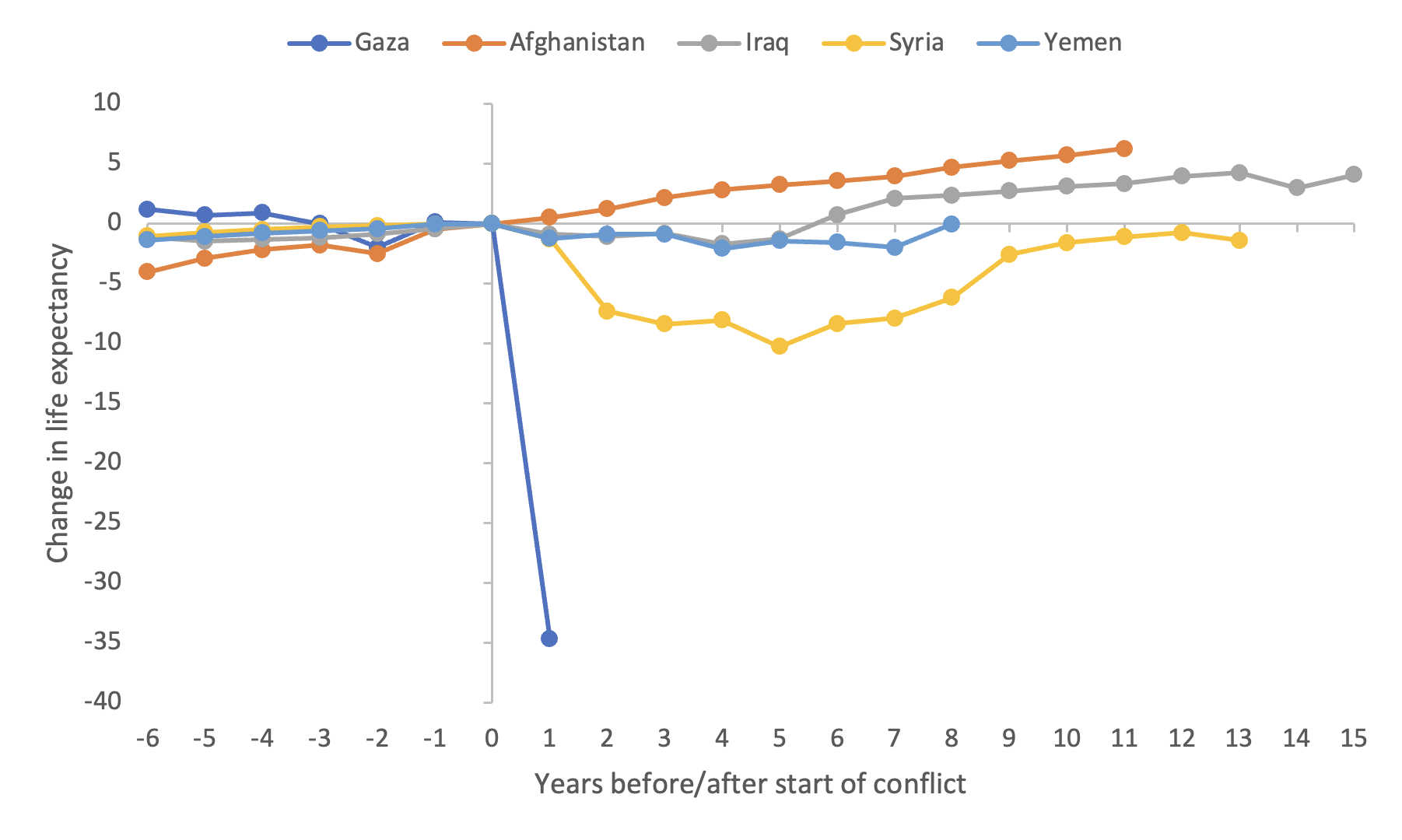
The War in Gaza clearly stands out for the intensity of killing. Indeed, the trajectory of life expectancy resembles that seen during the Rwandan genocide, as noted by The Economist. Although no estimates for the second year of the war have been published, we can infer from the rise in death toll that life expectancy in Gaza remains well below its pre-war level.
Stephens opens his article by asking why the War in Gaza has not been “vastly more deadly”? A closer look at the evidence shows that his premise is simply wrong.
Noah Carl is Editor at Aporia Magazine. You can follow him on Twitter @NoahCarl90.