There will be plenty spirits of Iraq policy past, present and future crowding the dais tonight as the President announces a “successful” transition and “a promise kept” for the drawdown of American troops from Iraq.
There’s George W. and Dick Cheney and their ghoulish courtiers – Donald Rumsfeld and his number two Paul Wolfowitz, not to mention coalition provisional authority viceroy L. Paul Bremer and Douglas Feith, all who dragged the country into Iraq and then botched it irreparably.
Hovering close by are our military demigods, Gens. David Petraeus and Raymond Odierno, gently plucking and pulling the strings of the president who is trying to convince the American people that Iraq is all but over, despite leaving 50,000 soldiers and a civilian force of at least 10,000 staff and heavily armed security contractors behind.
But the real phantasm casting a pall over the proceedings is an Iraqi one and he represents it all – the past, present and more importantly, the future of Iraq. Muqtada al Sadr, once dismissed by Washington neoconservatives as a desperate, washed-up five-cent firebrand, is now an Iranian-supported kingmaker who will not only help determine the next government and prime minister, but has threatened to activate the armed wing of his low-lying Mahdi Army, the Promised Day Brigade, if the American “occupier” doesn’t pack up and leave entirely.
The “Promised Day Brigade” will “prepare quietly to launch qualitative attacks against the occupiers (U.S. forces) if they stay beyond 2011,” said Sadr spokesman Salah al-Obeidi, to the Associated Press, in May. “It will have a big role to play to drive them out of Iraq.”
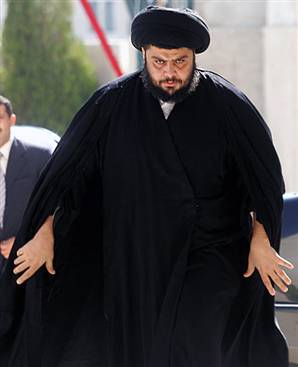
Sadr is of course, an awkward subject for an administration attempting to project the best, most optimistic image in the rear-view. This was Bush’s war, and Obama seems eager to keep it that way, more so, to move on and to focus on his mess in Afghanistan. But he is having a hard time fully extricating – Odierno has already suggested scenarios in which the U.S combat mission might have to resume – and the fact that there is no government, and may not be any government without Sadr’s say-so, must be very difficult to stomach back in Washington.
Says writer Babak Dehghanpisheh, in his August Foreign Policy piece, “The King of Iraq“:
“The Sadrists … aren’t going anywhere – which puts Washington, among others, in a bind. Sadr’s supporters are more than just a political party. The cleric is clearly following the Hezbollah model, creating populist political movement backed by a battle-hardened militia. The language Sadr uses when discussing the U.S. presence in Iraq – resistance, occupation, martyrdom – could easily have been taken from a speech by Hezbollah’s leader, Hassan Nasrallah. All this has discouraged U.S. officials from holding talks with Sadr – something they’ve never done since 2003. It’s not exactly like Sadr has gone out of his way to open up a dialogue, either. In fact, Sadr and many of his top aides have made it clear that the Mahdi Army won’t disarm as long as there are American troops on Iraqi soil.”
From the start, the 37-year-old cleric, politician and militia leader has openly denounced the security agreement allowing for the gradual drawdown of troops by 2011. When the Status of Forces Agreement (SOFA) was signed in 2008 by Bush and Sadr’s political rival, Iraqi prime minister Nouri al-Maliki, Sadr promised blood in the streets unless the U.S left sooner.
“I repeat my call on the occupier to get out from the land of our beloved Iraq, without retaining bases or signing agreements,” said Sadr, who has been in religious training, and managing his political affairs from a safe perch in Iran for the last three years. “If they do stay, I urge the honorable resistance fighters … to direct their weapons exclusively against the occupier.” His words came a month after tens of thousands of his supporters took to the streets in Baghdad against the SOFA.
In a piece called “The Bad Boy of Iraqi Politics Returns,” Mohamad Bazzi points out how “Sadr’s political ascendance threatens to stoke sectarian tensions in Iraq,” which are particularly acute as a wave of violence, reportedly sparked by remaining al Qaeda factions in Iraq, have killed hundreds in the country over the last several weeks. While American leaders appear to downplay it, the fact that an anti-American Shia who once tested U.S military resolve in Najaf, Karbala, Basra and Baghdad, is gathering himself up for a big political victory and possibly, a future Shia revival, seems to be the silent ugly truth of Obama’s “successful” troop drawdown.
“Under the circumstances, (Sadr’s) power and influence inside Iraq’s Shia community is both permanent and growing,” noted retired Army Col. Douglas Macgregor. “He is unlikely to lead the country, but he and his supporters will wield decisive influence.”
But We Thought He Was Dead!
Maybe not dead, but certainly defeated. A number of times – or at least it always seemed so. But he always comes back. Sadr is the son-in-law of a Shia martyr and the fourth son of the beloved Grand Ayatollah Mohammad Mohammad Sadeq al-Sadr, who was murdered in 1989 along with two of Sadr’s brothers, allegedly by Ba’athists working for dictator Saddam Hussein. Because Sadr’s father had sacrificed his life by remaining in Iraq rather than fleeing to Iran during Saddam’s dictatorship, his family name invokes great respect and authority among the Iraqi Shia to this day. Baghdad’s Sadr City was later named for his martyrdom.
Muqtada al Sadr has only enhanced this influence and legitimacy among Sadrist Shia followers during the U.S war, for rebelling against and not consorting with “the occupier,” nor bending to the wills of Maliki or even Iran. Just last week, Sadr told his hosts in Iran that he will leave them and set up shop in Lebanon if they continue to exert pressure on him to join Maliki in a coalition government. The political situation has been in a stalemate since March when parties backed by Sadr and former prime minister Iyad Allawi won enough seats to break Maliki’s grip over the formation of the future government.
Sadr does not support, nor trust Maliki, after the Iraqi prime minister took up common cause with the Americans and helped lead a series of crackdowns on Sadrist strongholds, particularly Sadr City, in 2007 and 2008 as part of the infamous “Surge.” At the time, throughout several wobbly ceasefires and Sadr’s exile to Iran, his movement appeared doomed to the dustbin. Since then, Maliki’s forces have fully penetrated Sadr City, the remaining loyalist fighters seemingly melted away.
According to the Washington Post, Sadr froze the Mahdi Army’s activities in 2008 and “has since divided most of his men into two unarmed civic organizations called Mumahidoon, ‘those who pave the way,’ and Munasiroon, ‘the supporters,’ to provide services to the poor, protect mosques and study religion. The aforementioned Promised Day Brigade is the Mahdi’s only armed wing. Offshoots of the old army, referred to by the U.S military as “special groups,” operate independently, and often contrary, to Sadr’s leadership and goals.
But Muqtada’s influence among the Shia has always been second-guessed by American analysts. During a wave of Mahdi Army uprisings in 2004 in which Sadr’s forces briefly gained control of key Shia cities over American forces, neoconservative Michael Rubin at the American Enterprise Institute called Sadr “a desperate man,” who wanted to “cash in on his family’s name,” and whose “support has hemorrhaged over the past several months.” A month later, Charles Krauthammer declared that Sadr’s militia, was “systematically taken down by the U.S military.”
Not quite – it turned out they had a few good fights left in them. Sadr, meanwhile, was not so disregarded by the Shia that he wasn’t able to influence the 2006 elections. Sadr-backed candidates won an impressive 30 seats in the election and helped to propel Maliki to the head of the government. Sadr’s political sway was only matched – and surpassed – in this way in March, when his candidates won 40 seats and a coveted place at the bargaining table.
“Sadr has once again shown greater political skill than the United States and his Iraqi rivals usually give him credit for,” wrote Mohamed Bazzi in July. Patrick Cockburn, author of Muqtada, told Antiwar Radio’s Scott Horton recently that Sadr represented “the only grassroots movement in Iraq.”
As Cockburn explained in his book, while U.S media and government “demonizes and belittles” Sadr, his political – and physical – survival belies a strength that Americans may not be fully prepared to understand or ultimately overcome. “Muqtada and his followers are intensely religious and see themselves as following in the tradition of martyrdom in opposition to the tyranny established when Hussein and Abbas were killed by the Umayyads on the plains of Karbala fourteen hundred years ago,” writes Cockburn.
In other words, while the American lens might see Sadr as just another ambitious man seeking political control of Iraq, it may be missing the bigger picture, that Sadr is studying in Iran to become an ayatollah in the tradition of his family, perhaps seeking to become an authoritative, supreme religious leader who commands the politics and steers Iraq into a more purist Shia vision – one that has no place in America’s own strategic vision for the Middle East.
The prospect for this should be what tickles the back of Obama’s neck as he takes to the podium this evening.
“The key point,” says Macgregor, “is we spent a trillion dollars, sacrificed and destroyed thousands of US lives and millions of Arab lives with the result that we changed nothing of significance inside Iraq.”