If there’s one thing mainstream "Iran experts" hate, it’s well-credentialed, experienced analysts who dare challenge Beltway orthodoxies, buck conventional wisdom and demythologize the banal, bromidic and Manichean foreign policy narrative of the United States government and its obedient media. Such perspectives are shunned by "serious" scholars who play by the rules they and their former bosses themselves wrote; those propounding such subversive ideas are likewise excoriated and banished, labeled apostates and attacked personally for failing to fall in line.
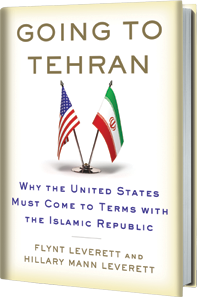
Enter Flynt and Hillary Mann Leverett, two former National Security Council officials, who have long questioned the wisdom and efficacy of the past thirty years of U.S. policy towards Iran. Their new expertly researched and meticulously-sourced book, Going to Tehran: Why the United StatesMust Come to Terms with the Islamic Republic of Iran, details and debunks numerous propagandized myths and delusional misunderstandings that many Americans have been led to believe about the country that is consistently referred to by our politicians and pundits as "the world’s most dangerous state." The Leveretts argue that, by at least taking into account the Iranian side of things and reviewing the misguided, myopic and unsustainable American policies toward Iran, the groundwork may be laid for a constructive and beneficial change of course for both nations; by engaging openly and acknowledging past grievances – rather than ignoring, justifying or ridiculing them – a new future is possible, one without threats or war, without sabotage and cyberattacks, without demonization and demagoguery.
The problem is, without such things, the revolving door of Beltway think-tankery and government appointments might not spin so lucratively for our "Iran expert" industry. As a result, the Leveretts and their ideas are pilloried by political and policy elites who confuse heterodoxy for apologia.
In a supremely smug and self-satisfied pseudo-review of Going to Tehran, just published in Survival, the journal of the International Institute of Strategic Studies, Washington’s "go-to" Iran analyst Ray Takeyh launches what is surely a paradigmatic opening salvo on the Leveretts’ work. Needless to say, he didn’t like the book; his review is the intellectual equivalent of a drive-by shooting. While lambasting the Leveretts, Takeyh fails to actually address any of their contentions or claims, preferring to make grandiose statements condemning their analyses of Iranian politics and foreign policy and their policy recommendations without bothering to back up these statements with evidence or explanation.
Takeyh is a mainstay of the Washington establishment – a Council on Foreign Relations Senior Fellow before and after a stint in the Obama State Department and a founding member of the neoconservative-created Iran Strategy Task Force who has become a tireless advocate for the collective punishment of the Iranian population in a futile attempt to inspire homegrown regime change (if not, at times, all-out war against a third Middle Eastern nation in just over a decade). Unsurprisingly, he dismisses out of hand the notion that “the principal cause of disorder in the Middle East today is a hegemonic America seeking to impose its imperial template on the region."
This is exactly the worldview that has produced the disastrous U.S. foreign policy of the last few decades, policies advocated time and time again by the same people – not only people like Takeyh, but including literally Takeyh himself – never learning from their mistakes or conceiving there might be a different way to engage the world (say, by not bullying, threatening, demanding, dictating, punishing, bombing, invading, destroying, dismantling, overthrowing, occupying, and propping up dictators). Takeyh’s contemptuous rejection of history means that those who disagree with him – like the Leveretts, even though their experience in government and direct contact with on-the-ground reality in today’s Iran dwarfs Takeyh’s – must inevitably be minions of the ayatollahs.
Takeyh’s dismissal of the Leveretts’ work is especially ironic, given that his own analytic nonsense is legion. He routinely makes statements that aren’t based in fact and that dispute even the most hysterical estimates of the United States government. He has no problem co-writing tomes of warmongering lunacy with psychotics like Matthew Kroenig, convicted criminals and racist demagogues like Elliott Abrams, and garbled inanity with his wife’s insane colleague at the Saban Center and perennial war champion Kenneth Pollack. Everything he writes is easily destroyed with a basic perusal of facts.
Never bothering to cite any evidence, Takeyh has long assumed Iran – oh sorry, I mean, “the mullahs” (how spooky!) – are building a nuclear bomb and only the fierce determination of the United States, its benevolent buddy Israel and vital Arab dictator friends can stop it, if not by beating the Islamic Republic into submission through economic and covert warfare, then perhaps by military might. In April 2003, he wrote, "Tehran often claims that instability in the region forces it to pursue nuclear weapons, when in fact it is Iran’s possession of such weapons that would increase instability." Actually, Iranian officials have never claimed anything remotely like that, instead declaring their commitment never to build nuclear weapons consistently for over 20 years. In 2011, Takeyh assured Washington Post readers, “Exact estimates vary, but in the next few years Iran will be in [a] position to detonate a nuclear device.”
In October 2011, when the US government tried to pretend that a bumbling, bipolar Iranian used-car salesman in Texas had been tasked by the Iranian Revolutionary Guard Corps to hire a Mexican drug cartel to assassinate the Saudi ambassador in a DC restaurant (it is literally impossible to read that without chuckling), Takeyh took to the airwaves to comment on the alleged plot. Speaking on NPR, Takeyh wholly endorsed the U.S. government’s version of events, never for a second doubting their authenticity. Though he claimed it was "unusual,” Takeyh made sure to add, “I don’t know what the evidence about this it, but I’m not in position to doubt it.”
There you have it, folks, Takeyh’s entire method of scholarship in a nutshell.
Takeyh’s disdain for empirical reality allows him to take multiple, often contradictory positions on many issues—whatever it takes to align himself with "centrist" foreign policy hawks in the Democratic Party’s national security establishment. In 2006, after the occupation of Iraq had turned irrevocably catastrophic and Democrats were looking for ways to distance themselves from Bush’s Middle East follies, Takeyh argued "for the United States to become more directly engaged in negotiations with Iranians and also make an offer of some corresponding concessions." While assuming an Iranian desire for latent nuclear weapons capability, he held, "I don’t think they’ve made up their mind yet to cross the threshold and actually weaponize [nuclear power]." He added, "For those who suggest that it is absolutely conclusively determined that Iran wants to have nuclear weapons, I think it behooves them to provide some kind of evidence for that claim." Just months later, though, Takeyh told the Senate that Iranian leaders were determined to achieve hegemony in the Persian Gulf and that, from their vantage, “it is only through the attainment of the bomb that Iran can negate the nefarious American plots to undermine its stature and power.”
As the possibility of Democratic victory in the 2008 presidential election drew closer, Takeyh’s views grew more hawkish. His transformation into an Iran hawk accelerated with his brief stint in the State Department during the Obama administration’s first year. In 2010, he co-wrote a journal essay and accompanying op-ed that sought to characterize war with Iran as a natural outcome, a normalized and inevitable progression of history. Over the next couple of years, he fully realized his penchant for conflating Iran’s monitored and safeguarded nuclear energy program with a nefarious, clandestine weapons program.
This conflation is present in Takeyh’s attempted takedown of Going to Tehran, where he references Iran’s "nuclear infractions," but provides no evidence for them other than collective Beltway wisdom, displaying a complete ignorance of what IAEA reports actually say and where such accusations actually come from (unverified American and Israeli allegations). His determination to blame only Iranian "intransigence" for the current nuclear dispute epitomizes the intellectual dishonesty for which most Washington think-tanks are unfortunately revered.
Takeyh’s analytic malfeasance extends to Iran’s domestic politics as well. His conversion from unimpressive establishment scholar to full-blown neocon fellow traveler is underscored by his remarkable insistence that Iran’s clerics are to blame for the 1953 CIA coup that overthrew Prime Minister Mohammad Mossadegh (sic). Takeyh also refuses to understand the reality of the Green Movement in Iran, elevating them to surreal heights of organization, unity and potential.
In his review of Going to Tehran, Takeyh notes what he calls "transparent electoral fraud in the presidential election" of 2009, but again fails to advance any actual documentation to support this contention. Since 2010, he has been warning us all of Ahmadinejad’s impending consolidation of power over the Iranian government. This didn’t happen. Good call, Ray, how astute.
The self-serving vacuity of Takeyh’s review is especially glaring in his treatment of the Leveretts’ critique of U.S. policy toward Iran. As the Leveretts themselves have already noted, Takeyh is adamant that the U.S. has often and openly reached out diplomatically to Tehran but can’t seem to square this with reality – including statements made by his former boss, Dennis Ross, who sees the perception of failed diplomacy as necessary to sell the American public on a new illegal war against another enemy that poses absolutely no threat to the United States.
Takeyh complements his rewriting of diplomatic history with a selective – indeed exploitative – focus on human rights issues in Iran. Along with the vast majority of the Leveretts’ detractors (and anyone else who rejects a reality-based approach to the three-decades-long U.S.-Iranian impasse), Takeyh seems unaware that basing American foreign policy on human rights is not only disingenuous, but also contrary to how the U.S. actually operates all over the world.
Going to Tehran is a policy prescription addressed primarily to the government of the United States, not to human rights organizations. Iran has as abhorrent a human rights record as many other countries – far worse than many, better than others. But the United States government has never cared one iota about human rights when it comes to strategic partnership with its closest and most trusted political allies (let alone its own actions).
Whether looking at our torture regime, our indefinite detention, our illegal drone program, our invasions, our assassinations, our surveillance state, our contempt for due process, our racist justice system and bloated prisons, and – perhaps, most relevant – our continued support and encouragement of ongoing Israeli war crimes, ethnic cleansing, colonization and occupation of Palestine alongside weapons sales and willful blindness to the atrocities of true dictatorships like Saudi Arabia and Bahrain, the concept that American diplomacy or interests rest upon virtuousness and humane practices is not only hypocritical; it’s downright laughable. As Glenn Greenwald recently wrote about Iran, Syria and Libya, "That the US and its Nato allies – eager benefactors of the world’s worst tyrants – are opposed to those regimes out of concern for democracy and human rights is a pretense, a conceit, so glaring and obvious that it really defies belief that people are willing to advocate it in public with a straight face."
If our government cared about human rights it wouldn’t be subjecting the Iranian people (who wholeheartedly oppose American sanctions and constant bullying) to collective punishment, just like it did the people of Iraq – the half million Iraqi children sacrificed to similar sanctions know full well the American consideration for human rights. Takeyh reflects this duplicity in his review, noting the appalling history of "show trials, mass repression and persistent international transgressions" in Iran and condemning the Leveretts for not making this the focus of their book. Yet if Takeyh actually cared about fundamental human rights and the importance of international law, he would not only call for Congress to sanction Israel and Saudi Arabia, he would be outraged by the closeness of these governments to his own here in the United States. But he doesn’t. Only Iran is the target of his anger and concern.
Because for the U.S. government, human rights abuses are used merely as a bludgeon against its adversaries while the myriad transgressions of its strategic partners are routinely ignored (if not, in the case of Israel, even funded and justified), Takeyh’s argument is disingenuous at minimum. As always, he and his fellow mavens of the established foreign policy community are silent about America’s role as the guarantor of Middle Eastern tyranny, as long as its puppet dictators do our bidding, namely with regard to acquiescing to Israeli regional hegemony and following the U.S. lead on isolating and threatening Iran.
In the most recent Human Rights Watch report, we learn that a large Middle Eastern country, ruled by an unelected religious fundamentalist misogynistic elite, has “arrested hundreds of peaceful protesters during 2012, and sentenced activists from across the country to prison for expressing critical political and religious views.” Not only this, but “thousands of people are in arbitrary detention, and human rights activists were put on trial on politicized charges. The Ministry of Interior forbids public protests. Since 2011, security forces have killed at least 14 protesters in the Eastern province who were seeking political reforms.”
It finds that the “government has gone to considerable lengths to punish, intimidate, and harass those who express opinions that deviate from the official line,” while “lawyers are not generally allowed to assist suspects during interrogation, and face obstacles to examining witnesses or presenting evidence at trial.” Furthermore, “Authorities have used specialized criminal courts, set up to try terrorism cases, to prosecute a growing number of peaceful dissidents on politicized charges.”
What country is this? Saudi Arabia, the leading U.S. trading partner in the Middle East, which receiving billions upon billions of high-tech weaponry from our noble nation year after year. The United States uses a secret Saudi base as a launchpad for lethal drone strikes in neighboring Yemen and is even working closely with the Kingdom on its nascent nuclear program. One wonders if this recent case (one of the worst things I have ever heard about) will cause the U.S. to reconsider its relationship with Saudi Arabia. Don’t hold your breath. But just imagine if that had happened in Iran.
Our best friend in the world, Israel, meanwhile is a militarized colonial state in routine contravention of existing international and humanitarian law. Ample evidence reveals the illegality of Israel’s Apartheid Annexation Wall, Israel’s use of administrative detention to hold Palestinians indefinitely without charge or trial and the rampant Israeli arrest of Palestinian children and toddlers, who suffer abuse – mental, physical and sexual – and who are tortured during and traumatized by their imprisonment. Palestinian communities are constantly victimized by housing demolitions and eviction, a particularly vindictive form of collective punishment favored by the Israeli government.
None of this seems to bother our government one bit and any attempt to hold Israel accountable for its crimes is met with derision in the circles in which Mr. Takeyh travels, all expenses paid, of course.
The issue isn’t about whitewashing or justifying abuse and repression; it’s about U.S. government policy, which clearly has no problem overlooking such horrors depending on who commits them. If the U.S. were consistent in its concern for human rights (rather than selectively using them only to condemn its enemies), Takeyh might have a point. But it isn’t, so he doesn’t.
The Leveretts explicitly address this issue in Going to Tehran. They write, "Washington has never demonstrated that it cares about human rights in the Middle East for their own sake. It cares about them when and where caring appears to serve other policy goals." In their explicitly stated effort "to outline a potentially far more efficacious diplomatic approach" (p.388), the Leveretts point out that "the only way human rights conditions in the Islamic Republic, as defined by Western liberals, are likely to improve is in a context of U.S.-Iranian rapprochement, whereby the United States had credibly given up regime change as a policy goal." (p.326)
While conventional Washington wisdom (and actual acts of Congress and executive orders by the President) hold that the U.S. government should be critical of Iran’s human rights record as a matter of policy, doing so is pure propaganda. The United States is in no position to affect the violations of the Iranian government because it has no diplomatic presence, credibility or connection to the Islamic Republic. As George W. Bush admitted in December 2004, in a rare moment of candor and honesty, "We’re relying upon others, because we’ve sanctioned ourselves out of influence with Iran…We don’t have much leverage with the Iranians right now."
Takeyh, by employing ad hominem attacks on the Leveretts in an effort to label them apologists for theocratic authoritarianism and thereby discredit their views, is trying to poison the well, so to speak, with anti-war progressives who might find a new approach to Iran novel and welcome. He calls Going to Tehran "tedious," "stale," and "trite." That’s coming from a guy who works at the Council on Foreign Relations and writes about implementing even more "crippling" sanctions on Iranians in order to compel their government’s capitulation to American and Israeli diktat. How original, fresh, and innovative!
Regardless of whether one finds their arguments compelling or their history sufficiently comprehensive, the Leveretts deliver a blow to the establishment narrative of "what to do about Iran." It is no surprise that Ray Takeyh is offended by the Leveretts – they directly address the danger he and others like him in the official foreign policy community pose to those who oppose another war.
They write that the claims put forward by Takeyh "that Iran’s leadership is too ideologically constrained, fractious, or politically dependent on anti-Americanism to pursue a strategic opening to the United States are not just at odds with the historical record. Such claims push the United States ever further in its support of coercive regime change and, ultimately, down the disastrous path toward war." (p.108)
The main thesis of Going to Tehran, as evident in the book’s title, holds that, as American power declines worldwide, recognition of faulty and detrimental foreign policy is required for the U.S. to better adapt to an ever-changing and more independent Middle East; a region in which Iranian influence is ascendant whether we like it or not. They see the precedent set by Richard Nixon’s historic visit to China as the best way forward with regard to Iran.
Such a suggestion, while increasingly relevant, is not actually new. A noted foreign policy expert proffered an identical view in 2006, explaining, "First of all, this is not a unique historical moment for the United States. We’ve been in this position before. If you look back in the late 1960s, early ’70s, we were in a position in East Asia where our power was declining because of the Vietnam War, and the Chinese power was increasing because of China’s own capability and declining American power. And then there was certainly antagonism between the two countries."
Lamenting the "conceptual divergence" of Iranian and American negotiating positions, the analyst continued,
I think you have to accept certain basic realities. Iran is an important power
with influence in the region, and the purpose of the negotiation would be how
to establish a framework for regulation of its influence. Therefore, in a perverse
sense, negotiations [are] a form of containment. We’re negotiating as a means
of containing Iran’s influence, surely as we negotiated with the Chinese in
the early 1970s as means of coming to some arrangements to rationalize U.S.-Sino
American relations as a means of regulating Chinese power.
He further insisted that the United States must take a bold step to enter into
"comprehensive negotiations on all of Iranian concerns and all of our concerns.
Our concerns are human rights, terrorism; they have their own grievances and
so forth. And these negotiations will take place ultimately without precondition,"
just as negotiations with China in 1970 were not preconditioned.
Again making the explicit analogy to Nixon’s overture to Beijing, he stated, "The purpose of these negotiations would be to foster an arrangement where Tehran’s relationship with Washington is more meaningful to it than various gradation of uranium or potentially its ties with Hezbollah." This way, he concluded, an "end point" would be reached "by creating a new framework and a new basis for U.S.- Iran relations," which would, in order to be at all successful would have to recognize Iran’s position in its own neighborhood. "[I]n all these discussions and negotiations," he affirmed, "we have to appreciate that in a sense we are legitimizing Iran ‘s at least Persian Gulf if not larger regional aspirations."
That analyst was Ray Takeyh. He was addressing the Senate Foreign Relations Committee of the 109th Congress. Sitting on the Committee at the time of his statement were John Kerry and Chuck Hagel. Its ranking member was Joe Biden. Also on the committee? The junior Senator from Illinois, Barack Obama.
Just six months later, Takeyh wrote in Foreign Affairs that no U.S. policy regarding Iran in the past thirty years has worked. Noting the impossibility of regime change, military action, isolation and obstinacy, Takeyh wrote the U.S. government must abandon these "incoherent policies" and "must rethink its strategy from the ground up."
He continued,
"The Islamic Republic is not going away anytime soon, and its growing regional influence cannot be limited. Washington must eschew superficially appealing military options, the prospect of conditional talks, and its policy of containing Iran in favor of a new policy of détente. In particular, it should offer pragmatists in Tehran a chance to resume diplomatic and economic relations."
He added, "The sooner Washington recognizes these truths and finally normalizes relations with its most enduring Middle Eastern foe, the better."
This is literally what Going to Tehran is about. Literally.
By attacking the Leveretts’ new book, Takeyh is attacking the very ideas he himself has espoused so confidently, both in a leading policy journal and to a Senate Committee that included the current administration’s President, Vice President, Secretary of State and Secretary of Defense themselves.
But he doesn’t want you to know that.
Nima Shirazi is an independent researcher and political commentator from New York City, where he runs the blog, Wide Asleep in America. Follow him on Twitter @WideAsleepNima